As we continue working to complete our new additive print services market study here at AM Research, our market database model is growing and being sharpened through data collection and research. We chose to develop this large-scale project on a regional basis in terms of the model, building out one region at a time. With the print services market in North America being supercharged with diverse government and defense opportunities, our model has initially focused on this exciting region for AM as a service.
There are many cool things we can do with a well-built market model in terms of analysis and insights. This article will present some of the details from our early modeling of AM print services in North America by providing a breakdown of the services market in terms of which print processes are tied to which industries in this region.
Dental Labs versus Powder Bed Fusion
Our market models treat the activity of dental laboratories using 3D printing as part of the 3D printing services market, since dental laboratories are, essentially, partly just 3D printing service bureaus. They take orders for printable parts from an end customer (generally a dentist) and then produce the part on their equipment and send the part to the customer.
With the United States being the world’s largest dental care market, it stands to reason that the activities of dental laboratories using 3D printing actually make up a huge portion of the overall 3D printing services market in North America. In fact, before 2022, dental labs in North America generated more 3D printing services revenue than all other types of 3D printing service providers (the ones focused on prototyping and manufacturing) in the region.

North American 3D printing service bureau revenues have grown faster than dental lab revenues since 2022, reaching nearly $1.2 billion in 2025. Image courtesy of AM Research.
The story behind what drives 3D printing services in North America can be mostly distilled down to powder bed fusion-based printing services for both polymers and metals, and dental laboratories. It is fairly significant how mutually exclusive these two segments are. Metal powder bed fusion is used to some degree in dental 3D printing services, but its popularity specifically in North America is limited due to the preference for cosmetic dentistry and favoring printed composites and ceramics due to their appearance.
By the numbers – at least in their current pre-final state in our ongoing print services market model project – if we combine metal and polymer powder bed fusion services together for North America,
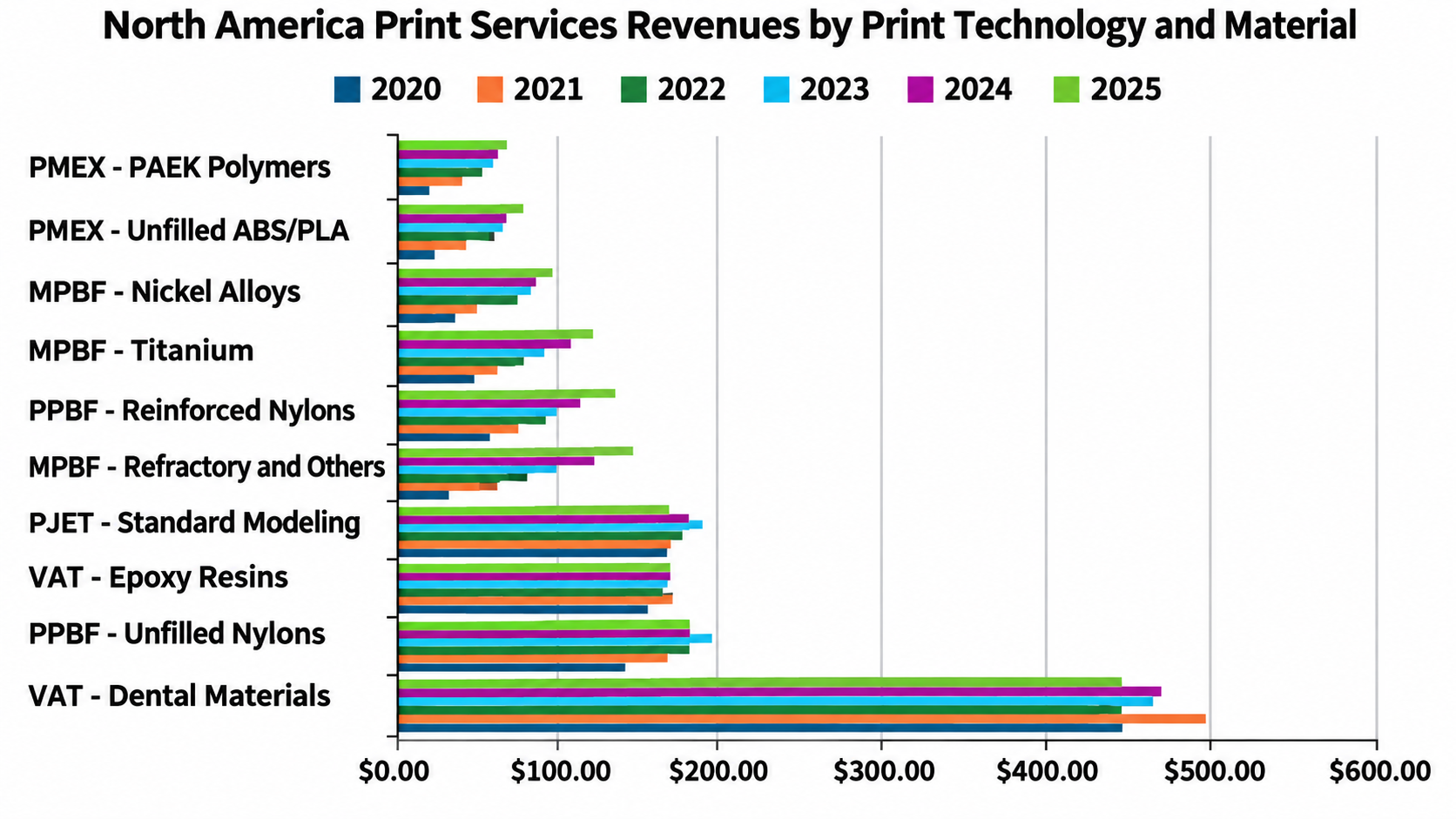
Dental materials lead North American 3D printing services revenue, while metal powder bed fusion and reinforced polymers are also growing strongly. Image courtesy of AM Research.
About 40 percent of the overall print services market belongs to dental lab activity using vat photopolymerization and UV jetting technology (and some metal powder bed), and as of just a couple of years ago, just over 40 percent of the NA services market belonged to the combined output of metal and polymer powder bed fusion tech.
The Most Widely Printed Materials by North American Service Bureaus
A first step to ultimately arrive at a model of the print services market in terms of what industries are demanding the most 3D print services is to break down the output of service-owned machines (by type) into specific groups of materials for the parts that the print service activity is based on. Basically, if we start by modeling the installed bases of the most influential service companies in the world, we then model their machine output. In this context, 3D printer output is parts ordered by a customer, and it can vary not only by the type of machine that printed them but also by the material of the part itself.
As far as print services in North America go, the combination of technology and material that is generating the largest revenues for print service providers in 2025 is, perhaps unsurprisingly, vat photopolymerization printing of certified dental materials by laboratories. Dental labs and production centers also generate print services revenue by printing otherwise standard, nonspecialized materials for dental customers through activities like printing the forming tools used for dental aligner production and general-purpose dental models. The use of certified dental materials, however, is by far the largest driver of services in North America. For all activities beyond that, into prototyping and manufacturing, the rest of the market is much more fragmented.
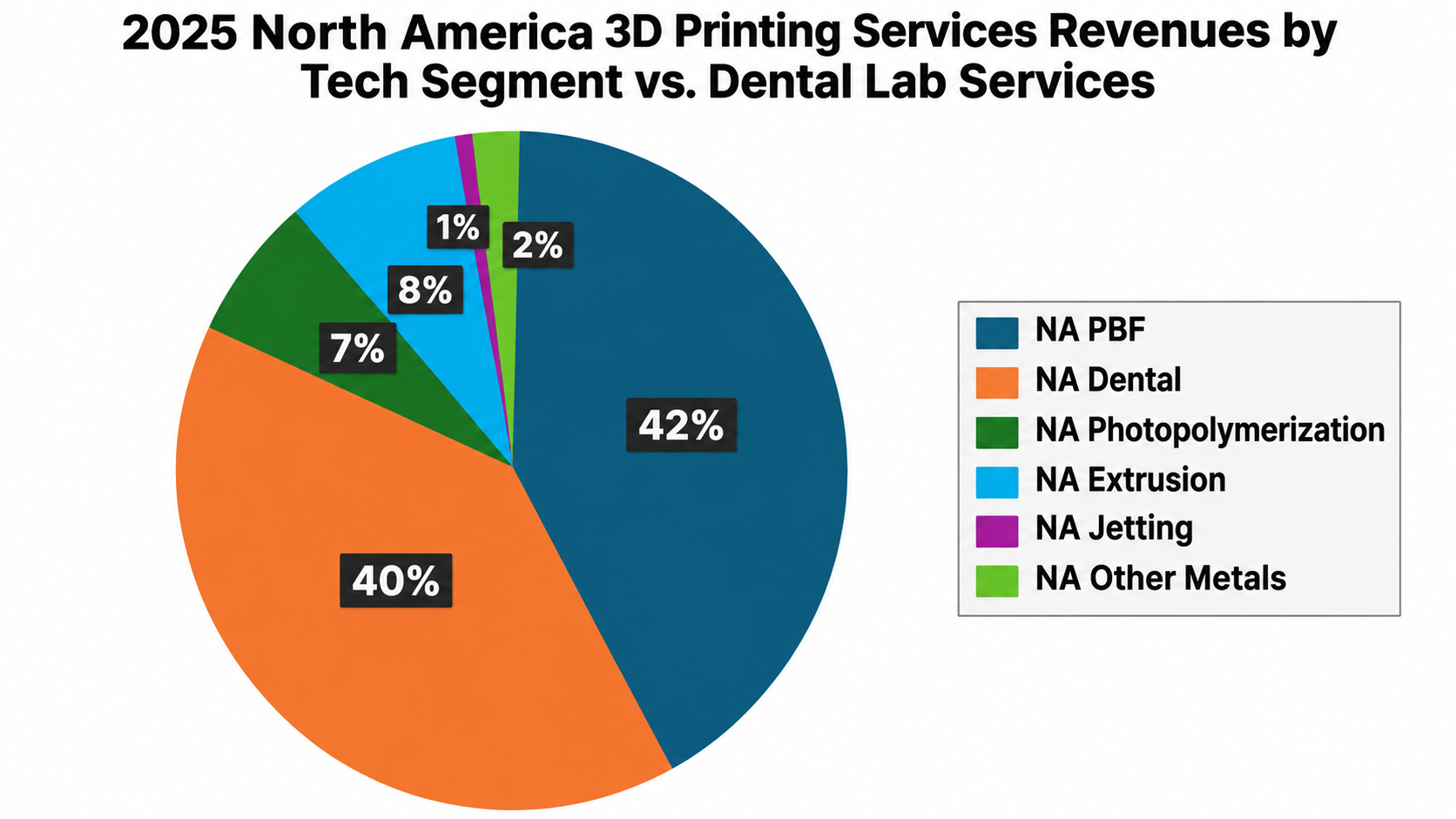
Powder bed fusion accounted for 42% of North American 3D printing services revenue in 2025, followed closely by dental lab services at 40%. Image courtesy of AM Research.
Seen in the chart above are all the tech/material categories for print services that generated greater than $50M in services revenue in North America in 2025. Significant sequential growth is seen in all metal powder bed fusion materials that meet this definition, including titanium, nickel alloys, refractory metals, and others, driven mostly by copper, tungsten, carbides, niobium, and molybdenum.
The polymer side has also grown strongly since 2020, including services for extrusion-printed ABS and PLA, as well as extruded PAEK polymers. In the polymer powder bed fusion segment, reinforced nylons are also growing rapidly, with glass-filled and carbon-filled variants of nylon 11 and 12 making major gains every year since 2020.
Which Groups Are Driving These Services?
Since we’ve established that the bulk of revenue-generating activity amongst print services providers is related to either dentistry or various powder bed fusion services, the real question then becomes: what groups or end-user types are really outsourcing so much powder bed fusion demand?
As a whole for 2025, the answers probably aren’t that surprising -aerospace, defense, and maritime end users lead the market for powder bed fusion print services. However, things get more interesting when we consider how this market has evolved since 2020, and what the breakdown in by-market demand has been for polymer powder bed fusion versus metal powder bed fusion during this time.

Aerospace led North American powder bed fusion services revenue in 2025, with defense and maritime showing some of the strongest growth since 2020. Image courtesy of AM Research.
In 2020, the Defense & Maritime sector was essentially tied for second-lowest use of powder bed fusion print services. Today, at the end of last year, this was the second-highest segment, nearly tying aerospace with almost $200M in services demand. The defense and maritime sectors grew the most out of any industry in both polymer powder bed fusion and metal powder bed fusion services demand, comparing 2025 to 2020. This has unseated the medical sector as the second-highest services-generating end-user group now in the industry, with aerospace still leading.
If you’re in the powder bed fusion 3D printing services market in North America, you probably are in -or need to get into -some kind of applications or services related to drones, shipbuilding, suppressors, satellites, or propulsion/munitions. However, if none of those areas interest you, the consumer goods sector actually had the second-highest growth in polymer powder bed fusion services during this time, trailing defense (which exploded for drone printing using polymer powder bed fusion).
If you enjoyed this kind of analysis, our upcoming 3D printing services market report and database can provide the same level of detailed, data-driven insights.
AM Research
Additive Manufacturing Services Markets 2026–2035
AM Research’s upcoming report takes a closer look at the metal and polymer 3D printing services markets, with historical data, industry analysis, and forecasts through 2035.
The report includes an Excel market database and forecast, along with the opportunity to discuss the findings with AM Research analysts.
Preorder by 11:59 p.m. on November 30, 2026, to receive the current discounted rate. Prices increase on December 1.
Subscribe to Our Email Newsletter
Stay up-to-date on all the latest news from the 3D printing industry and receive information and offers from third party vendors.
Upload your 3D Models and get them printed quickly and efficiently.