Despite the diversity of the applications that 3D printing is used for, there are still themes concerning what works for 3D printing companies that seem to be universal. One of the most strikingly universal themes is that effective partnerships result from jointly creating solutions from the ground up.
This seems to be all the more true the more “niche” the application is, which is something I recently learned from speaking to Melbs LeMieux, co-founder and president of Electroninks, as well as Mike Torre, a customer account manager at the Texas-based materials supplier, and Dov Phillips, sales manager at Integrated Deposition Solutions (IDS). I’m fascinated by the potential for 3D printed electronics, but I recognize that there are even greater limitations than exist in the AM industry as a whole, when it comes to actually moving the applications from the lab to production. According to three rare individuals with that experience, collaborating from the outset is key.
IDS, a New Mexico company that makes NanoJet aerosol systems, has been an Electroninks customer for years, and the partners announced recently that over the course of a three-week qualification program, they’d successfully used the IDS NanoJet Gen 2 system and Electroninks’ EI-615 silver conductive ink to print over 100 multilayer heaters for an aerospace customer, which reduced production time per device by 73 percent. Just as impressively, they “achieved near-perfect yield”, of the utmost importance in a production environment for the electronics industry. The devices have since entered environmental testing to verify their long-term reliability.
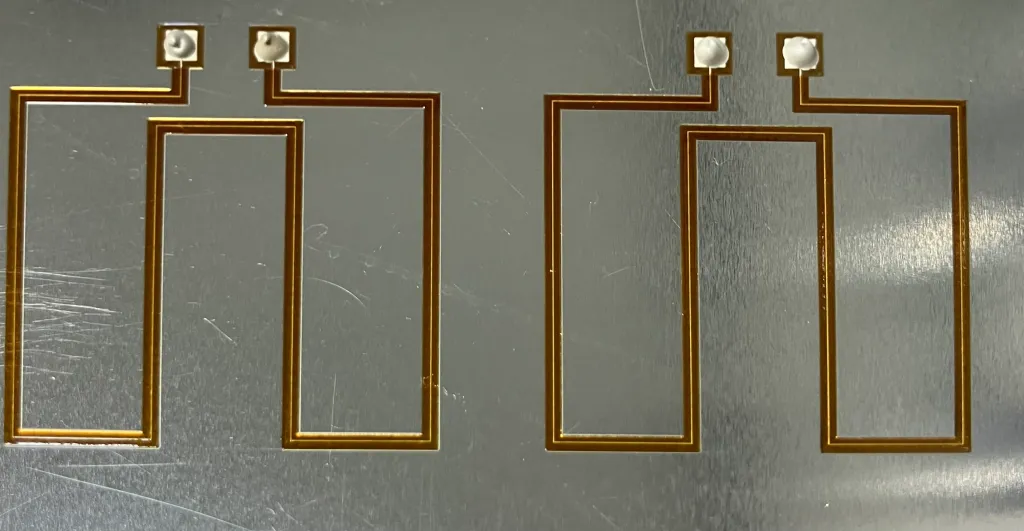
Small multi-layer resistors.
According to Phillips, that level of success couldn’t happen without Electroninks’ own competence in the electronics printing process, not just materials development:
“Our partnership with Electroninks has been really beneficial because they have experts in deposition at their facility as well,” Phillips explained. “We view successful projects as requiring this three-legged stool: you of course have to have a viable application, but you also have to have the appropriate tool and the material set, and you need all of those three components to be in alignment. If you don’t have all three, and if they’re not harmonious, you’ll get lost pretty quickly.”
In addition to their shared skill-sets, the fact that the two companies are located in neighboring states also helps their partnership.
“Working with the guys at Electroninks particularly on this project, we bounced a lot of questions back to one of their senior scientists, and got great results,” Phillips continued. “We also worked really closely with Michael [Torre] to help with the supply, as we were starting to use a lot more ink than we had previously used in some other R&D projects, to make sure that we were timing the deliveries, so that we could execute batch production without having to wait on a new delivery.”
Torre added that the advantages Phillips highlighted are especially important for customers in a vertical like aerospace and defense, which have such precise requirements. Those stringent demands, Torre said, mean that you have to go the extra mile to prioritize consistency:
“One of the things that’s definitely changed with our company over the last decade or so that I’ve been here is, we’ve not only worked on developing new materials, but we’ve also really worked a lot on the reproducibility and the reliability of these materials,” Torre told me. “There are customers that buy all different kinds of materials and then they go to buy a second batch, and they find that those materials just don’t exist anymore.
“With getting this material ready for mass production, it’s not only important to be repeatable from batch to batch, but also just to have that steady supply chain scalability and reliability, as Dov said about IDS’s increasing volume needs. We really made sure that we had the supply chain availability to get the material to them when they needed it, as well as the mass production capability to make sure that we had the supply to meet their demands.”
LeMieux put this collaborative approach nicely in terms of letting the customers dictate the solution as opposed to trying to lead the customer in a predetermined direction:
“You can’t just throw the material and the printer over a fence and hope the customers come to you,” the president said. “You really have to make sure that every aspect is compatible, meaning providing your solution for a specific customer, who is developing a solution for their own customer.”
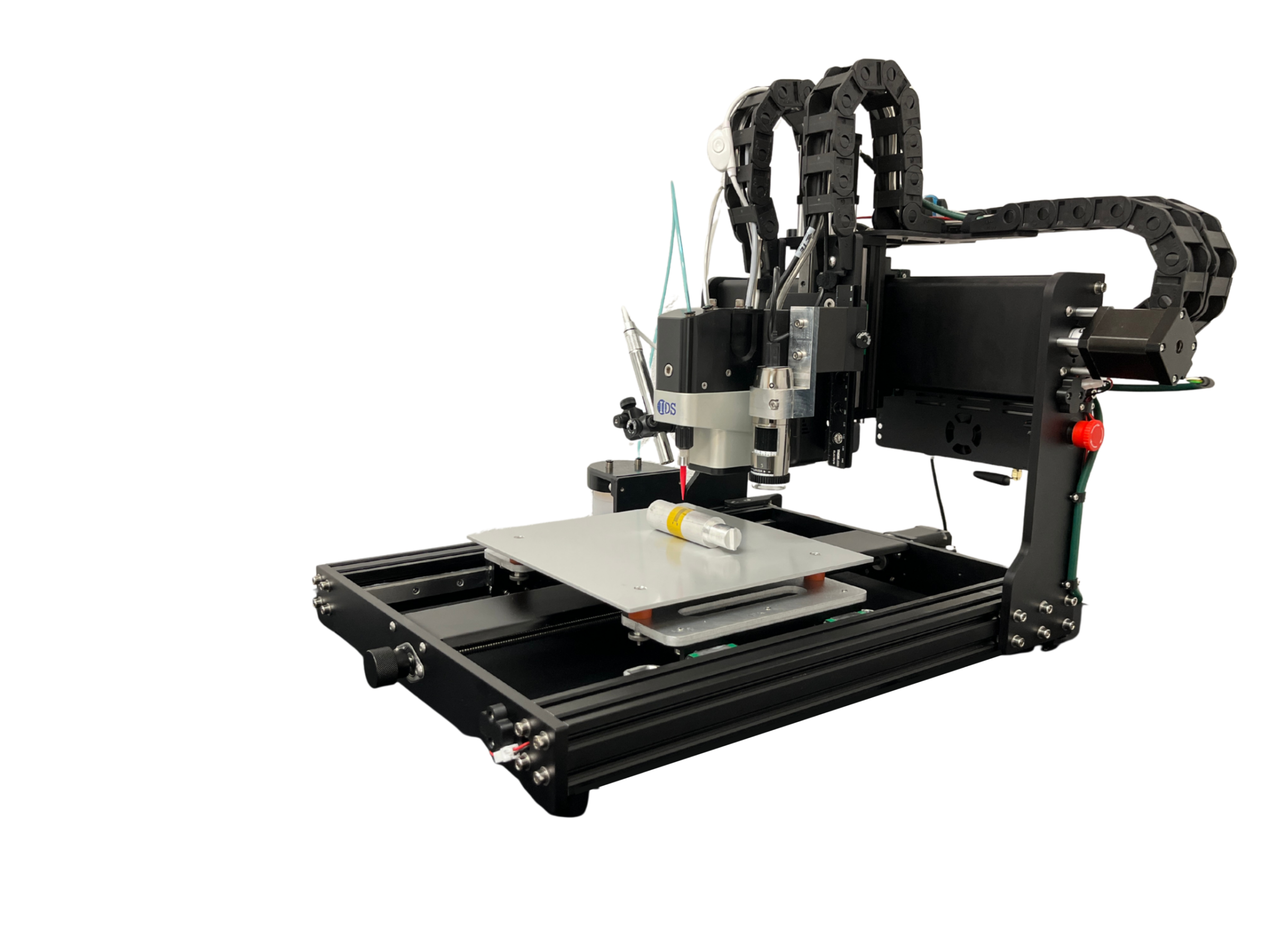
Integrated Deposition Solutions’ NanoJet aerosol printing system, designed for precision deposition of functional materials and printed electronics.
LeMieux said that the needs related to electronics for AI have made it even more important to take that dynamic into consideration:
“What we’re seeing is for traditional manufacturing supply chains, you know, whether it’s EMS [electronics manufacturing service] companies or OSATs [outsourced semiconductor assembly and testing], they’ve been building very high value devices, consumer electronic devices for years, and those customers are now getting displaced in conventional manufacturing by the AI giants because they’re paying five or ten times more than what anyone else can afford.
“What that means is there’s a lot of smaller manufacturers that have to get brought up to speed to handle the need for increased production capacity,” LeMieux continued. “Whether it’s consumer devices, medical devices, automotive — these have to get done, and I think that’s where tools like additive can get new factories up to speed much more quickly, with a lower capex and a lower overall footprint.”
Along with how it’s reshaping demand, AI is also influencing the operations of the companies themselves in ways that should encourage observers who are searching for more examples of how manufacturers can use AI to enhance innovation:
“In terms of work that we’re doing internally, we’ve been starting to utilize AI in terms of the formulations development that we’re doing,” Torre noted. “Coming up with new ideas related to what components we put in certain materials, in what ratios, and exploring how the possibilities work at a molecular level, and what effects those possibilities will have on the macroscopic properties we’re aiming for.”
Phillips said he’s been impressed by what IDS’s own customers are already able to achieve with AI:
“It has almost exponentially sped up the tool path creation process that I’ve seen from some of our customers. In our facility, we’re still doing a lot of stuff more in the traditional way, but I’m amazed at the speed at which some of our customers are creating really complex print geometries very, very quickly, using fairly simple AI tools.”
Again, while 3D printed electronics is often viewed as its own standalone universe, I think the transmission of core electronics manufacturing philosophies across the manufacturing sector as a whole is precisely what’s opening up so much opportunity for AM. It will therefore be very useful for the AM industry to pay greater attention to how electronics manufacturers operate.
Images courtesy of IDS
Subscribe to Our Email Newsletter
Stay up-to-date on all the latest news from the 3D printing industry and receive information and offers from third party vendors.
Upload your 3D Models and get them printed quickly and efficiently.