
On the first day of the recent MMX 2026, the annual Members Meeting and Exchange held by America Makes in Youngstown, Ohio, someone asked me if I had any early thoughts as to the initial theme of the event. Having already listened to several presentations, I half-jokingly answered, “‘I hate Bambu,’ ‘I love Bambu,’ and ‘everything is expensive.’” But really, the answer was “speed,” and that we need more of it.
Many of the speakers throughout MMX called back to the opening keynote by Matthew Sermon, Executive Directer, DRPM Submarines, DoW. He stated that while the progress in the additive industry has been real, “it’s not near fast enough.”
“It’s nothing like the speed that our adversaries move at,” he stated. “We have to move faster.”
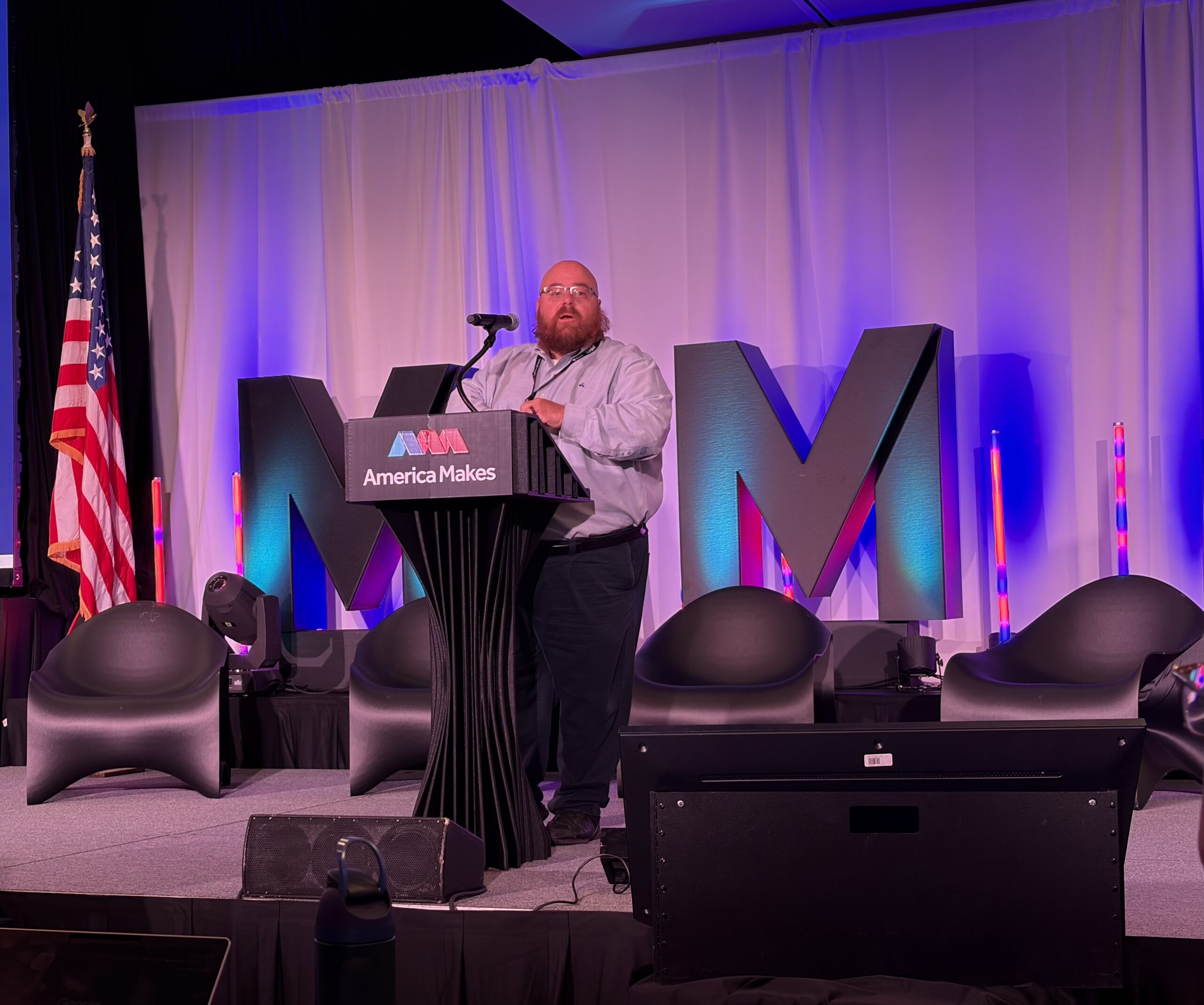
Matthew Sermon, Executive Directer, DRPM Submarines, DoW
Institute Updates
Here’s a rundown of what America Makes has been up to over the last year. Driven by the non-profit National Center for Defense Manufacturing and Machining (NCDMM), America Makes is one of nearly 20 Manufacturing USA institutes, which were designed to accelerate advanced manufacturing in the U.S. While its main focus is on additive manufacturing (AM), last year the organization announced that it was broadening its scope to include adaptive manufacturing.
As Executive Director John Wilczynski explained in his State of the Union, the Institute has welcomed around 80 new members since last year’s MMX. These new members break down to 11 academic institutions, four non-profits, 13 large businesses, and nearly 60 small businesses. America Makes released 11 Project Calls this year, and is, as Wilczynski said, “actively prioritizing how we align to national strategies,” such as the National Defense Strategy for Advanced Manufacturing and the National Defense Authorization Act.
“The value of membership is increasingly tied to building connections, visibility, and opportunities,” he said.
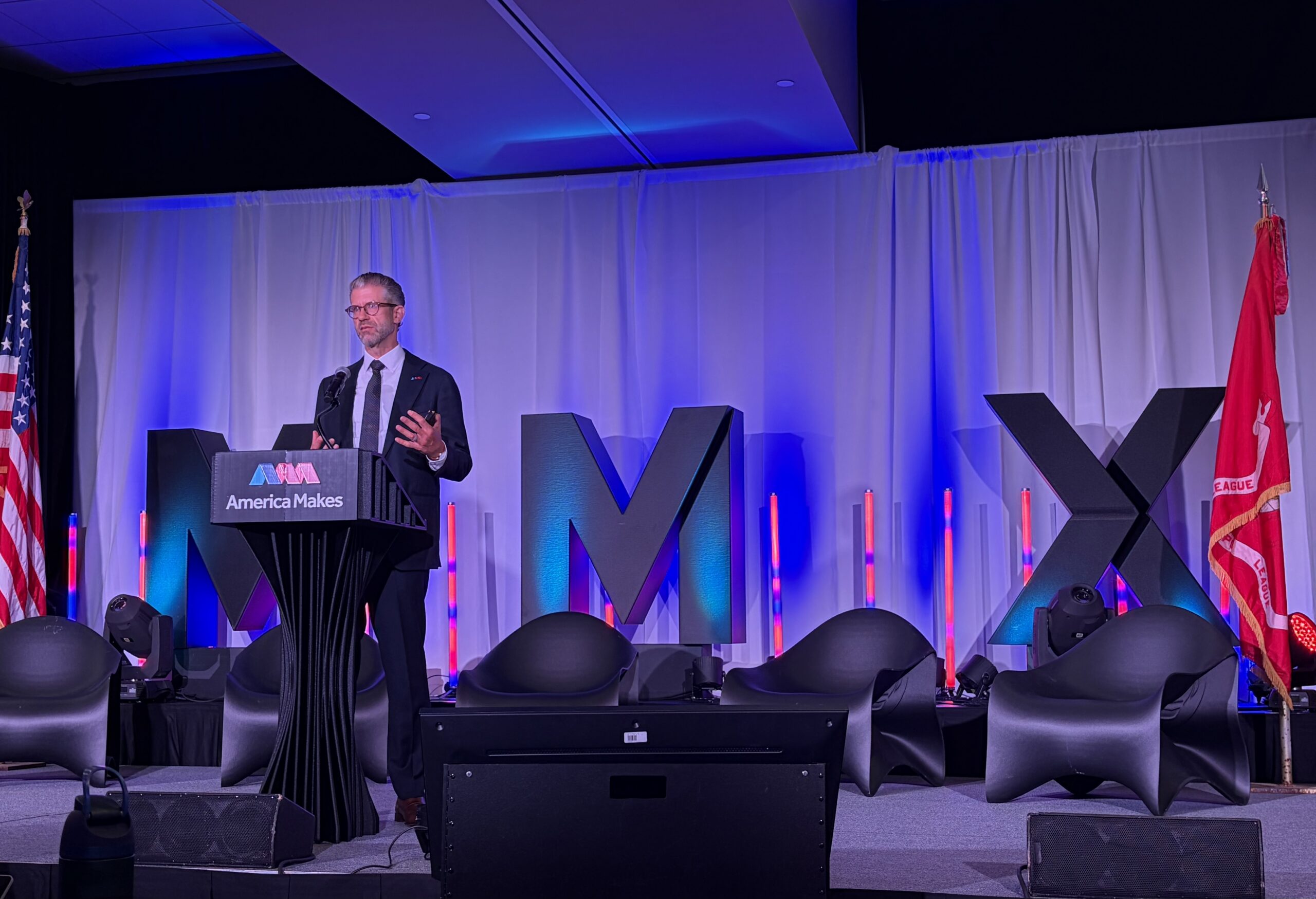
John Wilczynski, Executive Director, America Makes
Operations Director Alexander Steeb noted that America Makes has “a pretty healthy and engaged membership,” and that the Institute’s portfolio currently sits at 194 active projects, which is twice as many as last year. $112.6 million in Project Call funding has been made available to members over the last 12 months, and America Makes is hoping to launch six new Project Calls soon.
Technology Director Brandon Ribic said that engagement is strong with the Advisory and Working Groups, and noted the many “great opportunities” in the last year, such as the Joint Additive Qualification for Sustainment – Supplier Qualification (JAQS-SQ) Project Call launched at last year’s MMX, and more to come.
“We all get to a point where we can test into oblivion,” Ribic said. “But we’re being encouraged to get to that place faster. The keys that we see to getting there are materials data, protocols and practices, specs and standards, and training.
“We’re getting aligned on strategies and next steps, and bringing folks together to allow ourselves to take action. But that’s not going to be done in a silo.”
Ben DiMarco, Technology Transition Director for America Makes, reminded us that we’ve been transitioning technology for a long time, like the iPhone, which was invented over decades, not overnight, and integrated strategic investments from DARPA, the DoE, NSF, and more.
“Transition is not, ‘can I print it?’ It’s engines, systems, rockets. Capability is iterative,” he said.
DiMarco is looking to increase engagement with program offices, depots, shipyards, and industry partners, and is also working on a formal transition strategy, with transition measured by connecting projects and deliverables.
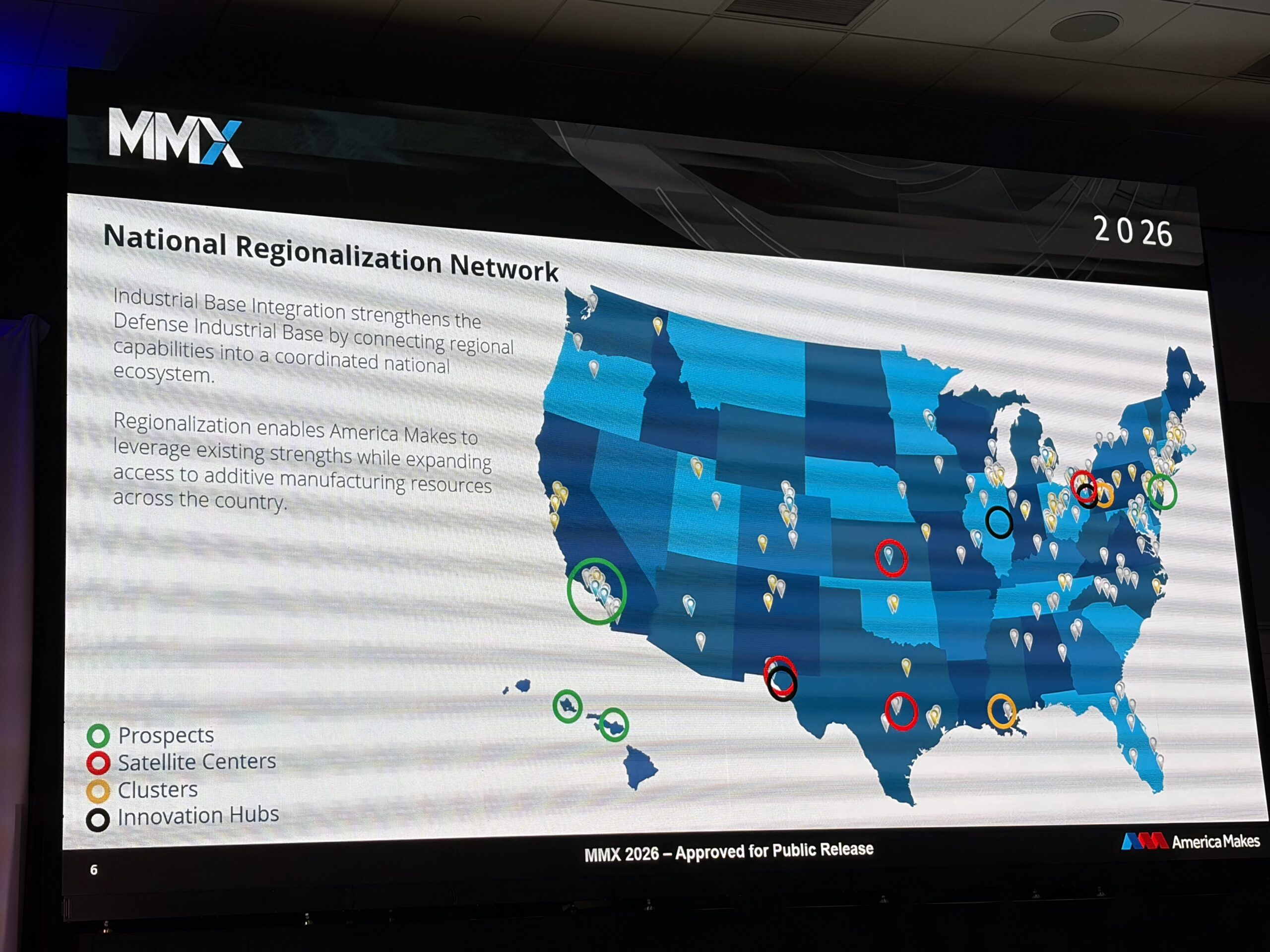
The point of industrial base integration (IBI) is to turn a collection of different capabilities into one coordinated, national industrial ecosystem. As Industrial Base Integration Director Kimberly Gibson explained, the industrial base faces four major challenges: fragmented supply chains, slow technology transition, workforce gaps, and regional coordination. By connecting regional capabilities into a national ecosystem, IBI can make the Defense Industrial Base stronger.
Work continues in regards to the IBI strategy America Makes rolled out last year, which has five swimlanes:
- Activate – expanded funding opportunities and collected over 40 white papers from members for future funding opportunities
- Accelerate – building capacity, like joint efforts with education and workforce development
- Integrate – connecting the ecosystem by identifying Illinois, Utah, Connecticut, California, and Hawaii as new regions of opportunities
- Mobilize – accelerate adoption by organizing the crossover between the Technology Transition Pillar and Industrial Base Integration Pillar
- Advocate – help our government representatives understand the very deep technical expertise we have, and how it affects legislation
Ed Herderick, Director of Education & Workforce Development (EWD), told us that the team completed seven EWD pillar projects in FY25, and reached 9,427 learners through EWD programs at the Institute. Now, they’re working to grow key partnerships and scale their impact, as well as expand supply chain capacity through more industry-grounded EWD efforts in AM. Over the next 18 months, the EWD team plans to focus investments on the skills that will enable future manufacturing success.
“Rather than general additive awareness, which definitely has its place in the industry, what does the mid-career materials engineer need to do their job effectively? Someone who went to trade school and became a machinist? That specificity is really important,” Herderick said.
The Roadmap Advisory Group (RMAG) facilitates networking and expert conversations between members, documenting what’s said to help manage the national AM roadmap on behalf of America Makes. RMAG Chair Andrew Thompson, Manager & Deputy Chief Engineer of AM for Northrop Grumman, said over the past year, the group updated its framework to align roadmap priorities, then reorganized and realigned the five Working Groups: Design, Material, Process, Quality, and Data & SIM. Now they’re working to ensure that the projects developing roadmaps are integrated into the RMAG roadmap, so more expert insights can be added.
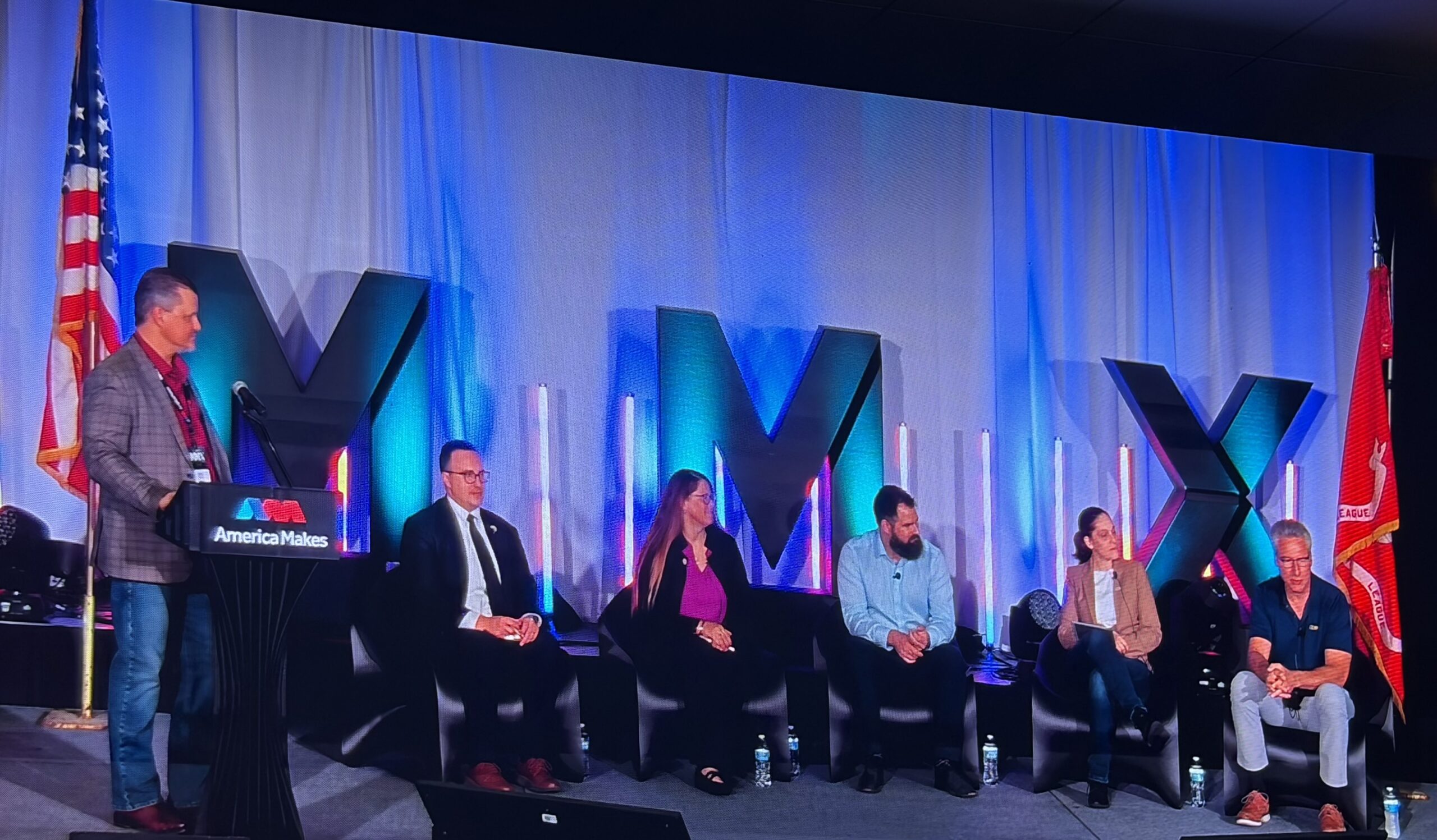
L-R: Brian Schmidt, NCDMM; Kyle Cobb, Office of the Under Secretary of War for Research & Engineering; Elisa Peters, Office of the Under Secretary of War for Research and Engineering, Manufacturing Technology Office; Evan Handler, Naval Surface Warfare Center Carderock Division; Rachel Levine, ACE 3D; Mark Shaw, National Institute for Aviation Research
There was a briefing on the previously mentioned JAQS-SQ Project Call, moderated by NCDMM Program Manager & Lab Director Brian Schmidt. Mark Shaw, Chief Engineer at the National Institute for Aviation Research (NIAR) at Wichita State University, explained that JAQS is about process control, but does not replace NADCAP or ASTM standards, using accreditation rather than qualification.
“Once I’ve established that I can do it, how confident am I doing it 10 more times? 100?” Shaw explained. “JAQS doesn’t prescribe a method, but asks you to describe what you use, and then show us the evidence that it works.”
Rachel Levine, AM Consultant and Founder of Additive Consulting & Engineering (ACE 3D), said this qualification program is “the most holistic I’ve seen.” Many contract manufacturers and suppliers that could be working with the government, but aren’t, have one printer qualified for one spec, another qualified for a different one, and so on. JAQS is a training, implementation, and auditing process to standardize inconsistent qualifications.
Evan Handler, Chief Technology Advisor for America Makes and Chief Engineer AM Branch, Naval Surface Warfare Center Carderock Division, said their biggest hope is that JAQS can “have a single point for all the document review, auditing, and what we need them to do to make critical parts across services.” The goal is that if a supplier takes this training, and becomes JAQS-accredited, the government won’t have to go in and confirm every single document.
Success Stories & Lessons Learned
Just like Steve Fournier, Senior Manager – Additive Manufacturing at General Atomics Aeronautical Systems (GA-ASI), did at AMUG 2026 with Divergent‘s Scott Sawyer, he and Travis Mayberry, Technical Portfolio Manager at Divergent, talked at MMX about how the two companies had built a relationship, across industries, that was centered around additive and how it can be used in the aerospace and defense (A&D) sector.
“Nobody cares about additive until it serves a purpose. Let’s just burst that bubble right now,” Fournier said.
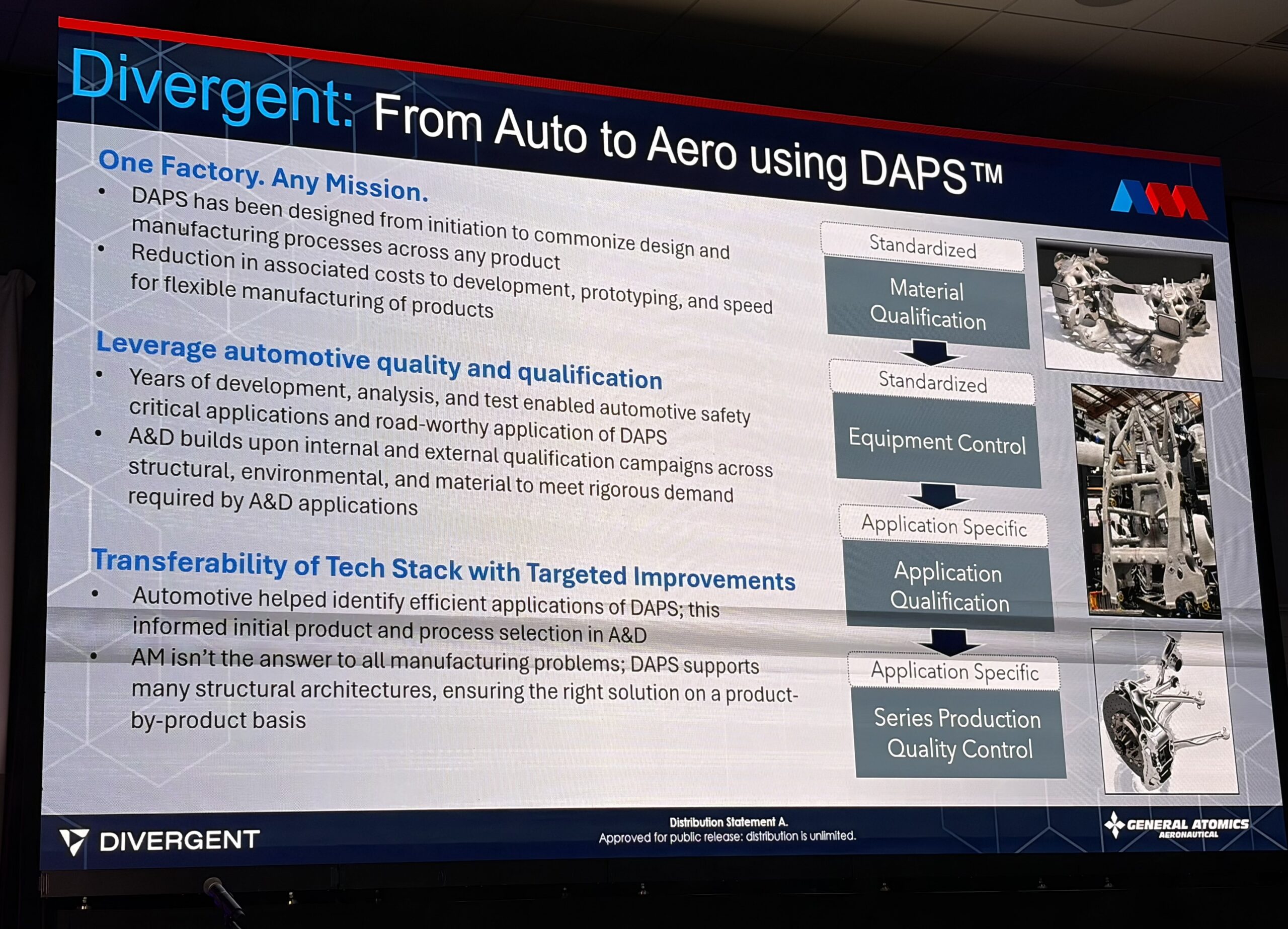
Divergent got its start in automotive applications, and Mayberry said that its DAPS technology—short for Divergent Adaptive Production System—has helped qualify it as a Tier 1 supplier by six of the world’s premier automakers. Both Mayberry and Fournier reiterated that using additive for part count reduction is critical in both the automotive and A&D industries.
“I saw a car highly integrated with control systems, chassis, skins, a structure with lot of fatigue and static loads, and recognized the patterns of a UAS,” Fournier said of Divergent’s hypercars. “It just doesn’t operate in the same domain. We took an application and applied the technology.”
Mayberry said Divergent isn’t leaving automotive behind, just expanding into A&D, like the kind of unmanned aerial systems (UAS) that GA-ASI develops.
“This is a showcase of a successful collaboration that’s born from this community. As you go out at this event, take advantage of the community,” Mayberry urged attendees.
CWO3 Matt Pine, Innovation Officer, II Marine Expeditionary Force (MEF) Innovation Campus, said the process of making a drone is “very convoluted.” But because of the need to modify, it’s better for the military to make a drone, rather than just buy one.
“What does additive do for us? The same thing it does for parts – gives us adaptability and speed. We’re not waiting on some supply chain bottleneck, we’re making something where it actually matters. That’s the goal,” he said. “But it doesn’t resolve part availability, or resolve the acquisition model underneath that was built for a 1960s paradigm. We’re trying to move at an analog speed in a digital era, and we need to do better.”
He said that in terms of drone manufacturing and usage, we need to learn from Ukraine to compete with China, as we are way behind, and Ukraine is able to successfully source non-Chinese components for drones.
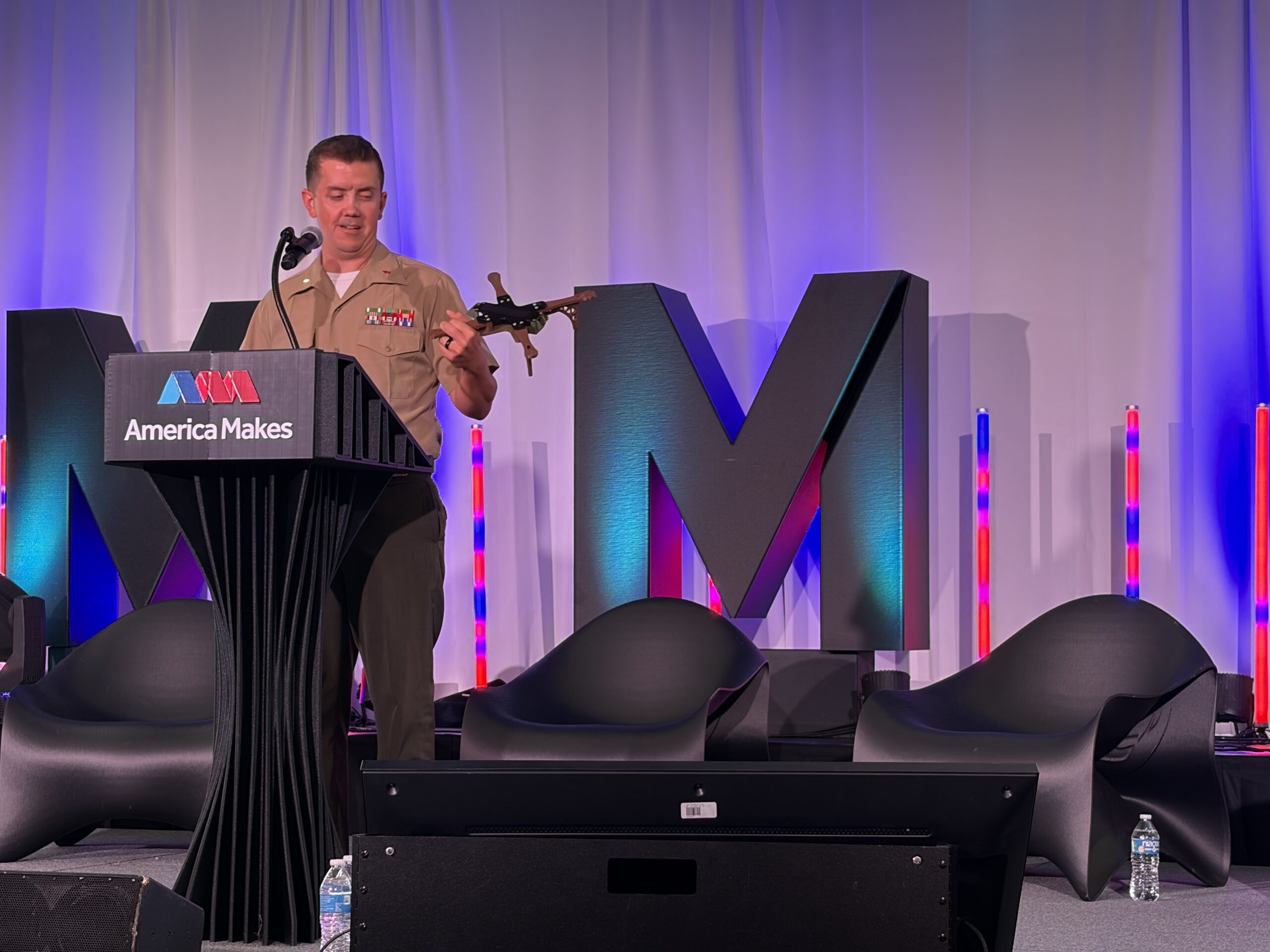
CWO3 Matt Pine, Innovation Officer, II Marine Expeditionary Force (MEF) Innovation Campus
Pine said the U.S. government isn’t “learning the right lessons, and that’s not on you, that’s on us. We just need your help.”
America Makes members can help by developing capabilities that are able to produce at speed and at the point of need, and working with the government to adapt the acquisition process to the speed that additive provides at scale.
Demand Signals
Theodore Gronda, Naval Aviation AM Program Manager, Naval Air Systems Command (NAVAIR) Sustainment Group (NSG), echoed Pine’s request for help. He said the Navy Supply Systems Command (NAVSUP) gets about 9,000 requests annually for parts that have lost their supply sources. Each year, Fleet Maintenance Officers at NAVAIR’s Fleet Readiness Centers see an average of 3,700 Material Readiness Degraders (physical, environmental, and procedural factors that cause the breakdown of equipment and structural materials).
“We’re being overwhelmed with part requests,” Gronda said. “Is America Makes the right fix for me to get to you to help fix these parts?
“We have weapons systems down. I can’t suffer a nine-month contract lead time, I need to start now. I need you on contract today.”
He did note that cybersecurity of 3D printers is “insanely important,” which makes sense when you’re talking about military parts. But, what’s not as important is getting a perfect replacement for an OEM part; good enough needs to be it sometimes.
“Do I need to be finished with all the tests before I can get a part that will get systems back up in the air?” he asked. “We have to change. If they need those expensive weapons systems back online, I think there’s some risks we can take.”
During an early panel on “Polymer AM Crisis & Opportunity,” Gibson, who was moderating, asked JAMWG Co-Facilitator Catherine DeLeal what’s needed to stimulate actual demand from the government for polymer 3D printers. DeLeal answered that the signal is being sent now, saying it’s like Batman is missing the Bat Signal in the sky.
“We need you to do better, we’re sending the signal now,” she said. “We as a nation can do the hard thing. All we need is an affordable printer that’s usable, that kids can use, but so can military service members, that’s essentially plug and play. It’s not that far out of reach, we are capable.”
The equivalent in China is, obviously, Bambu printers. Dayton Horvath, Senior Director of Emerging Technology for the Association for Manufacturing Technology (AMT), said 5 million 3D printers were sold last year that cost less than $10,000, but that most were under $1,000.
“There’s clearly an opportunity globally for this, and the Chinese are way ahead of us.”

L-R: Kimberly Gibson, America Makes; Dayton Horvath, AMT; Mara Hitner, MatterHackers; Tim Gornet, Stratasys; Catherine DeLeal, JAMWG; James Klett, PhD, (Retired) ORNL
The 2026 National Defense Authorization Act (NDAA) prohibits the DoW from owning or operating 3D printers and 3D printing software from adversarial nations, including Russia and China. So far, we don’t have a system in the U.S. that’s comparable to what Bambu is offering. Gibson said it will take “a lot of discussion and policy” to fix this.
Mara Hitner, VP Strategic Partnerships at MatterHackers, said many lawmakers don’t truly understand what 3D printing is. If we make the technology accessible, she said, things will move forward, but “we need innovation to create that accessibility.”
If we were murmuring about Bambu printers at last year’s MMX, we’re screaming about them now. In a later panel discussion on “3D Printing for Drones,” moderated by Herderick, Henry Sullivan, Co-Founder of Strongpoint Labs, mentioned a sight many of us have seen: walls of Bambu 3D printers busily printing everything from toys to drones.
“When the first Bambu came out, it was a revolutionary technology, and the speed of everything increased by tenfold. It’s the Apple of printers. Its whole experience, it’s so easy to use,” Sullivan said.
Staff Sergeant Devan Siler, United States Air Force, Air Mobility Command, said that if a printer is more advanced than a plug and play system, “we’re not gonna use it.”
“If it’s an 80% solution that works every single time, that’ll be it,” he continued. “I just need to hit the catalog, find the part, and push print.”
He also said that it may sound like a lot of money when military funding is reported, “but I don’t know where it goes.” So accessible, low-cost printers are really important in this arena.
“I could have a guy reach out and say, ‘Hey, we want to get a 3D printer,’ and I’d say ‘Great, how much are you willing to spend?’ The answer would be $800, because that’s all they have available, and I’d say, ‘No, you need at least $3,000,’ and they’d say, ‘Never mind, talk to you next fiscal year.’ Many companies could swing that, but it’s not the average for your small platoon entity.”
China’s AM Landscape
With all the talk about China, it only made sense to have a presentation focused solely on the Chinese AM landscape. Ben Ferrar, CEO of AM consulting company M²F, said the U.S. is the only country in the world with the capability to compete with what’s happening in China…so that’s good, right? But we’re not there yet.

Ben Ferrar, M²F
M²F and AMPOWER worked with America Makes on a study to assess the scale, trajectory, and maturity of China’s AM base across public and private investments, and benchmark it against the U.S. In one part of the study, they segmented the data into four categories: Desktop Print Farms, Industrial Polymer, Metal Production, and Material Capacity. In every instance, China came out on top. An FFF print farm in the U.S., like Wigglitz, operates close to 3,000 printers; in China, it’s 20,000. Ferrar said that Avimetal in China has close to 10 atomizers for making titanium powder, while U.S. companies like Continuum Powders and 6K Additive have half that.
Ferrar explained that China has been very successful with its AM scale-up, forming the Made In China 2025 program in 2015 to define the technology as one of critical importance. It was named a national priority around 2020. In the country’s latest Action Plan, they’re now more focused on AI and automation, as they essentially consider additive “done.”
“Aerospace and defense is nearly entirely state-owned in China,” Ferrar said. “When China backs additive, there’s no private sector. The full strength of the nation is behind it.”
According to the study, China is ahead of the U.S. in desktop polymer 3D printing, the number of printer OEMs, AM feedstock capacity, the number of large-format metal printers, and even the amount of research articles written about the technology. Chinese printers are in the top five slots for worldwide desktop additive manufacturing capability.
“They own the consumer base that everything else is built on. In my opinion, they will dominate and own this market, it’s almost gone already,” Ferrar said.
If this doesn’t scare you, it should.
Working with the Government
So how do we pull ahead? Carmen Pillitteri, Procurement Analyst for Weapons Support, Defense Logistics Agency (DLA), encouraged all attendees to look at DLA’s advanced manufacturing website for help navigating what they need to do in order to get additive solicitations. He acknowledged that DLA has a lot of administrative logistics to deal with, but explained that it’s only because the agency is tasked with ensuring that counterfeit material doesn’t get into the supply chain.
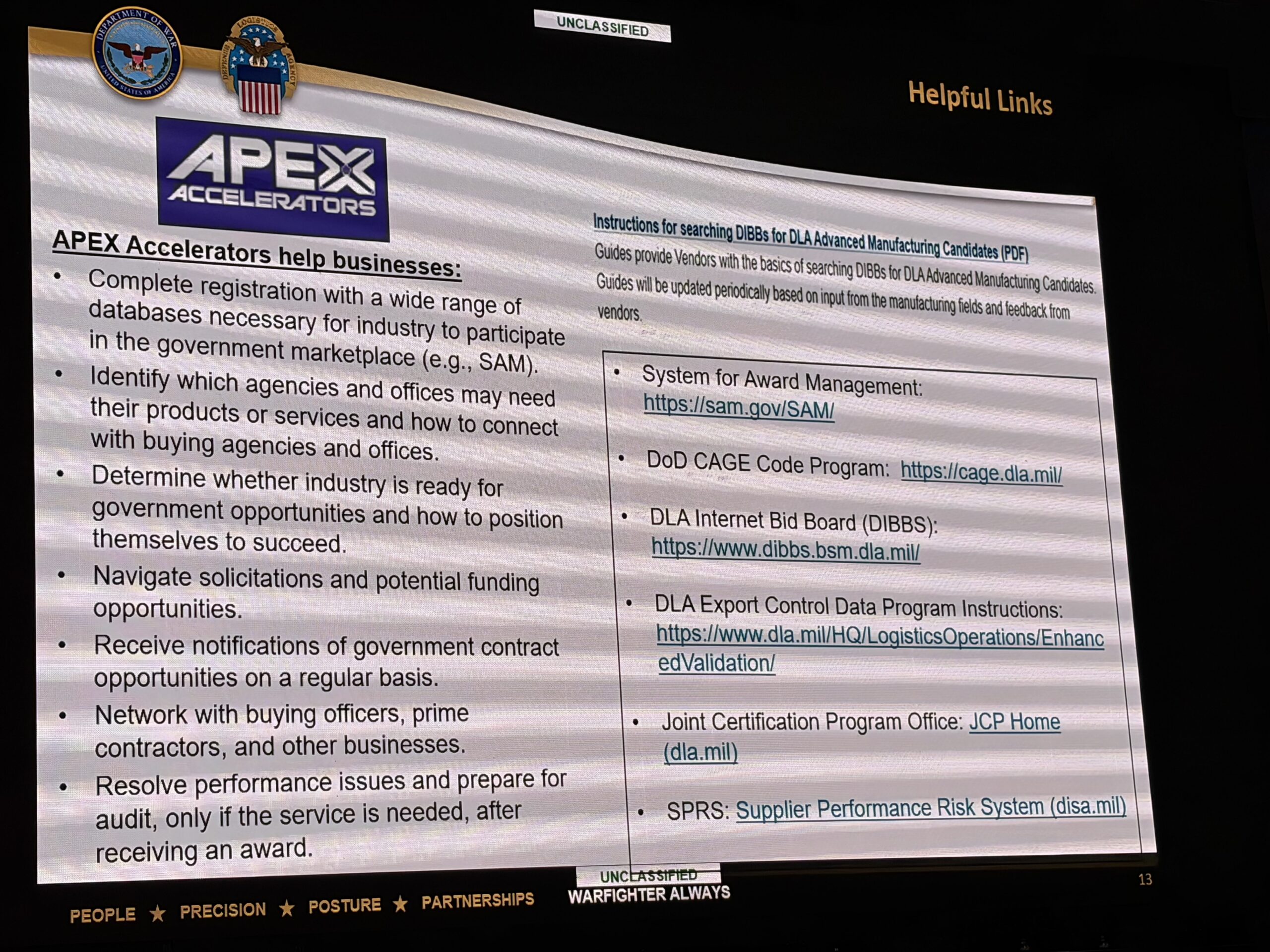
Pillitteri shared some helpful tips, such as searching the phrase “potential additive” on the DIBBS (DLA Internet Bid Board System).
“Check on the Focus Solicitation List, which is a list of solicitations with no quotes that we are having difficulty procuring,” he suggested.
He also told any business just starting to work with the government to utilize APEX Accelerators, a nationwide network to help businesses get local, state, and federal government contracts.
One of the things I love about MMX are the speakers actively helping America Makes members navigate these kinds of complicated processes. However, I feel many attendees would disagree with this assessment when applied to the presentation by Cybersesc Investments, an accredited C3PAO. Vice President Government Services Strategies Stacy Bostjanick and Chief Information Security Officer Fernando Machado told everyone how important it is to implement a Cybersecurity Maturity Model Certification (CMMC) ecosystem that’s compliant with NIST SP 800-171 standards, and they’re not wrong; did you know the average U.S. data breach costs over $10 million?!
However, one audience member made the important point that it is cost-prohibitive for many small businesses to do so, as it can be upwards of $25,000 to attain compliancy. The rebuttal from Cybersec was that businesses should have already been working on this for the last decade, as the requirements have been in place since 2017. But when questioned about newer small businesses, there was no answer. Hmm.
I Feel the Need…the Need for Speed
At the end of MMX, Wilczynski shared some trends he’d noticed throughout the event, including the idea of quality vs. quantity. But that’s not all.
“If I had to sum this up in one word, it would be speed,” he said. “That’s the main thing I’ve heard about across the majority of the talks. We need to think about how we get there. From the Institute’s point of view, we’re really beating the drum of transition and industrial base integration. It ultimately comes down to getting us in the position where we have this industrial base that we need, and we have products on the back end. But we need to do that more quickly. So that’s my big takeaway.”
I think it’s fitting that we began and ended on this theme of speed. It can be frustrating, especially when faced with the looming threat of China, to hear hours of talk about the nitty gritty qualification work that’s going on, and about committees and swimlanes, etc., when it seems like all we need to do is get a move on already! However, those things are important too, because if you just rush forward with no plan and no data to back you up, that’s when mistakes happen.
But I do think there’s merit to what Gronda said, about being able to take some risks to keep things moving forward. Maybe we can find a happy medium somewhere.
All images courtesy of Sarah Saunders for 3DPrint.com
Subscribe to Our Email Newsletter
Stay up-to-date on all the latest news from the 3D printing industry and receive information and offers from third party vendors.
Upload your 3D Models and get them printed quickly and efficiently.