Hyundai Motor Group (which, in addition to owning Hyundai, holds a large ownership stake in Kia) maintains an R&D center in Hwaseong, South Korea called Namyang, the company’s largest such facility globally. It’s over 3 million square feet and employs over 10,000 workers, and Hyundai and Kia recently publicized that, this year, the location also became the site of their joint Additive Manufacturing Solution Center (AMSC).
Now, as an article on the AMSC in Automotive World notes, the fact that Hyundai has been using 3D printing since 1996 but only opened a dedicated facility 30 years later implies that AM took a while to gain much traction in the company’s operations. On the other hand, it’s noteworthy that the company has at least half a dozen different AM processes on display at the facility, evenly spread across both metal and polymer.
In the company’s recent blog post on the topic, Hanwoo On, the senior manager of the Additive Manufacturing Solutions Team at Hyundai Motor Group, explained, “We are rapidly internalizing [AM] technologies through a growing range of applications across the Group. Beyond vehicle components, we are expanding their use in high-value applications such as equipment consumables and manufacturing tools.”
As I wrote about last year, while 3D printed tooling for automotive is by no means new, multiple catalysts have led AM tooling applications to experience renewed interest lately from automakers. Supply uncertainty related to materials has been a primary factor, but there’s also the sheer persistence of across-the-board production workflow delays, meaning that everything manufacturers can bring to the table to prevent additional delays has been prioritized.
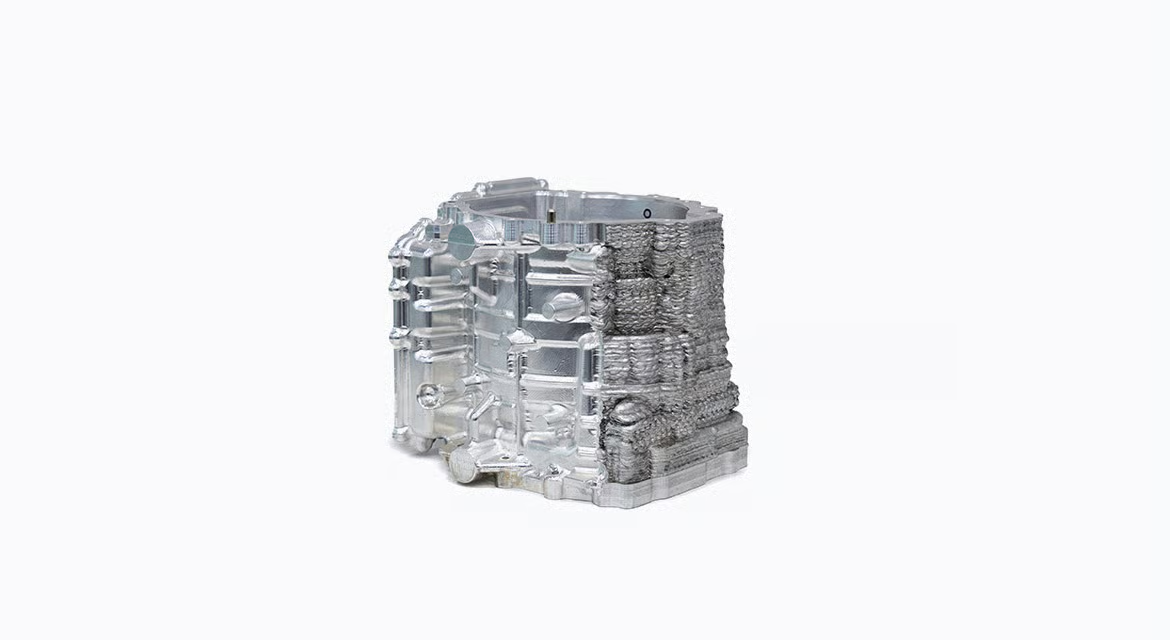
If I had to guess, then, the tooling angle is probably the immediate explanation for why Hyundai Motor Group is choosing to emphasize its AM capabilities right now. But even if the company was driven in this direction by one thing in particular, it nonetheless seems to be looking to implement a rather holistic approach to its AM activities, going forward.
That starts with instilling in its engineers a basis in DfAM, alongside getting them familiar with the full range of AM processes. Beyond prototyping, tooling, and emergency spares, Hyundai’s activities extend to producing legacy parts on-demand — facilitated by reverse engineering accomplished with 3D scanners — as well as a number of components for Hyundai’s motorsports division. Establishment of the AMSC might be a recent thing, then, but Hyundai Motor Group appears to be using AM as competently as any other major automaker: the scale of output in automotive is simply so large that it has taken some time for AM’s technological maturity to get where it needs to be to move the needle for the car industry.
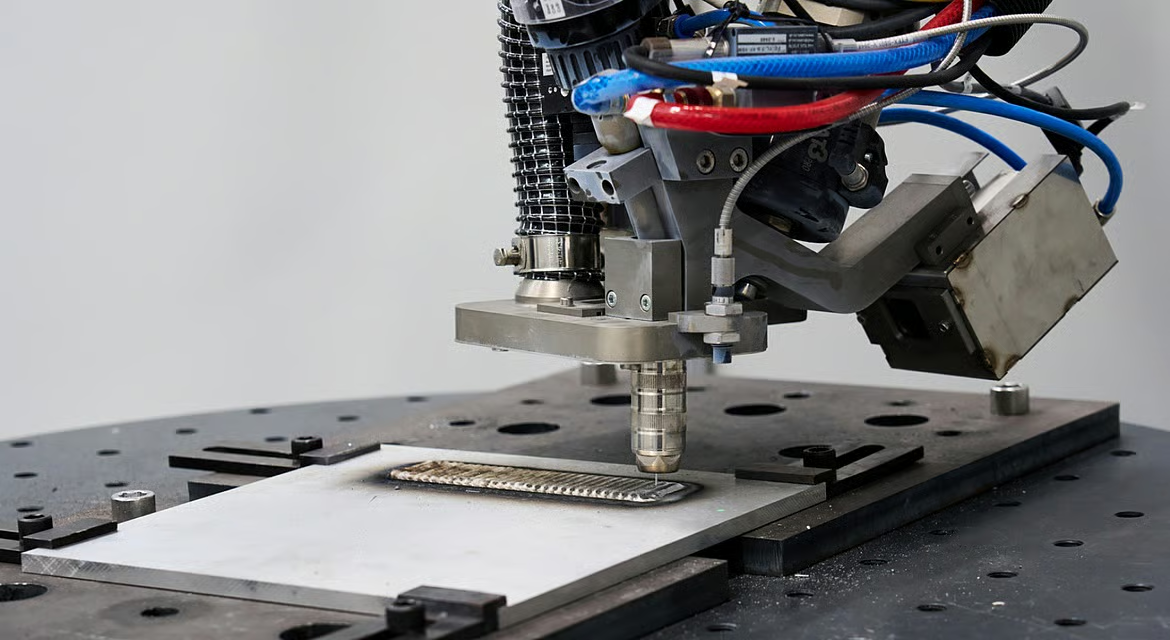
A DED-WAAM (Directed Energy Deposition-Wire Arc Additive Manufacturing) system fabricates a metal component by depositing material layer by layer
While it’s not mentioned specifically in the Hyundai blog post, I think the most exciting prospect for AM in the Hyundai and Kia workflows has to do with EVs. Hyundai and Kia have both been targeting the EV market very aggressively, especially in the US. I’m not sure why this is the time span they chose to isolate, but through the first five months of this year, Hyundai’s EV sales grew by nearly 25 percent compared to the same period in 2025, outpacing YOY growth in the broader EV market about eightfold.
That’s both impressive and the sort of trajectory that’s required for Hyundai, which is currently the world’s seventh largest EV maker, to meet its goal of becoming a top 3 EV brand by 2030. Just like AMSC, Hyundai Motor Group’s EV R&D is headquartered at Namyang, a facility which includes, among other things, ‘environmental chambers’ that simulate different kinds of extreme weather.
The EV market is a perfect opportunity for AM because of the heightened need for flexible production against what are currently such uncertain demand conditions. Also, the fact that EVs are still a comparatively new product category, certainly when contrasted with conventional vehicles and even hybrids, means that the product development cycle is likely to change more frequently than any other area of the auto market, necessitating rapid iteration and profitability at lower volumes enabled by AM.
Perhaps oil prices won’t remain elevated over a multiyear timeframe, although that would presumably require, at minimum, a reversal of the comprehensive deterioration of market stability in the Middle East, the likelihood of which is currently indicated by nothing. If that’s the case, and the new norm is “higher for longer” gasoline prices, then the EV market should continue to gain ground. Under those circumstances, we’d have an ideal opportunity to see how EV makers like Hyundai and Kia plan to deploy AM to support their visions for the future.
Images courtesy of the Hyundai Motor Group
Subscribe to Our Email Newsletter
Stay up-to-date on all the latest news from the 3D printing industry and receive information and offers from third party vendors.
Upload your 3D Models and get them printed quickly and efficiently.