Lithuania-based AmeraLabs is putting new dental 3D printing resins on the market. Its new Made in Europe resins will include one material for impression trays, one for surgical guides, and another for try-ins. Try-ins are wearable intermediate dental appliances used to check comfort before placing final veneers, implants, or dentures. An impression tray is a jig, I guess, that holds silicone or another molding material so you can take an accurate impression. If you’ve ever had aligners, a night guard, or some whitening treatments, then you’ve probably used an impression tray. And surgical guides, of course, are for improving the accuracy of procedures while reducing failure rates.
The new resins cost around $170 a liter. Dental resins typically cost from $85 to around $800 a liter; comparable tray and guide resins from Formlabs, for example, cost around $249. SprintRay´s try-in resin costs $360 per liter. Chinese dental resins tend to come in at around $80 to $160. LuxCreo and Dentsply Sirona resins, as well as similar brands, tend to be around $180 to $260. It depends on the resin, class, and more, but generally we’re seeing AmeraLabs offer a value play in the middle of the market. Independent, made in Europe, but affordable. To me, this is the most exciting segment of the resin market.
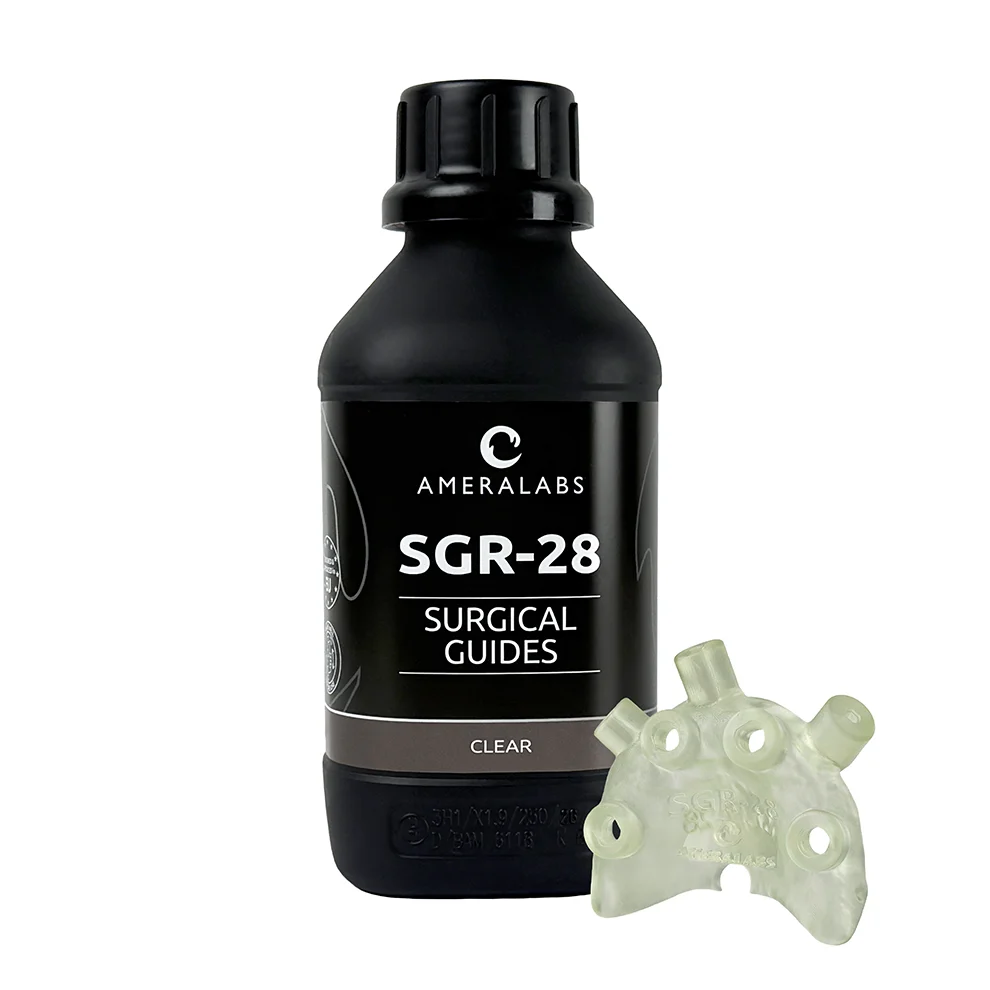
AmeraLabs SGR-28.
For a long time, you could either pay more for the resin supplied with your printer, or you could get a cut-price Alibaba resin and hope it would be safe. When a lot of companies entered the market, Dentsply, Henry Schein, and Bego tended to focus on the higher-end ones. This leaves quite the opportunity for a mid-market offering that builds on trust while not breaking the bank. With 3D printing becoming more quotidian, more labs printing more parts, and more open printers on the market, this could be a strong play.
AmeraLabs Co-Founder Andrius Darulis says,
“With CIT-25, SGR-28, and TRY-23, we are expanding our dental resin range with dedicated materials for daily lab applications. Each new resin is built to deliver the accuracy and reliability our dental customers expect.”
I’ve spoken to dentists about this, and it seems the initially adventurous ones now fall into two camps: those who wish to have easy solutions that just work (e.g. SprintRay) or those who want to drive cost out through low-cost machines. For the latter, they often opt for European or American resins, but then use them with low-cost systems from Elegoo and the like. For that group, this seems like a great play. There is, of course, a third group that is perfectly happy with their existing Formlabs or whatever setup, but the dental community has really surprised me at just how cost- and process-focused they are. We’re really seeing people go for easy workflows to save on assistant or practice time, or really go low-cost as dental 3D printing becomes more mainstream.

AmeraLabs CIT-25.
The TRY-23 by AmeraLabs is for 385 nm or 405 nm, has a 2 GPa strength, and can be used with Formlabs, Asiga, Phrozen, Elegoo, Prusa, and Anycubic printers. The resin is rigid and comes in the A1, A2, B1, and B2 tooth shade colors. The SGR-28 resin is sterilizable, and the firm says it has been developed for “freehand guidance, pilot-drill guides, single-implant cases, full-arch and full-mouth reconstruction (FMR) cases, as well as partially and fully guided surgery.” The material is also suitable for complex stackable “puzzle-type” immediate loading guides. Finally, the Custom Impression Tray CIT-25 resin has minimal shrinkage after curing, as per the manufacturer. They also say it doesn’t need separator sprays, which are sometimes required as a release agent to separate 3D printed parts from composites and foils used in procedures. I’m not sure if this is a big problem, but it seems useful and like it would save time. Each material is CE Class I marked and complies with EN ISO 10993-1.
As well as being biocompatible, the resins are “non-cytotoxic, non-sensitizing, and non-irritating” while being “free from TPO, THFA, MMA, BPA, and phthalates.” TPO can be harmful to reproductive health and is used in some 3D printing resins as a photoinitiator. THFA is a viscosity additive and is a skin sensitizer that is currently used in some 3D printing resins as well. Methyl Methacrylate resins are very common in 3D printing, but are a known risk that could cause respiratory stress. The NIH, in a paper on Bisphenol A release in 3D printing resins for dental use, found that when cured, the tested resins did not release BPA. But it’s a worrisome compound, especially when uncured parts are handled. Phthalates are endocrine disruptors, and the NIH and others have looked at their potential release in parts such as hearing aid shells.
One thing I super like is that it’s easy to download all the relevant MSDS and TDS for its resins; I appreciate a firm that has nothing to hide, especially when they’re trying to put stuff in my mouth. And as you can see, there are quite a few materials used in 3D printed dentistry and resins in general that you probably won’t want in your mouth. So working with a trusted name is paramount. If AmeraLabs can keep up the quality and safety standards while offering good pricing, then the firm could be building a Lithuanian success story in 3D printing.
Images courtesy of AmeraLabs
Subscribe to Our Email Newsletter
Stay up-to-date on all the latest news from the 3D printing industry and receive information and offers from third party vendors.
Upload your 3D Models and get them printed quickly and efficiently.