A musical desktop companion, an interactive guessing game, and a tabletop fighting robot might seem like three very different projects. But they all have something in common: they were created by students at Tsinghua University’s Academy of Arts & Design using 3D printing, programming, and Bambu Lab‘s CyberBrick system.
The students presented their work at the “Tsinghua Academy of Arts & Design × CyberBrick Creative Showcase,” held on November 14, 2026, at Bambu Lab’s Beijing Guomao store. Organized by Bambu Lab and Tsinghua’s Department of Information Art & Design, the event featured three projects developed as part of their coursework: Guess Who I Am, DJ Cat, and milk ARENA. I attended the showcase and interviewed students, faculty members, and Bambu Lab representatives about their projects and how 3D printing is being used in design education.

Bambu Lab representative discussing CyberBrick and its creative applications. Image courtesy of Xu Fanglei.
AI and digital tools have made it easier to generate ideas. But a model on a screen cannot tell you whether a material will break, a mechanism will jam, or an object will be enjoyable to use. These three projects demonstrate a practical process: students used AI to explore early concepts, 3D printing to fabricate components, and Bambu Lab’s CyberBrick system to bring their creations to life. The course emphasized turning designs into physical objects that could move, be played with, and withstand hands-on testing.
The course was supervised throughout by Professor Zhang Mangmang of Tsinghua’s Academy of Arts & Design. Students combined digital modeling, 3D printing, and CyberBrick programming and control. They tested different materials, refined assembly structures, and iterated on control logic and interactive algorithms. Rather than producing renderings or virtual models alone, they built fully functional, working prototypes.
CyberBrick played a central role in bringing the projects to life. The modular smart hardware system combines electronic components, 3D-printed structures, and a two-level programming environment. A wireless controller and solder-free connections allow makers to add interactive functions to printed parts without soldering circuits. Motors and software controls can be combined much like building blocks. The roles are complementary: AI helps students explore directions, students solve the aesthetic and structural challenges, and CyberBrick powers the mechanisms.
Bambu Lab product manager Mamba told me that CyberBrick was designed to bring movement and interactivity to static 3D-printed models. Creators can integrate hardware modules into their own structures, while users with limited programming experience can configure control logic through the system’s programming environment. According to Mamba, at the time of the interview, nearly 1,000 CyberBrick creators had shared almost 1,000 related models on MakerWorld. Other users can download the designs, print the parts, and assemble them themselves.
Discussing the collaboration, Mamba noted that students in Tsinghua’s Information Art & Design program bring together artistic creativity and information technology. Bambu Lab had previously organized a similar workshop at Tongji University and collaborated with institutions including Nanjing University of Aeronautics and Astronautics. The company has also expanded into hands-on 3D printing education for younger children through a creativity center in China. This partnership went further by integrating the technology into an academic course.
The three exhibits offer distinct forms of interaction. Guess Who I Am is a food-themed, hands-on assembly and deduction toy. DJ Cat turns audio algorithms and physical interaction into a musical desktop companion. milk ARENA is a controller-operated tabletop bipedal combat robot built around positioning, tactical movement, and mechanical competition. All three feature detailed 3D-printed shells and internal transmission mechanisms, with CyberBrick providing dynamic control. Together they range from puzzle-solving and movement-based musical play to remote-controlled battles.
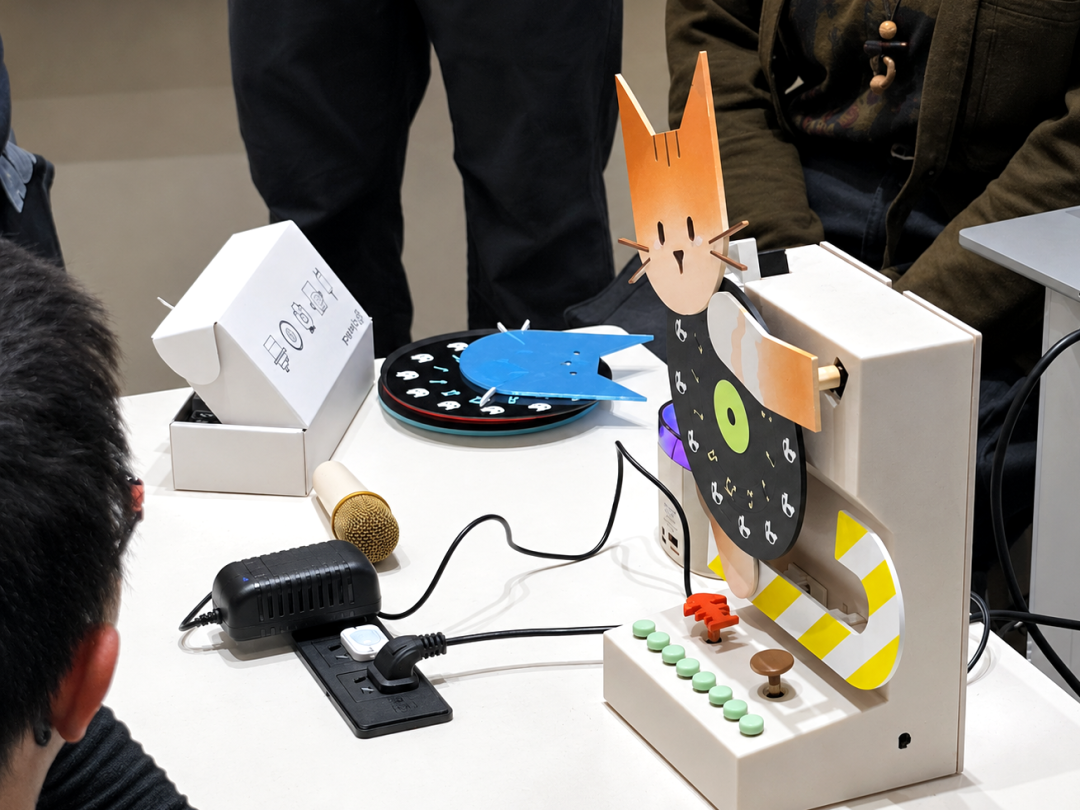
DJ Cat, an interactive student project combining 3D printing and programming. Image courtesy of Xu Fanglei.
Professor Zhang Mangmang told me that the department began exploring partnerships with companies several years ago to encourage students to learn and experiment. “Ultimately, what matters most is their perspectives, their creativity, and their own ideas,” he said. CyberBrick, he added, helps students turn concepts into prototypes they can test and refine. He hopes to incorporate 3D printing into creative work across more courses.
At the event, one student explained that the team had moved from an integrated design to a modular one, separating the mechanical functions from the exterior appearance. The mechanical elements use a relatively standardized structure, while users can design and assemble their own outer shells. The course has made models, dimensions, and related materials openly available on Bambu Lab’s platform so that makers can reproduce and modify the projects.
For design education, this is the difference between making something that looks functional and making something that actually works. Founded in 2005, Tsinghua’s Department of Information Art & Design was among China’s early academic programs dedicated to integrating art and science. Over 21 years, it has grown into the academy’s largest department by student population and research scale, with areas of study including interaction design, emotional design, user experience, creative coding, and physical computing.
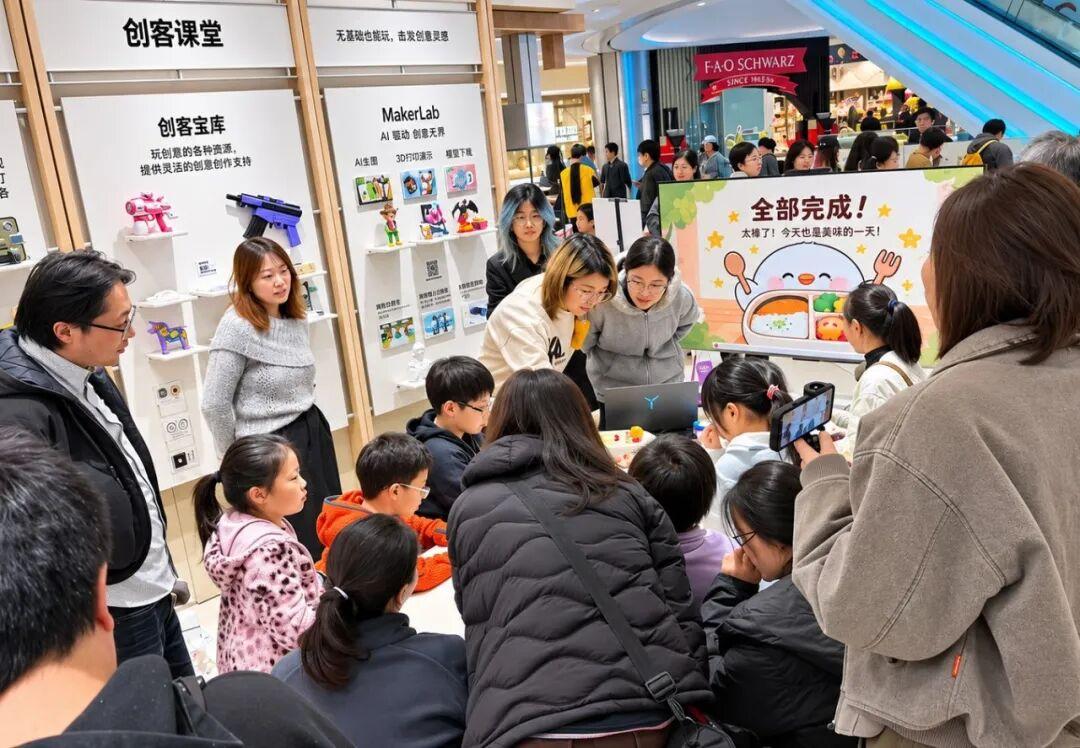
Families take part in hands-on activities at Bambu Lab’s Beijing store. Image courtesy of Xu Fanglei.
The course brought together interaction design, mechanical engineering, programming, and 3D printing, giving students a chance to apply these skills to real projects. It could also serve as a model for similar courses at other universities. The course also aligns with China’s Outline of the Plan for Building a Strong Education Nation (2024–2035), which calls for stronger integration of science, technology, and the humanities, as well as improved hands-on skills among students.
AI is making it easier to develop and explore new ideas, but students still need to find out whether those ideas work in practice. That’s where 3D printing, physical testing, and hands-on learning come in.
Combining 3D printing with modular programming systems makes it easier for students and makers to create their own interactive products. Instead of relying on ready-made toys or devices, they can design, print, assemble, and program their own creations. For Bambu Lab and Tsinghua’s Academy of Arts & Design, the collaboration shows how these tools can bring hands-on engineering and design into the classroom.
Images courtesy of Xu Fanglei
Subscribe to Our Email Newsletter
Stay up-to-date on all the latest news from the 3D printing industry and receive information and offers from third party vendors.
Upload your 3D Models and get them printed quickly and efficiently.