
What if doctors could find out whether a cancer drug would work on a patient before giving it to them? Researchers at the University of California, Davis (UC Davis) Health are working toward that possibility by combining bioprinting and artificial intelligence (AI) to test cancer treatments on miniature versions of patients’ own tumors.
UC Davis Health revealed that the team has already used its platform to examine more than 50 cases of prostate cancer and nearly 60 cases of bladder cancer, as well as several other types of cancer. The researchers also found that some drugs they thought wouldn’t work showed promising results when tested on the 3D bioprinted tumors.
Behind the research is Christopher A. Lucchesi, a cancer researcher and an assistant professor of urologic surgery at UC Davis Health who also serves as a research scientist at the U.S. Department of Veterans Affairs (VA) in California. For Lucchesi, who is himself a cancer survivor, the project is also personal.
One of the biggest challenges in treating cancer is that two patients with similar tumors may respond very differently to the same drug. If the first treatment doesn’t work, doctors may have to try another medication. In the meantime, patients can lose valuable time and experience side effects from a treatment that is doing little to help them. Lucchesi and his colleagues hope to reduce that uncertainty by testing different drugs in the laboratory before giving them to patients.
Printing a Patient’s Cancer
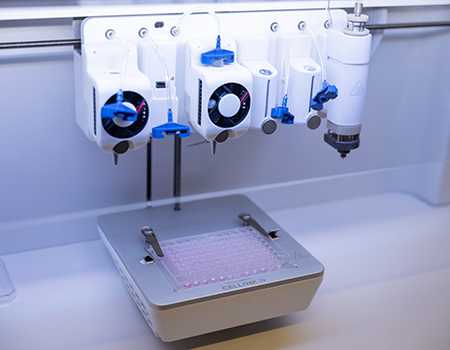
Using a specialized 3D printer, researchers deposit tiny droplets containing the patient’s tumor cells into a bioink, or hydrogel to create tumoroids. Image courtesy of UC Davis.
Working with the VA, the researchers collect tissue from biopsies or surgical procedures and separate it into individual cells. A specialized bioprinter then places tiny droplets containing these cells into a hydrogel, creating miniature living tumors called tumoroids.
“The easiest way to explain the concept is that it’s your actual primary tumor, just miniaturized,” explained Lucchesi. “We can actually test the therapeutics ex vivo, or outside of your body, before you actually are treated with anything.”
One particularly interesting part of the technology is that the team is trying to recreate more than just the cancer cells. According to the UC Davis Comprehensive Cancer Center, the bioprinting platform also preserves immune cells and stromal cells, which are part of the tissue surrounding and supporting a tumor.
This surrounding environment, known as the tumor microenvironment, is important because cancer cells do not exist on their own. How they interact with nearby cells can affect how a tumor grows and responds to medication. By keeping these different types of cells, researchers hope to create laboratory models that better reflect what is happening inside a patient’s body.
The platform is also designed for high-throughput research, meaning scientists can create many tumor models and use them to test different treatment options. For bioprinting, this is a particularly interesting application. Instead of trying to recreate an organ for transplantation, researchers are printing small pieces of living tissue that can help them better understand an individual patient’s disease.
Giving AI Predictions a Real-World Test
Along with the bioprinting platform, Lucchesi’s team has developed an AI-powered system that examines different types of patient data to identify potentially effective drugs.

Urology researcher Chris Lucchesi in his lab with biological 3D printers. Image courtesy of UC Davis.
However, a computer prediction alone is not enough to know whether a treatment will work. This is where the printed tumoroids come in. They give researchers a living model on which they can test individual drugs and combinations of drugs, while observing how both cancer cells and the patient’s immune cells respond.
The findings reported by UC Davis show why this approach could be particularly useful. Some of the laboratory results were different from what researchers had expected based on the molecular makeup of the original tumor. In other words, watching how living cells respond to a drug can reveal information that studying their molecular makeup alone may miss.
For oncologists, having access to both types of information could eventually help them identify more treatment options for individual patients, especially those whose cancers have not responded to standard treatments.
Prostate and bladder cancer have been the main focus of the team’s work so far. However, researchers have also investigated tumors originating in the kidney, lung, liver, and head and neck. The range of cancers studied suggests the technology could be useful beyond urology. However, the platform is still in the research phase, and further studies are needed to figure out how well it can help doctors choose treatments for patients.
What’s more, the technology is still under development, and while the researchers hope to begin clinical trials, no timeline has been announced. An important next step will be finding out whether a patient’s response to a cancer drug matches the results seen in their bioprinted tumor. Researchers will also need to determine whether the entire process can be completed quickly enough to help doctors make treatment decisions.

Christopher A. Lucchesi and his colleagues analyze the makeup of a tumoroid. Image courtesy of UC Davis.
Much of the attention surrounding bioprinting has focused on the possibility of manufacturing replacement tissues and organs. But some of its most practical medical applications could come much sooner, through the production of living tissue models that help doctors make better decisions.
For Lucchesi, the ultimate goal is to identify an effective treatment earlier, potentially reducing healthcare costs and, more importantly, giving patients back something that is especially precious when facing a cancer diagnosis.
“Because we could potentially get patients treated with the correct drug on the first try, saving money and time,” Lucchesi said. “Time matters for cancer patients.”
Subscribe to Our Email Newsletter
Stay up-to-date on all the latest news from the 3D printing industry and receive information and offers from third party vendors.
Upload your 3D Models and get them printed quickly and efficiently.