
We’re once again in lovely Singapore. This time, the National Additive Manufacturing Innovation Cluster‘s (NAMIC) Global Additive Manufacturing Summit (GAMS) has a clear focus on AI. Many panels are dedicated to AI or have a side of it. The event was opened by Dr. Chaw Sing Ho, who welcomed everyone, and the theme was “building resilient industries with additive manufacturing and AI.” Chaw Sing spoke about Apple’s scaling of additive manufacturing in consumer electronics. He felt that there was a need for more real-world outcomes and applications. Along with industrialization, he stressed that standards development is crucial going forward. Sing spoke of Singapore’s strong industrial base and its ability to collaborate across the nation and beyond.
Next was guest of honor Shawn Huang, Senior Parliamentary Secretary at the Ministry of Finance and Ministry of Manpower, who spoke of COVID-related supply chain interruptions and the need to quickly build up additive manufacturing capability in the country. He said NAMIC had brought together industry, innovation and technology to meet this national challenge, and he was grateful for the partnership and friendship with Sing during those trying times.
Looking ahead, Huang spoke of an uncertain future with expanded competition. AI and AM can be a solution for a small nation to adapt to changing circumstances. He believes that AM is delivering real-world impact across Singapore. Huang also stressed the need for job skills and the development of technicians and engineers. Upskilling engineers in government and industry was also seen as an important way to strengthen the workforce.
Next, NAMIC and ASTM International announced a partnership to develop standards. The effort will look at AM, AI, and robotics. After this, there was an announcement of a memorandum of understanding between NAMIC’s Additive Innovation Center, ATC Globe Holdings, Forefront AM, and GD Precision.
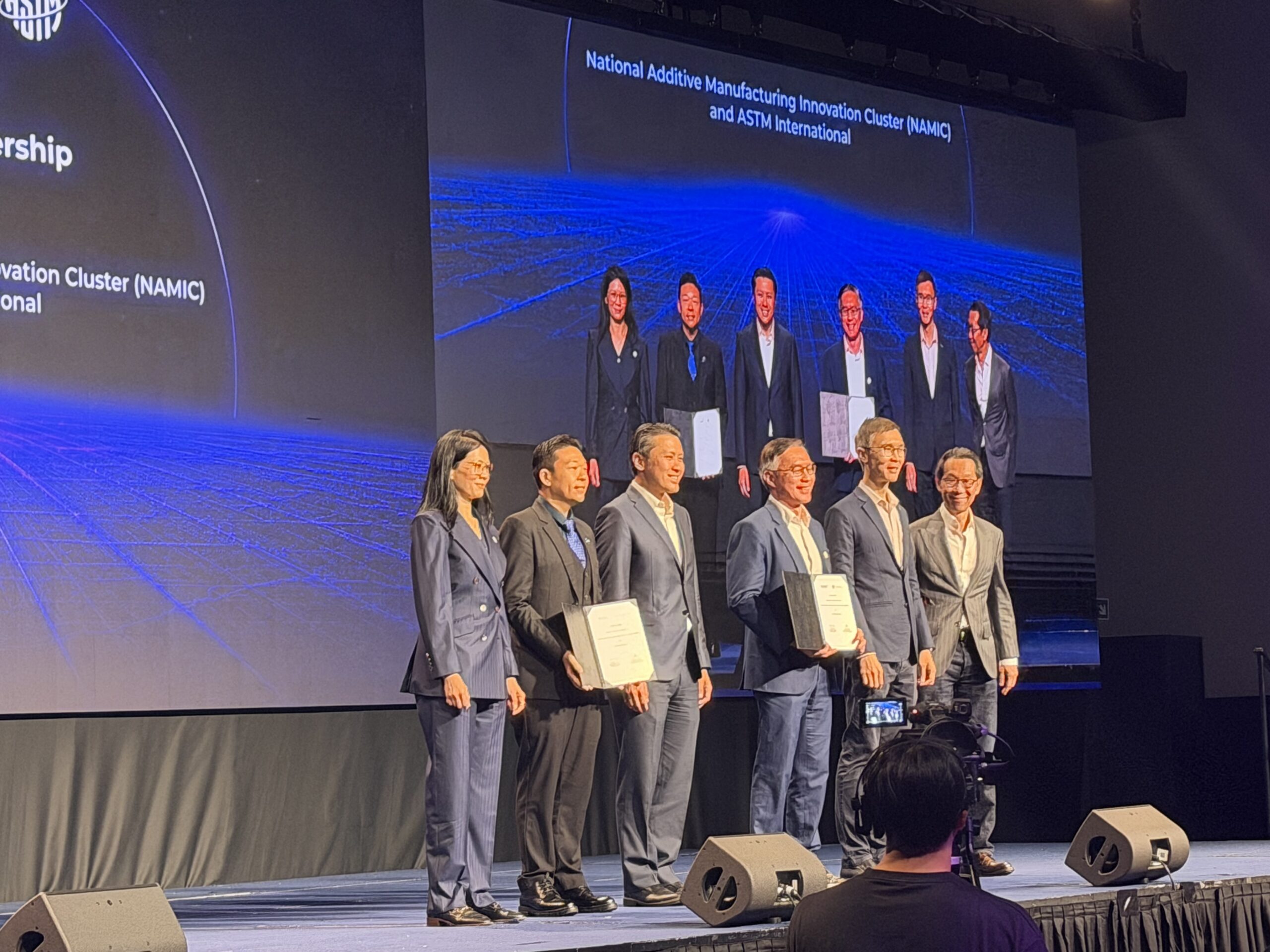
Representatives of NAMIC and ASTM International at the partnership announcement during GAMS 2026 in Singapore. Image courtesy of 3DPrint.com/Joris Peels.
Next came the keynote from Arno Held, who picked up where he left off at Additive Manufacturing Strategies 2026 (AMS 2026), where he had pointed out some uncomfortable issues with the additive manufacturing industry. He spoke about AM Ventures and explained that he had sold his shares in the firm and was now a “free man.” As he put it, “I have nothing to sell to you, just my view.”
His presentation reiterated many of the points he made at AMS. He said that AM was not underfunded but underpopulated. He suggested that only three companies would survive and the rest would either die or pivot. He pointed to binder jetting being under one roof and a machine tool company walking away from additive manufacturing.
To him, these things are not a failure of 3D printing but rather a natural move. Held also argued that the scale of the industry is moving east. He spoke of Creality attracting a lot of interest and a 76% rise in industrial metal 3D printer shipments from China. He also highlighted growth in defense, as well as aligners, hearing aids, and insoles. According to Held, these applications have succeeded because there was no alternative. He argued that the winners own the application and don’t see themselves as additive manufacturing firms. He sees strong opportunities in thermal management and liquid cooling for data centers, sustainment and spare parts in times of need, refractory metals for applications like hypersonics, and the energy and grid sectors.
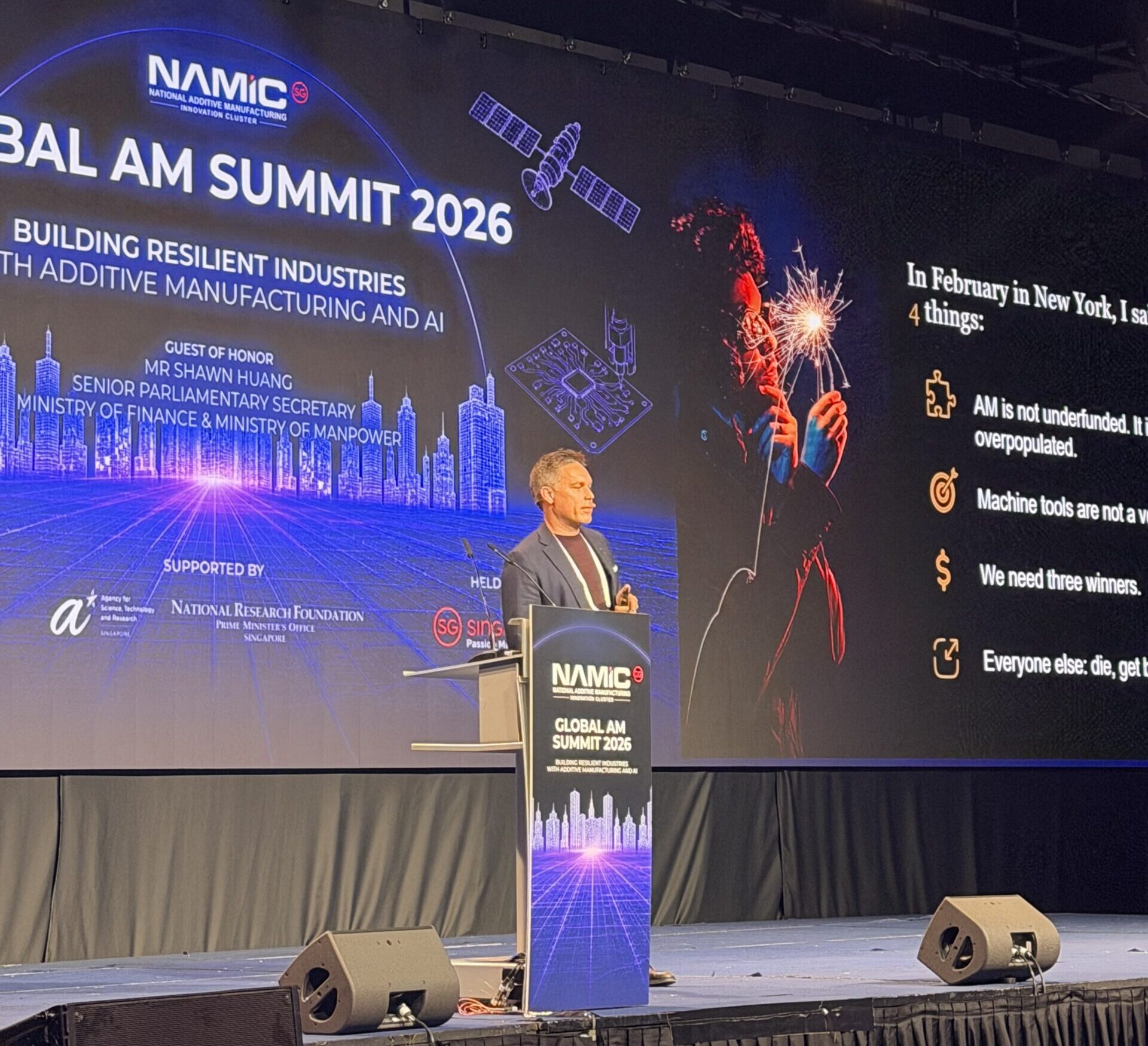
Arno Held speaks at NAMIC 2026. Image courtesy of 3DPrint.com/Joris Peels.
In cooling, he thinks there is no alternative to AM. Bad applications fail faster with additive, which he sees as part of an industry growing up. Arno also pointed out that additive was a technology built to ignore borders. However, the landscape is changing, particularly when it comes to export controls. Geopolitics is also helping additive, and he believes the industry is in the best place he’s seen. For Held, whoever owns the qualified process data will be the winner, whether it’s a company or a group.
Then we had a panel with Held, Kitty Wang of SynaCore, Michael Agam of Tulip Interfaces, and Chee Teck Lee of Moveon Technologies. I moderated the panel, and we discussed collaborating in a divided world, resilience, and the role of AM and AI. We explored whether AI could introduce new dependencies, particularly when relying on tools that could go offline and leave users unable to recreate their work in the same way. Agam pointed out that 80% of traffic was from open models, which could help ameliorate this concern. We also talked about how CNC and other processes could work well with additive manufacturing, as well as how AI could make it easier to exchange data. Different modes of working together were discussed, along with where AI would make the most sense.
Karsten Heuser talked about boats being made with additive manufacturing. He also explained how AI and AM were helping Adidas. Then he detailed how “industrial-grade AI” was right now happening at and through Siemens. Then Julian Rascal of the Airbus Tech Hubs explained how Airbus went from low-rate prototyping to low-rate production. He mentioned that Airbus has over 10,000 metal parts flying. It was interesting to see so many different views. We can really see how people are struggling with the rapid change worldwide. Additive seems to be part of the answer, and we stand to profit from this uncertainty. Increasingly, the additive answer seems to be populated by AI.
Karsten Heuser talked about boats being made with additive manufacturing and explained how AI and AM were helping Adidas. He also detailed how “industrial-grade AI” was already being used at Siemens. Next, Julian Rascal of the Airbus Tech Hubs explained how Airbus went from low-rate prototyping to low-rate production. He mentioned that Airbus has over 10,000 metal parts flying. It was interesting to see so many different views. We can really see how people are struggling with the rapid pace of change worldwide. Additive seems to be part of the answer, and we stand to profit from this uncertainty. And AI seems to be playing an increasingly important role in that answer.
Subscribe to Our Email Newsletter
Stay up-to-date on all the latest news from the 3D printing industry and receive information and offers from third party vendors.
Upload your 3D Models and get them printed quickly and efficiently.