
In a recent post, I argued that solid rocket motors (SRMs) are the first big scaling challenge for 3D printing in a real-world production environment that supports the US military. A new contract for Nikon Advanced Manufacturing (Nikon AM) from the Pentagon — while not directly related to SRMs — may suggest how optimistic US military stakeholders are about 3D printing’s ability to enable domestic SRM production.
Equally, it demonstrates how optimistic the Pentagon is concerning Nikon AM’s ability to accelerate munition deliveries currently challenged by long lead times. The company will be developing and delivering multiple units of its Nikon SLM Solutions NXG-E system, customized with two-meter z-heights. The machines are intended for mid-bodies of Tomahawk Land Attack Missiles (TLAM), although the military may be interested in utilizing the machines for additional applications down the road.
Nikon AM’s contract falls under the Cornerstone Other Transaction Agreement (COTA) category, a special subset within the OTA mechanism — itself a unique mechanism allowing the US military to do business outside the conventional budgetary process — established in 2018. Managed as part of the Industrial Base Analysis and Sustainment (IBAS) program, COTA contracts are used to optimize the path to production-readiness for strategically critical infrastructure.
In an interview I did over the summer with Hamid Zarringhalam, the CEO of Nikon AM, he specifically mentioned Tomahawks as among the best candidates to benefit from increasing the US defense sector’s “large-format metal AM” adoption. Now, going back to what I said about SRMs: while Tomahawks don’t rely on SRMs alone, they do use them as part of the initial launch process.
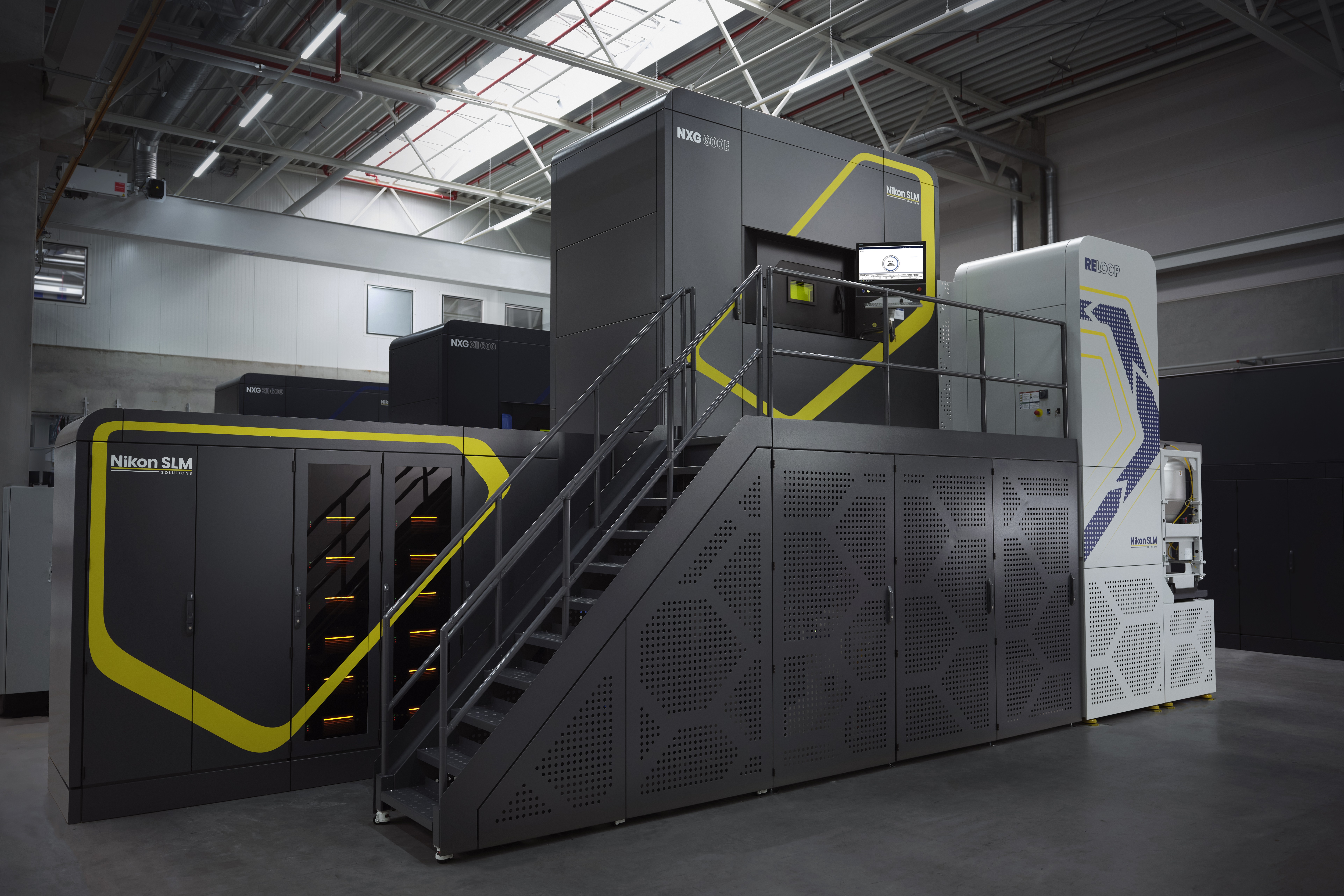
Nikon SLM NXG 600E.
While there’s no specific timeline yet for Nikon AM’s delivery of the customized machines, the fact that the contract falls within the COTA purview would seem to indicate that the military wants them fairly quickly. As I mentioned in my SRMs post, the military’s buildup of 3D printing for the SRM supply chain primarily has to do with the polymer machines that are required for propellant. But the fact that Nikon AM is being contracted to produce Tomahawk components means that there are plans to ramp up metal AM production for additional components in the missile supply chain.
This is important for at least two reasons. First, as I said in the opening paragraph, it’s a signal that the US military anticipates that the AM-enabled SRM buildup will be successful: it’s hard to imagine that the Pentagon would be seeking to use AM to fill demand for even more missile components, components that are arguably much more difficult to produce than propellant grains, if it didn’t have faith that its AM adoption was on the right track. And, secondly, it illustrates that the US AM industry is on the path to eating a meaningful chunk of the conventional supply chain associated with one of the US defense sector’s most sought-after weapons systems.
That’s relevant far beyond the US military itself. Even now, when only four US allies can acquire Tomahawks, filling demand is enough of a challenge to require the sort of innovation represented by the Nikon AM COTA. But two of those allies — Japan and the Netherlands — only recently reached agreements to acquire Tomahawks, which will obviously add to supply-chain challenges. And, finally, other nations, most notably Ukraine, are also looking to get their hands on them.
Of course, a primary rationale for using AM in this context is that it enables distributed manufacturing, which is another angle that makes Nikon AM a particularly noteworthy partner for the US military. If, at some point, Japan starts producing parts domestically for the Tomahawks it purchases from the US, the comfort level of such an arrangement for all parties involved would no doubt be enhanced by the involvement of the US subsidiary of a major Japanese conglomerate.
Images courtesy of Nikon AM
Subscribe to Our Email Newsletter
Stay up-to-date on all the latest news from the 3D printing industry and receive information and offers from third party vendors.
Upload your 3D Models and get them printed quickly and efficiently.