This year’s RAPID+TCT trade show is in full swing in Boston this week, and we already have plenty of news to share with you, from a simulation and optimization platform for metal additive manufacturing (AM) and in-process quality assurance (IPQA) to new materials, 3D printers, and more.
PanOptimization Exhibiting PanX Metal AM Simulation & Optimization Platform
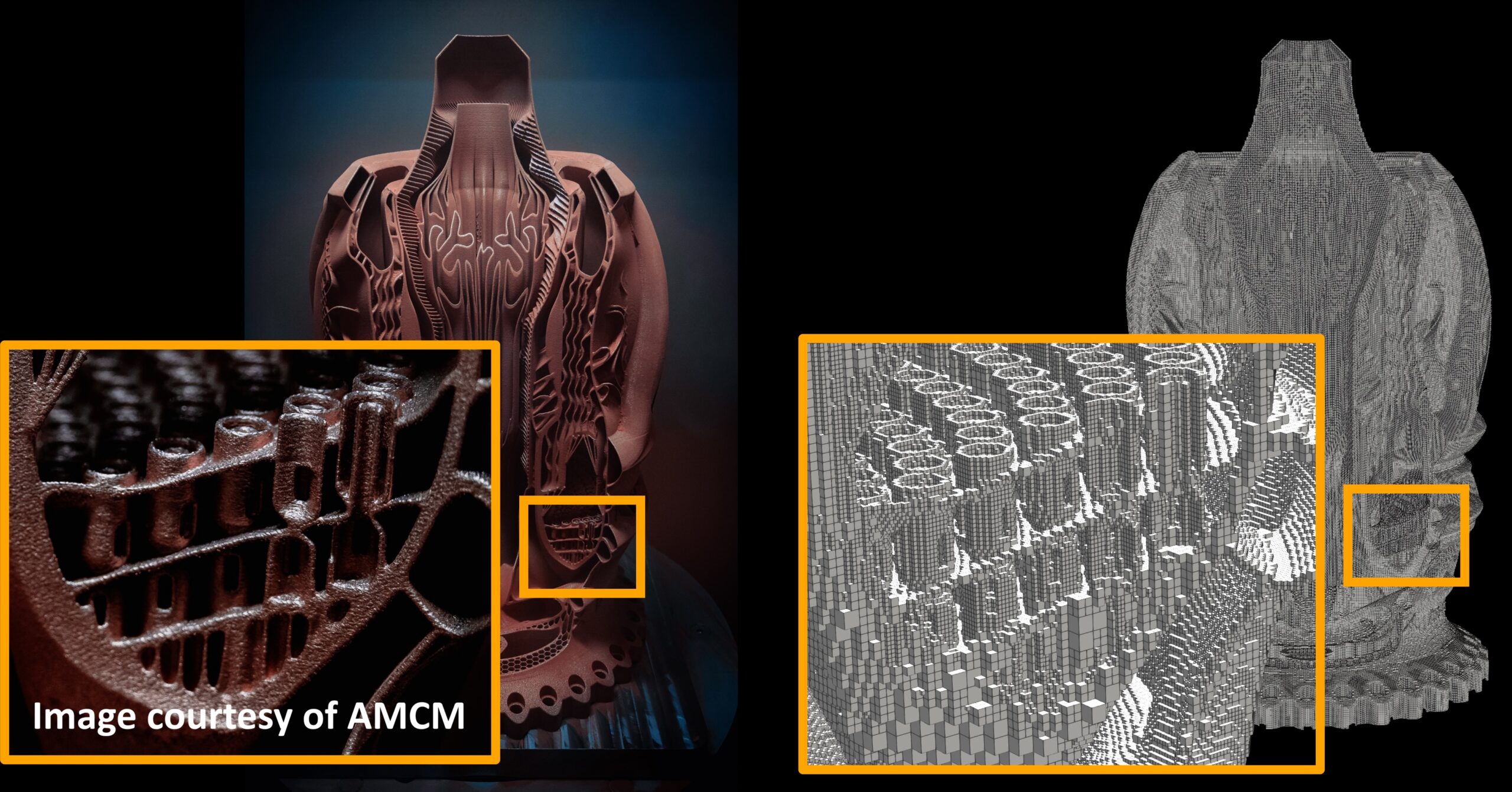
PanX full-part LPBF aerospike simulation at high refinement: 26M elements / 57M nodes.
First up, PanOptimization will be exhibiting its PanX simulation and optimization platform for metal AM and invites attendees to share their most challenging geometries and build problems for laser powder bed fusion (LPBF) and directed energy deposition (DED). The company says that many traditional simulation approaches for part distortion and failure mode prediction aren’t addressing the market’s needs well enough, because these tools were built mainly to predict distortion and stress trends on small- to medium-sized parts; parts with large footprints and high geometric complexity can’t be simulated at the necessary resolution. The team would like to hear from you at RAPID if “your current toolchain struggles to give timely, actionable insight.” PanX can simulate and optimize thermal and mechanical build issues with high accuracy at full scale and plugs right into existing production software toolchains to directly interface with machine OEM print software. They can even set you up with a free trial of PanX, so you can learn how to shorten development cycles and reduce risk.
“The metal AM market continues to move in the direction of larger and more complex geometries, which has created very large demand for scalable and accurate simulation capabilities. These types of parts cost well over a hundred thousand dollars to print, so the cost of failure is unacceptable,” said Erik Denlinger, Co-Founder and Chief Engineer at PanOptimization.
“At RAPID + TCT, PanOptimization will highlight the value of production-grade simulation and optimization. For manufacturers pushing into larger, more complex metal AM components, the ability to simulate and improve build outcomes is increasingly tied to commercial outcomes, fewer failed prints, faster progress toward qualification, better machine utilization, and reduced risk.”
PanOptimization will be at Booth #2142 at RAPID this week.
Additive Assurance Demonstrating AMiRIS In-Process Quality Assurance
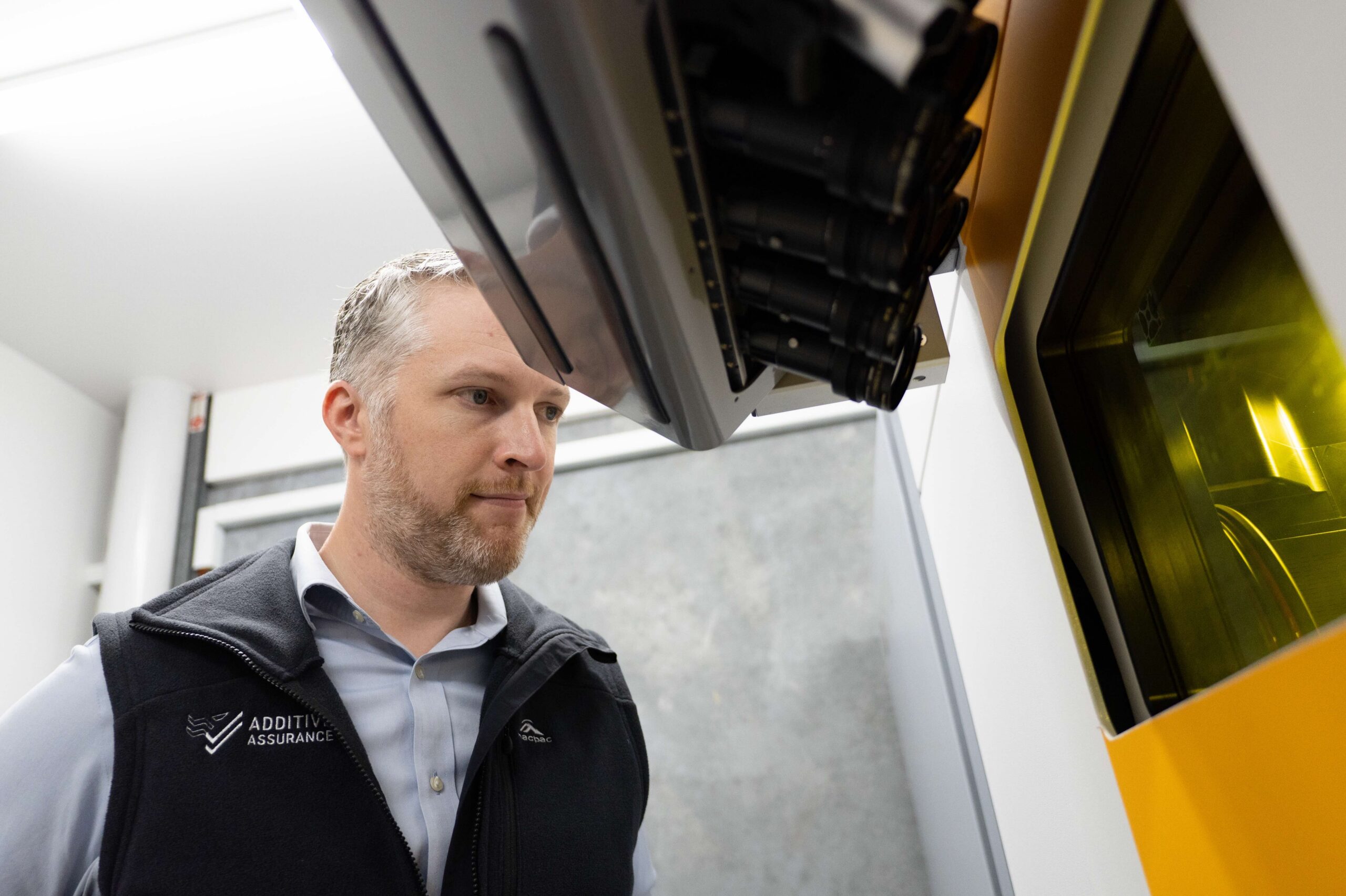
Aussie company Additive Assurance will bring its “decision-ready” AMiRIS in-process quality assurance (IPQA) system to RAPID, so manufacturers can learn to use it to validate LPBF builds as they are being made. There are in-situ approaches out there that only offer ambiguous answers, but Additive Assurance says AMiRIS was designed to create truly usable evidence “Quality, Operations, and Certification stakeholders can act on, trace, and defend.” Moving past generic print monitoring, the company offers its “assurance” to support build decisions like what to release, what to hold, what to investigate, and what to audit, without bringing about an overhaul of current quality systems. By validating builds as they’re actively being made, manufacturers can find and fix issues early on, and AMiRIS also enables automatic evidence generation.
“In metal AM, quality isn’t a final inspection activity — it’s a production capability. The goal is simple, give teams the confidence to scale, by putting reliability and repeatability at the heart of the build process, not at the end of it,” said Marten Jurg, Co-founder and CEO of Additive Assurance.
RAPID attendees having a hard time with long qualification cycles, surprise print issues late in the game, and/or costly inspection bottlenecks are invited to visit Additive Assurance at Booth #2636.
Stratasys Expands Software & Materials Platform
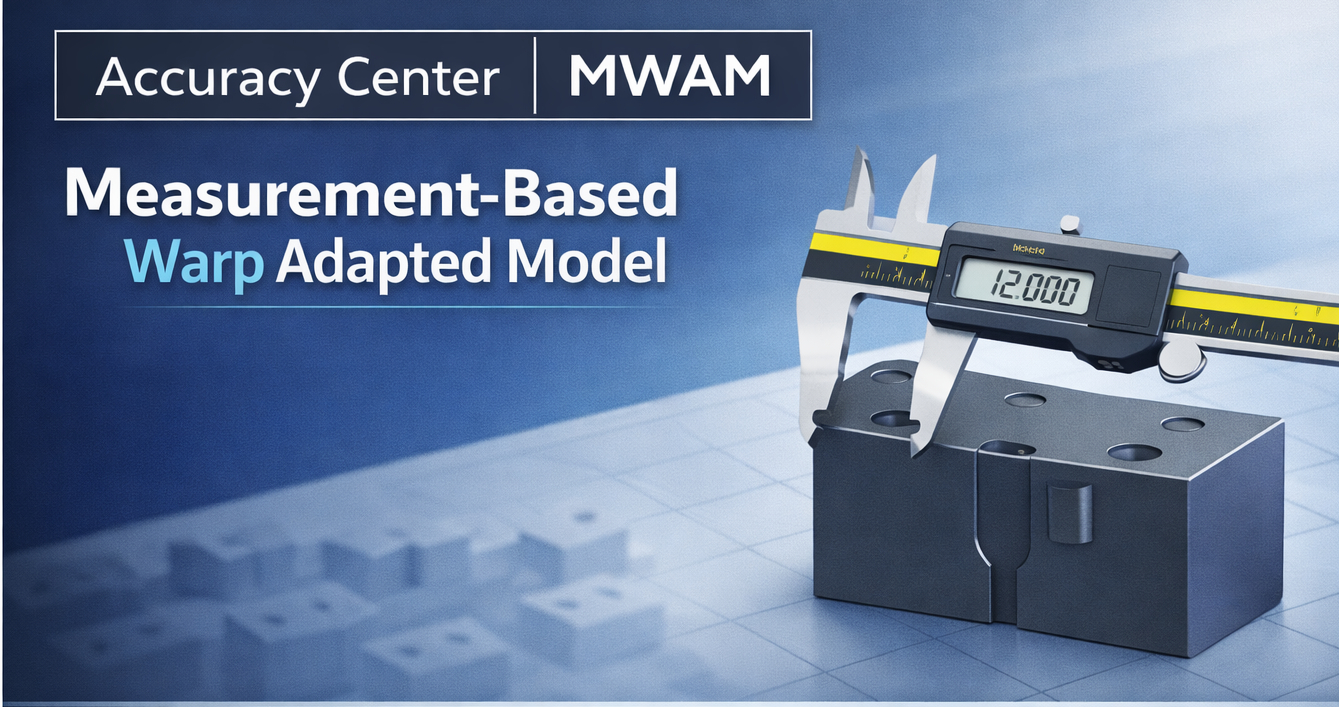
To improve accessibility and expand applications for its existing systems, Stratasys announced additions to its AM solutions portfolio ahead of RAPID, including some new materials and a software enhancement for GrabCAD Print Pro. First, ULTEM 1010 resin is now available as a filament for the F3300 printer. This material was optimized for composite tooling and makes it possible to print high-temperature, aerospace-grade parts with great heat resistance. Stratasys also rolled out photocurable materials for real-world applications, including P3 Deflect 110 resin for printing production parts like brackets, automotive connectors, and jigs and fixtures, and Loctite 3D IND3785 Low Migration with injection molding-quality surface finish for small-batch production in food and pharmaceutical applications; both of these are for the Origin system. For the J3 and J5 systems, Stratasys introduced PolyJet ToughONE White for durable prototypes and PolyJet ToughONE Black for application testing and functional demonstration parts. The new Somos WaterShed White for SLA-driven Neo printers offers a smooth surface finish for functional test models and industrial prototypes. Finally, Stratasys integrated Measurement-Based WAM™ Warped Adaptive Modeling (MWAM) into GrabCAD Print Pro. This software addition will use measured dimensional data to automatically correct warping in complex parts, like industrial fixtures and electrical connectors, printed on the Origin DLP platform.
“These innovations are designed to solve real challenges manufacturers face when adopting or scaling additive manufacturing. We are committed to continuous investment and development across our portfolio, working closely with customers to reduce barriers to adoption and unlock the incredible value that additive manufacturing can provide throughout the whole production workflow,” said Rich Garrity, Chief Business Unit Officer, Stratasys.
See demonstrations of its software and hardware, and learn more about the new materials, at Stratasys’ Booth #1601 at RAPID.
ELEGOO Showcasing Jupiter 2 Resin 3D Printer & New Ecosystem Products
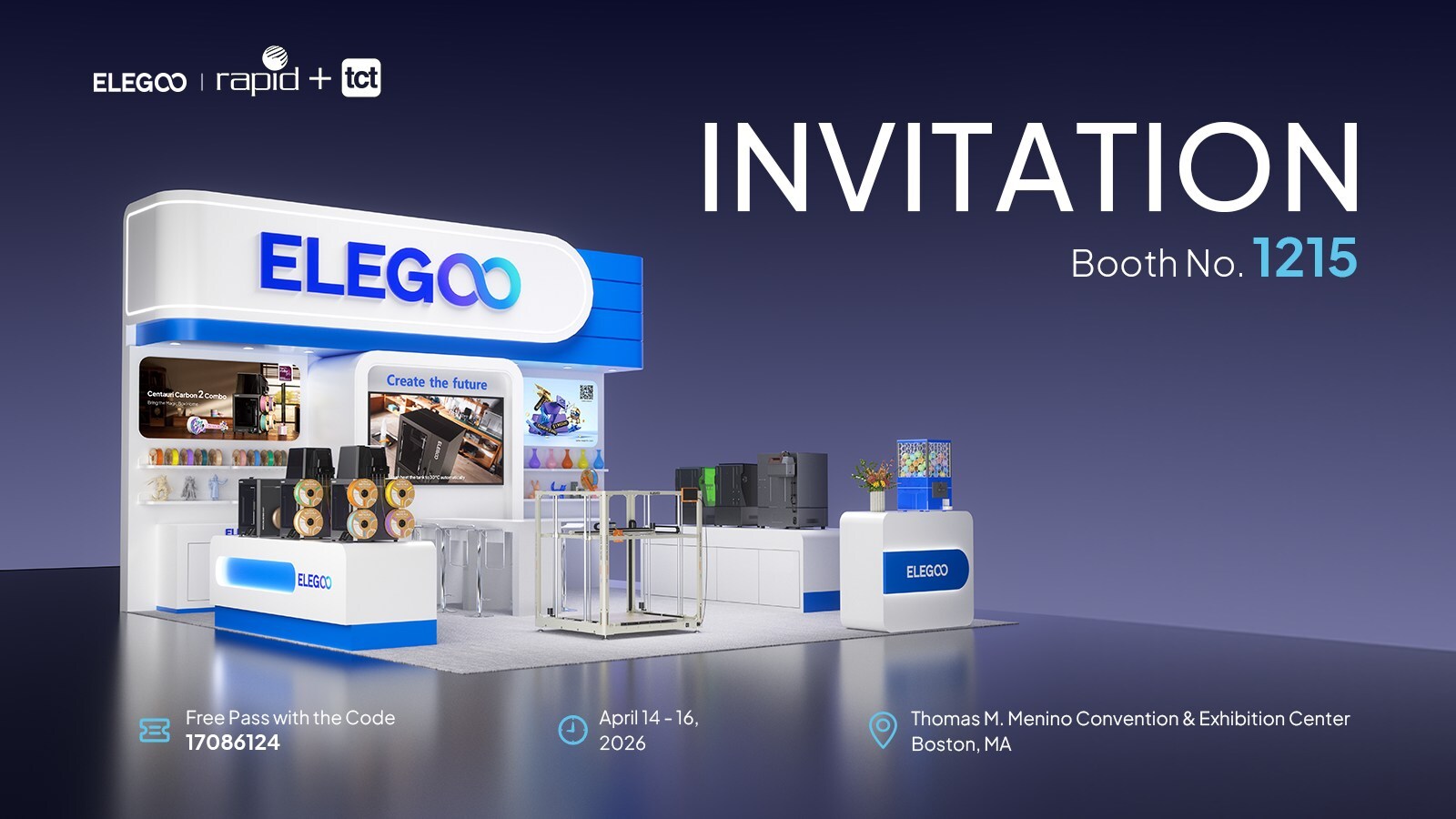
Shenzhen-based ELEGOO will be showcasing its newest large-format resin 3D printer, the Jupiter 2, at RAPID this week, along with new ecosystem products. The company will also present several real-world applications from the consumer, creative, and professional sectors that were completed by the new Jupiter 2 and some of its other printers. With a build volume of 302.40 x 161.98 x 300 mm and a double door design, the Jupiter 2 was developed to meet the demand for larger, more precise resin 3D printing. Users can produce larger models or batch-print multiple parts in a single job by leveraging the Jupiter 2. The printer actually debuted at RAPID 2025 in Detroit, so if you missed it last year, make sure to check it out in Boston this week.
ELEGOO will also present several hero products, including the Centauri Carbon 2 Combo, Saturn 4 Ultra 16K, and OrangeStorm Giga, along with related accessories and filaments. Also present at the booth to complete its integrated ecosystem will be the company’s remote control Matrix APP and the Nexprint 3D model platform. ELEGOO will also feature a range of application-driven displays to show how 3D printing can be used to achieve practical outcomes for real-world products. Some of the featured models include dental models, gaming figures and props, functional storage solutions, jewelry prototypes, large robotic builds, and everyday accessories, like phone stands. The company will also host a special “Print What You Scan” event from 6:30-9:30 pm on April 15th at the Westin Boston Seaport District. In addition to Q&A sessions and community activities with creators, visitors will see how 3D scanning is integrated with 3D printing to achieve even more real-world applications.
Visit ELEGOO at Booth #1215 this week.
Solukon Presenting SFM-AT350-E for EOS M4 ONYX Compact Parts
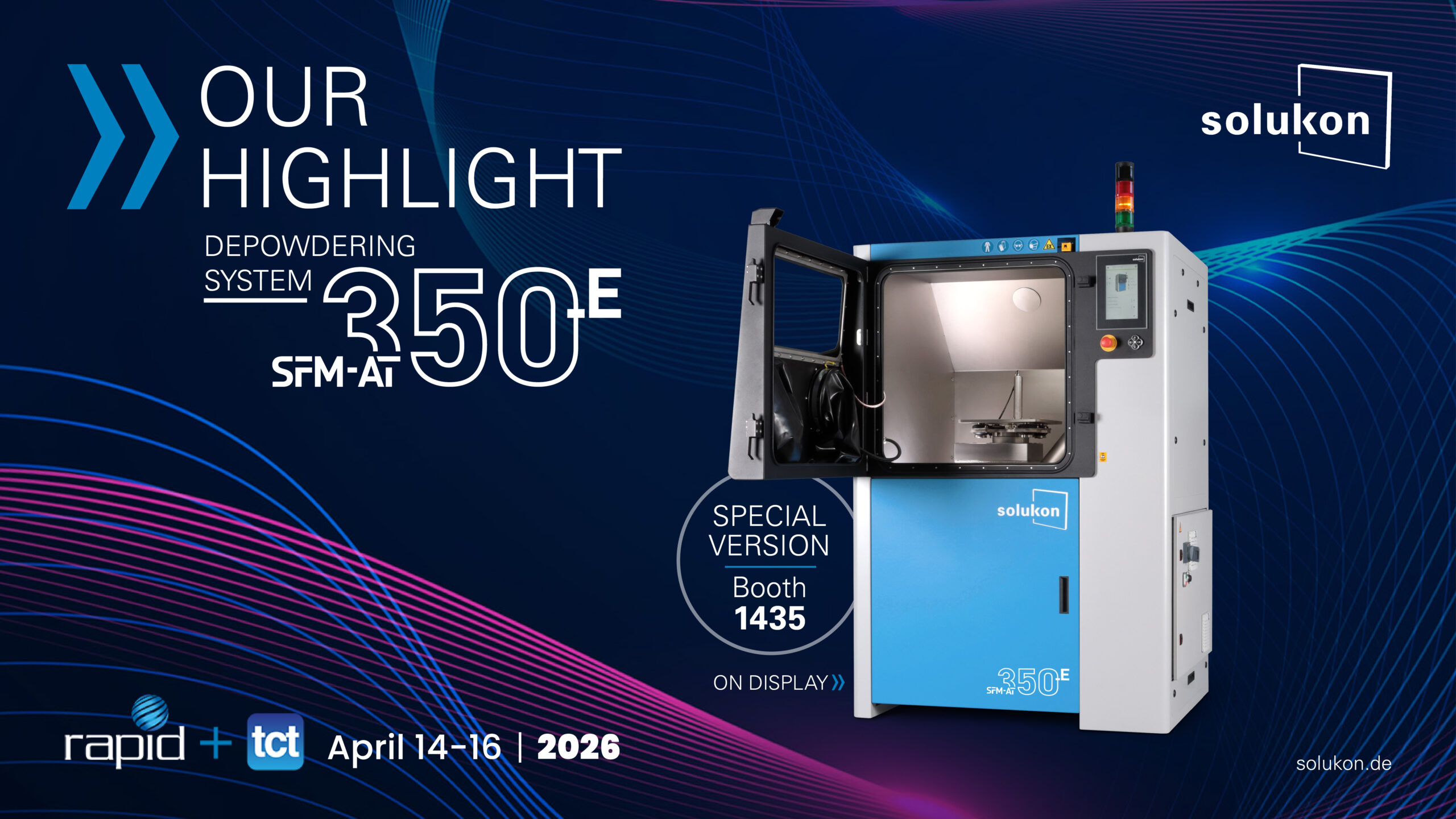
At Formnext 2025, EOS launched the EOS M4 ONYX 3D printer, with a significantly larger build volume from the previous M400-4 system. Now, for the first time at RAPID, Solukon will be presenting its SFM-AT350-E, a special configuration compatible specifically for the M4 ONYX. This “super-compact” system is for depowdering ONYX parts with a z-height < 250 mm and weighing up to 100 kg. The company claims to offer “the best cost-footprint ratio” of any depowdering system currently on the market. But it’s important to note that this system is specifically for compact prints. If you have larger parts, even if they were printed on the EOS M4 ONYX, you should use the larger SFM-AT800-S and SFM-AT1000-S depowdering systems.
A major advancement in post-processing for AM is ultrasonic depowdering for delicate medical components, like spinal cages and other sensitive implants. This effective but gentle cleaning process can remove residual powder from parts with complex geometries without causing any issues to the surface quality or structural integrity. Solukon can now process these kinds of medical parts through the integration of its SFM-AT350-E depowdering system. At RAPID, the company will showcase titanium 3D printed spinal implant cages being actively processed within the system.
Meet Solukon, and see the SFM-AT350-E for yourself, at the company’s RAPID Booth #1435.
Subscribe to Our Email Newsletter
Stay up-to-date on all the latest news from the 3D printing industry and receive information and offers from third party vendors.
Upload your 3D Models and get them printed quickly and efficiently.