Maintenance and interiors aircraft giant Lufthansa Technik is exploring 3D printing at greater depths, hoping to take its customers to the heights they’re accustomed to. A team at Lufthansa Technik made a titanium LPBF latch to replace a damaged polymer one. Usually, in 3D printed MRO, we try to go the other way, implementing lighter-weight, cheaper polymer parts in place of metal ones. In this case, a specific latch kept breaking.
Any time parts break on aircraft, the resulting repair can be costly. It could delay a flight, or a plane may actually have to be unused for a while for repairs. Meanwhile, not doing this may expose safety issues or make a classy airliner look dingy. Even if a metal 3D printed component is much more expensive than a polymer alternative, making it more durable may solve a lot of downtime and repairs, saving a lot of money in the end. And customer experience-wise, for the airline, interruptions and a reduction in the customer experience will bring further advantages. In this case, the part was not available for purchase, expediting the need for a solution.
-
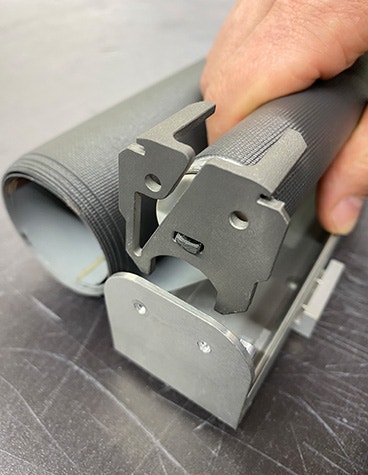
- Close-up of the 3D printed titanium latch. Image courtesy of Materialise.
-
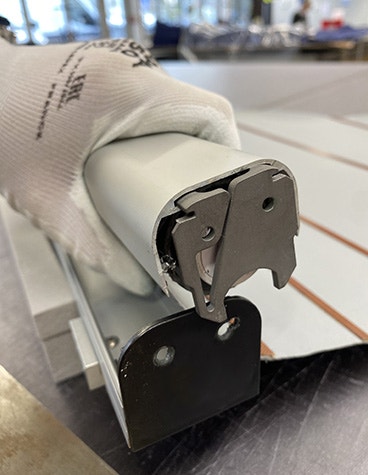
- 3D printed titanium latch installed in the aircraft roller shutter. Image courtesy of Materialise.
-
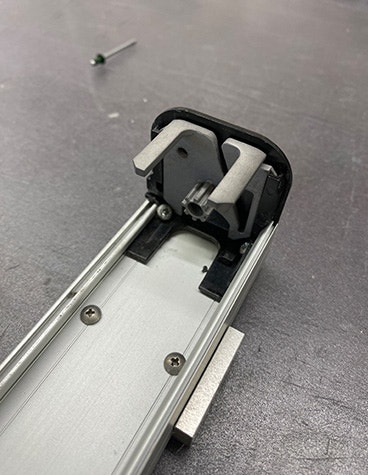
- 3D printed titanium latch inside the roller shutter mechanism. Image courtesy of Materialise.
The new part was made in Ti6Al4V in an EN 9100 process using Technik’s EASA Part 21. G and 21. J certification, while the part was a latch for a roller shutter. The part in question is in use on the A330, A340, and A380. The latch inside the roller would wear out and malfunction, requiring the entire roller shutter to be replaced. The supplier also wouldn’t allow Lufthansa Technik to buy the replacement component on its own. By making a replacement part, the entire shutter would last longer, while if it did break in the future, the company could just use a new printed part rather than buy a shutter. Lufthansa can do this because of the company’s ability to self-certify.
Project Engineer at Lufthansa Technik David Rudolz stated,
“The original part was an injection-molded polymer component with a complex geometry. It was immediately identified as an ideal candidate for metal additive manufacturing.”