
Hardware is rapidly commoditizing across additive manufacturing. Specifications have converged. Price competition has intensified. Margins have compressed. For companies attempting to scale additive manufacturing beyond prototyping, this shift has profound consequences.
Yet within this competitive landscape, some companies are building durable advantages that grow stronger each year. The differentiating factor is no longer the machine itself. It is the software layer that transforms commoditized hardware into intelligent manufacturing systems.
The Bambu Lab Proof Point
No example illustrates this shift more clearly than Bambu Lab. In roughly 3 years, the Shenzhen-based startup captured a significant share of the global FDM market. The conventional narrative credits aggressive Chinese pricing. This interpretation misses the point entirely.
Bambu Lab did not win by inventing novel hardware. Stepper motors, linear rails, and heated beds are widely available to anyone and easily replicable. What they built was a superior software experience based on automatic calibration, AI failure detection, and seamless cloud integration. Setup that once took hours now takes minutes, and the software makes 3D printing effortless.
The consequences for established Western OEMs have been severe. Companies that had dominated for decades saw their positions collapse. Better kinematics and superior thermal management provided no defense against a competitor whose software simply worked better. Hardware differentiation alone proved increasingly insufficient.
Software Compounds. Hardware Depreciates.
Hardware businesses face a structural challenge: every machine shipped begins depreciating immediately. Competition drives prices down, components commoditize, and this cycle repeats.
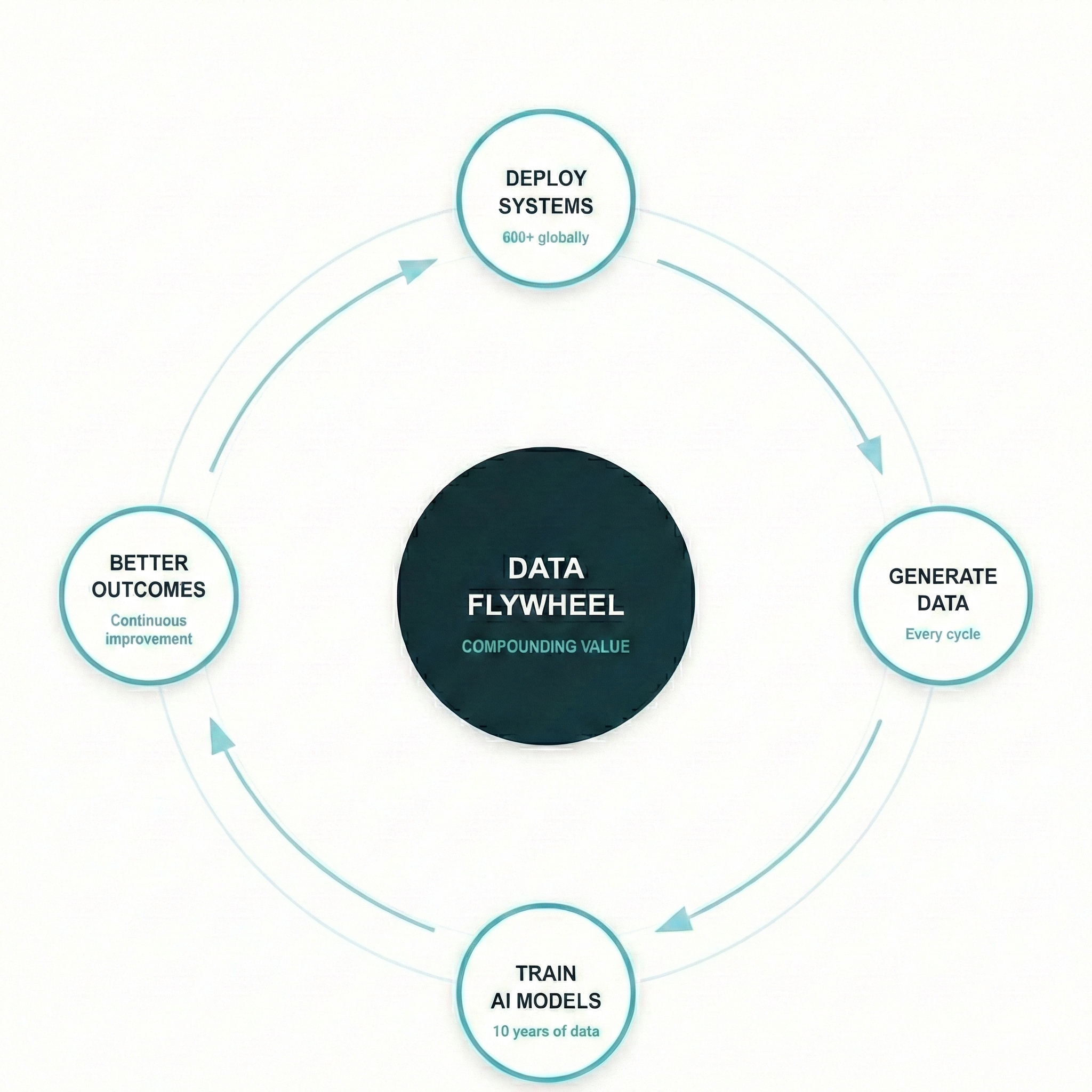
Software operates under fundamentally different economics. Each deployment generates data. The data improves models and processes. Improved performance attracts more customers, which in turn generates more data. The flywheel accelerates.
A competitor can reverse-engineer hardware in 18 months. They cannot reverse-engineer ten years of compounding process data.
At AMT, our 650+ systems across 40 countries continuously generate proprietary process intelligence. Thermal profiles, chemical concentrations, cycle parameters, and failure modes are captured across different production environments. Every edge case our systems encounter makes the entire platform smarter. The machines matter, but they increasingly serve as a means of data collection and intelligence deployment rather than the primary source of value.
From Selling Machines to Selling Outcomes
The software layer also transforms commercial models. Traditional hardware sales force customers to bear all risk: CapEx purchase, maintenance contracts, downtime costs. The vendor’s incentive ends at the point of sale.
AI-enabled, data-driven systems change this equation. Real-time monitoring and predictive analytics allow vendors to offer outcome-based models such as pay-per-part pricing, guaranteed uptime SLAs, pricing that flexes with actual usage and performance. The vendor can confidently underwrite these models because AI predicts failures before they occur and optimizes processes continuously.
This shifts the total cost of ownership dramatically in the customer’s favor while creating recurring revenue for vendors. Hardware-only companies cannot offer this because they lack the data infrastructure to understand how their machines perform in the field. The software layer enables commercial models that hardware alone never could.
Our Mission: Finish Manual Finishing
At AMT, we have made this transition. We think of ourselves now as an AI company with a hardware delivery model. Our mission is to deliver intelligent surface finishing for autonomous manufacturing. Our vision is simple: to finish manual finishing.
And we practice what we preach. Internally, AMT runs on custom AI systems, from customer service to HR to operations. We’re not just selling AI-enabled products. We’re an AI-enabled company. Top to bottom.
This perspective influences everything we build. The same intelligence that optimizes customer processes informs how we operate internally, reinforcing a feedback loop between deployment, learning, and improvement.
Three Questions That Reveal Real Value
When evaluating any manufacturing company, as investor, customer, or competitor, hardware specifications now provide diminishing insight. We should ask ourselves instead:
1. Where does the intelligence live? In hardware that can be copied, or in software and data that compound over time?
2. What data compounds over time? Every hour of operation should make the system smarter.
3. Could Shenzhen replicate this in 24 months? If yes, there is no durable advantage.
The Path Forward
Manufacturing has always been about outcomes: parts that meet spec, delivered on time, at a cost that works. For decades, better hardware was the path to better outcomes. That era is ending.
The companies that will dominate the next decade are those building software platforms that guarantee outcomes, not just technically, but commercially. The machine becomes a node in an intelligent network. The data becomes the moat. The software becomes the product.
The question for every company in additive manufacturing: will you recognize this shift early enough to adapt, or will you be the next cautionary tale?
****
This article builds on ideas explored by Pawel Slusarczyk in Hardware alone is not enough (RECODE.AM #31). His analysis of software-defined manufacturing crystallized a thesis I’ve been developing since watching Bambu Lab reshape our industry. I recommend reading his original piece.
****
Joseph Crabtree is the founder and CEO of Additive Manufacturing Technologies (AMT), which he established in 2017 to enable additive manufacturing at scale through AI-driven automation and robotics in post-processing. With a background in Materials Science and Engineering and more than 20 years’ experience in aerospace, defense, and manufacturing, Joseph has led AMT’s growth into a profitable global hardtech company. Its patented PostPro technologies are now deployed in over 50 countries, helping manufacturers transition additive manufacturing from prototyping to true industrial production.
At Additive Manufacturing Strategies (AMS) 2026, Joseph will participate in a panel on “Advances and Trends in Software and Automation for AM” on February 24th, and give a talk about “The Commoditization of Hardware and the Rise of AI in AM” on February 25th. These sessions are part of the broader AMS 2026 conference, which brings together industry leaders, policymakers, and innovators from across the global AM ecosystem. Learn more and register here.
Subscribe to Our Email Newsletter
Stay up-to-date on all the latest news from the 3D printing industry and receive information and offers from third party vendors.
Upload your 3D Models and get them printed quickly and efficiently.