
If you walked the floor of any major additive manufacturing expo in 2025 — as a buyer, engineer, or exhibitor — the buzz was unmistakable. It wasn’t just hype; it was mechanical. High-speed stepper motors screamed across show floors as manufacturers competed to outdo one another with ever-higher print speeds. The so-called “Speed Wars” had reached their peak, with 600 mm/s proudly printed on booth graphics and product boxes alike.
But heading into 2026, the rules of the game have changed. Physics, reliability, and real-world usability have imposed a natural ceasefire. Speed has reached the point of diminishing returns. Faster is no longer better—it is simply expected.
As the industry gathers in Shanghai for TCT Asia 2026, a new narrative has taken hold. Speed is no longer a differentiator; it is table stakes. The real battleground for desktop 3D printing is shifting decisively from how fast machines can print to what they can print. Multi-color and multi-material capability — once niche, expensive, and experimental—is rapidly becoming the defining axis of competition.
As we prepare for TCT Asia 2026, the narrative has shifted. Speed is no longer a differentiator; it is a prerequisite. The new frontier for desktop 3D printing is not about how fast you can print, but what you can print. We are witnessing a paradigm shift from pure velocity to “Versatility”—specifically through the mass adoption of multi-color and multi-material 3D printing systems.
The Data Points to a Structural Shift
This transition is not anecdotal. Market data suggests a clear structural change in the desktop segment.
As recently as 2024, multi-material printing was positioned as a premium feature, limited to flagship models and advanced users. Today, market tracking across multiple regions suggests that more than 65% of desktop systems priced above USD 500 ship with some form of multi-material capability as standard. Looking ahead to the next product cycle, industry observers expect that roughly three-quarters of new desktop launches debuting around TCT Asia 2026 will emphasize multi-color or multi-material functionality as their primary value proposition.
However, rapid adoption has exposed a fundamental weakness in first-generation systems: efficiency. Early Automatic Material Systems (AMS) delivered visual complexity at the cost of speed, reliability, and — most visibly — waste. Excessive purge material, long changeover times, and inconsistent material handling undermined the promise of multi-color printing.
At TCT Asia 2026, attention will center on the manufacturers that claim to have solved this problem. Pre-show disclosures and early benchmarks point to a new generation of machines designed not just for visual impact, but for material discipline.
Four Machines That Define the Post-Purge Era
1. The Mainstream Optimization: Creality SPARKX i7
Exhibiting at TCT Asia 2026 — Booth No. 8E87
For the mass market, the goal is accessibility. Creality’s answer to the multi-material demand is the SPARKX i7, a machine that refines the AMS concept into something far more efficient.
The core innovation is the new CFS (Color Filament System). While maintaining the familiar form factor of a multi-color box, Creality has optimized the internal logistics to address user complaints about waste. Benchmark data indicate the SPARKX i7 reduces filament waste by 50% (dropping from a typical 648g to 320g in standard tests) while boosting material change speeds by 15%.
With features like RFID automatic identification and a sealed, moisture-proof environment, Creality is signaling that multi-color printing is no longer a “tinkerer’s” feature — it is a reliable, “set-it-and-forget-it” standard for the general consumer.
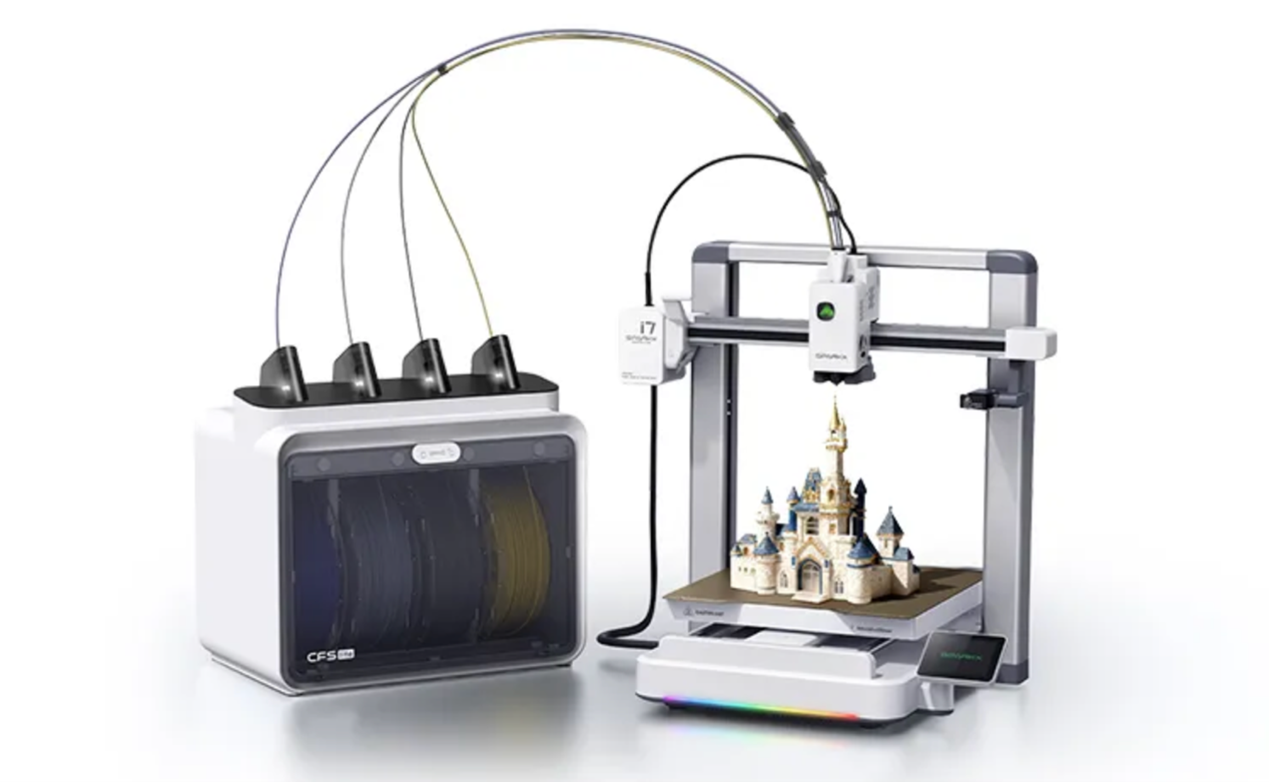
Creality SPARK i7. Image courtesy of Creality.
2. The Structural Innovator: Snapmaker U1
Exhibiting at TCT Asia 2026 — Booth No. 8D87
While others optimize existing structures, Snapmaker has reimagined the mechanics of material switching entirely. The Snapmaker U1 is set to be a mechanical highlight of the show, challenging the single-nozzle paradigm.
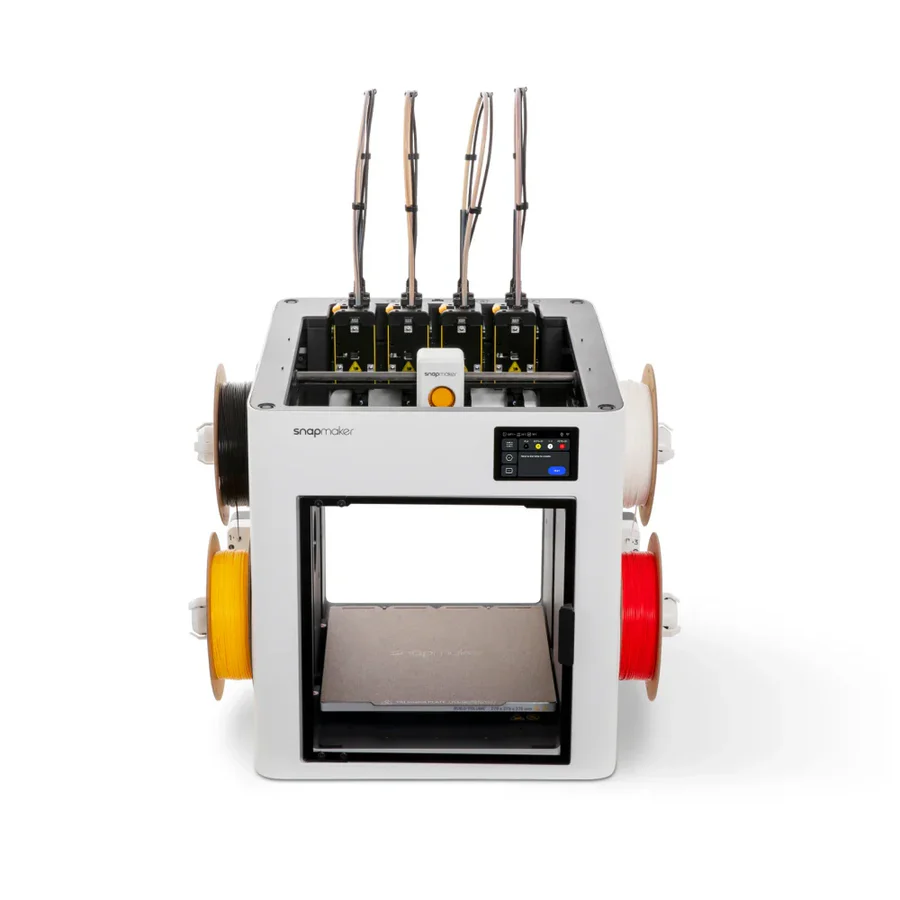
Snapmaker U1. Image courtesy of Snapmaker.
Instead of purging filament through one nozzle, the U1 utilizes the SnapSwap™ system, which manages four independent print heads. By pre-loading and pre-heating materials in separate heads, the machine achieves a swap time of just 5 seconds.
Crucially, this architecture eliminates the need for purge towers. Snapmaker claims this approach delivers material savings of up to 80% per print. For users tired of the “waste anxiety” associated with multi-color printing, the U1’s industrial-grade steel-ball locking mechanism offers a clean, efficient alternative.
3. The Productivity Beast: Bambu Lab H2C
Exhibiting at TCT Asia 2026 — Booth No. 8D25
Bambu Lab, the company that ignited the speed wars, is now targeting the “Prosumer” productivity market with the H2C. Their marketing is explicit: this is “not a toy.”
The H2C introduces the Vortek System, a radical departure from filament retraction. It features up to 6 induction-heated hotends that can physically swap and heat to 220°C in just 8 seconds.
This design is a direct response to the needs of engineers who require mixed materials (e.g., PA6-GF with soluble supports) without cross-contamination. The machine is heavily instrumented with 59 onboard sensors, ensuring reliability that rivals industrial equipment. In stress tests, the Vortek system generated a fraction of the waste seen in traditional systems (522g vs. 3000g), positioning the H2C as the definitive tool for small-scale manufacturing farms.
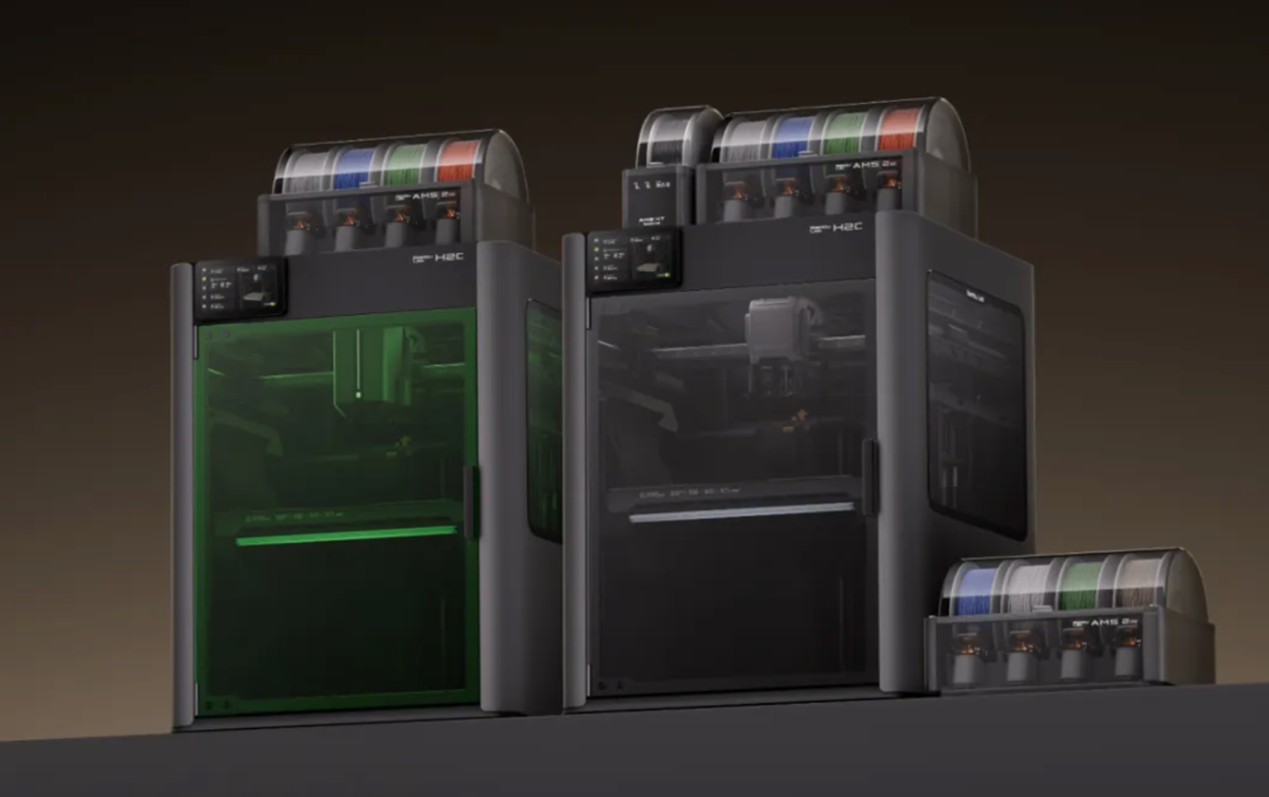
Bambu Lab H2C. Image courtesy of Bambu Lab.
4. The Future of Density: Atomic Form Palette 300
Exhibiting at TCT Asia 2026 — Booth No. 8F35
Finally, for those looking to see the absolute limit of desktop capabilities, the Atomic Form Palette 300 is the showstopper. Fresh from its debut at CES 2026, this machine redefines “capacity.”
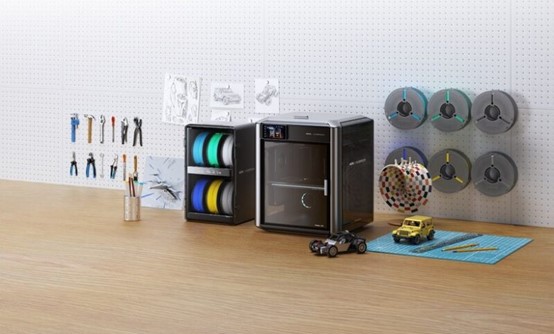
AtomForm Palette 300. Image courtesy of AtomForm.
The Palette 300 boasts a staggering 12 independent nozzles. Using their proprietary OmniElement™ system allows for the simultaneous use of up to 36 colors (mixing inputs per nozzle).
This “brute force” approach is managed by an intelligent array of 4 AI-driven cameras and 50+ sensors. Atomic Form claims a 90% reduction in waste compared to traditional switching methods. It represents the extreme end of the spectrum, proving that desktop machines can now handle complexity that was previously impossible outside of industrial additive manufacturing centers.
From Fast Plastic to Functional Production
The Speed Wars were a linear competition. The emerging Versatility Era is not. It introduces new dimensions of complexity, capability, and accountability to desktop additive manufacturing.
The machines highlighted here — from Creality, Snapmaker, Bambu Lab, and Atomic Form — represent only the most visible signals of a broader shift. Across the halls of TCT Asia 2026, hundreds of exhibitors will showcase complementary advances: high-performance materials, AI-driven slicing software, and post-processing systems designed to close the loop between prototyping and production.
The transition from fast plastic to efficient, functional manufacturing cannot be fully understood through spec sheets or videos alone. It requires context, comparison, and direct engagement. For engineers, designers, and manufacturers seeking to understand where desktop 3D printing is truly headed, Shanghai will not just host the conversation — it will define it.
Explore the full exhibitor lineup and register for TCT Asia 2026.
For readers looking to dive deeper into the latest machines and technologies featured at the show, more standout products and innovations can be found here.
Subscribe to Our Email Newsletter
Stay up-to-date on all the latest news from the 3D printing industry and receive information and offers from third party vendors.
Upload your 3D Models and get them printed quickly and efficiently.