I gotta say, the approach that EOS takes to machine development impresses me. Last year, when the OEM launched the M4 ONYX at Formnext, my post on the launch focused on how the metal 3D printer had “…extensive, wide-ranging input from the company’s user-base built into the design.” I think it’s safe to refer to that launch as a success, given that months later, EOS announced that Beehive Industries would spend $50 million on M4 ONYX units.
At this year’s Formnext, EOS launched another machine, this time a polymer system, the HELIOR. Different materials, same approach, and this time the company took things up a notch: it had the HELIOR validated by five pilot customers in advance of the launch.
As EOS’s polymer portfolio lead, Rüdiger Herfrid, told me in an interview ahead of the launch, just as with the M4 ONYX, the HELIOR was built to capitalize on everything EOS has learned throughout its long history in the AM industry, while simultaneously tailored as much as possible to precisely where the industry is currently headed:
“Even if this is a new machine with a new name, it’s built on the platform that we’ve had for ten years,” Herfrid said. “The experience of 10 years is in it. Some of the innovations, for instance, are already part of previous platforms. Then we improved it during the development phase with input from the pilot customers. We’re confident that we have a system with the reliability that customers have come to expect from us, and also that there’s brand new features they’ll be able to take advantage of, including the advanced software parameters.”
The input from the pilot customers, including familiar names like FKM, Prototal Group, and Materialise, all centered around what’s required to maximize ROI on an industrial AM system in a real-world production environment. Herfrid kept coming back to the need to design a machine around the reality that industrial customers want their machines running in 24-hour cycles:
“Our focus was always, what can a customer print in 24 hours?” he explained. “Contract manufacturers and service providers want to produce parts in a 12 or 24 hour cycle to maximize uptime.
“This means you have to be able to print six consecutive jobs in a row. We designed the HELIOR so that customers will have a very short change over time from job to job, so that they’re not losing time cleaning in between prints.”
That is also why the HELIOR features a build volume (700 x 380 x 580) that matches the P 770, which has the largest build envelope of any previous EOS polymer system. The HELIOR, though, also has three 70W lasers compared to the P 770’s two. The HELIOR is a workhorse.
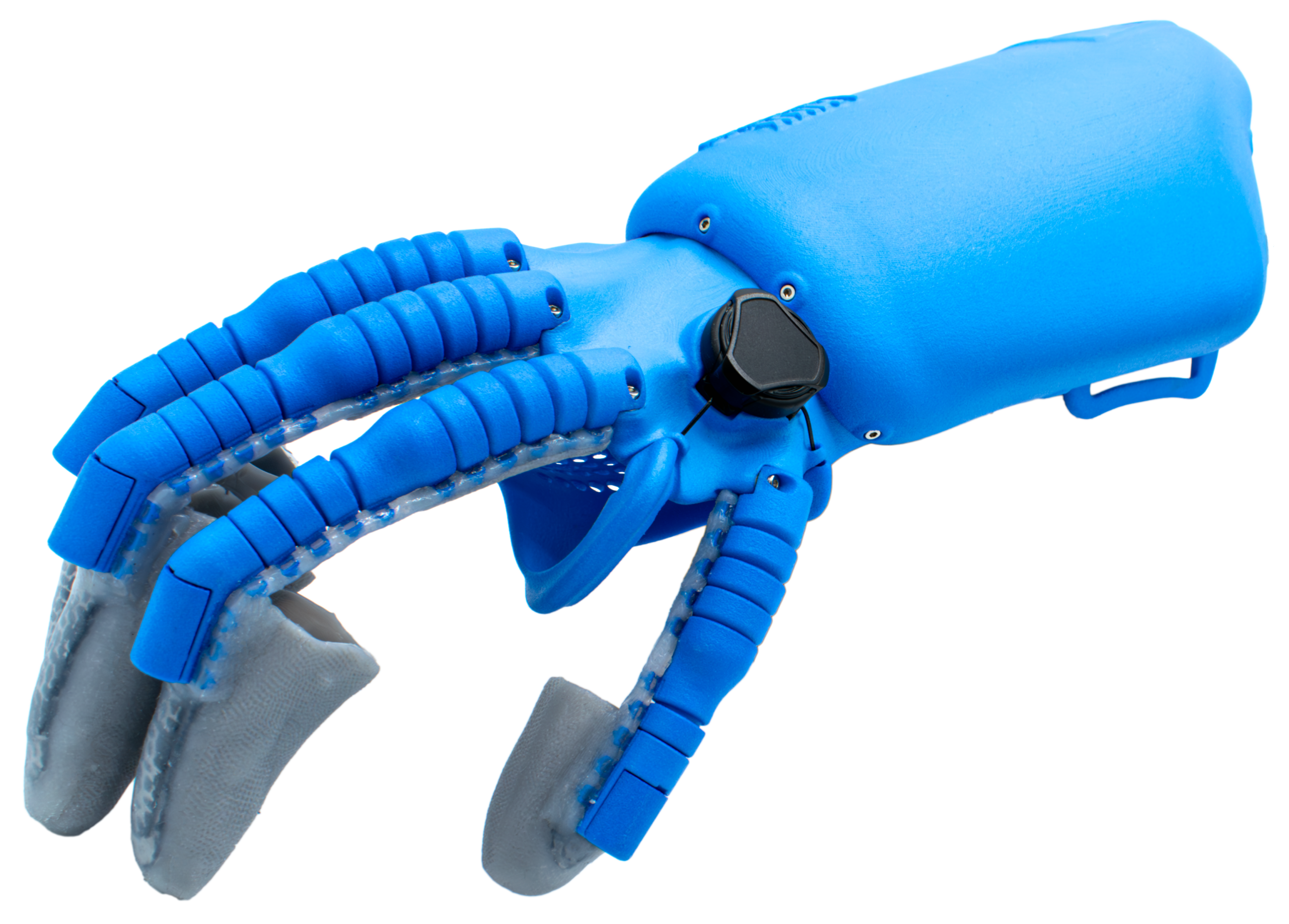
HKK Bionics’ exomotion hand one GEN2, a customized 3D printed hand orthosis manufactured through a collaboration with Formrise using EOS polymer technology. Image courtesy of HKK Bionics GmbH.
At the same time, it’s EOS, so quality control is still the paramount consideration:
“Build volume is important, but always focus on quality — that’s a big differentiator. The same customers that require a large build capacity need reliability for build after build, as well.
“This is the reason behind the new advanced exposure parameters, which are geometry dependent. You can imagine, if you have this big build frame, you’ll have differences depending on where the parts are in the build frame. The new software features adjust for that, so every part, independently from where it is in the build chamber, has the same properties — the same dimensional accuracy.”
Even with these other advantages, the shorter post-processing time may be the biggest selling point for potential customers. According to EOS, they’ve achieved up to 80 percent less post-processing time compared with earlier generations of EOS polymer systems. This is thanks largely to a new advanced roller coater, which is something that Prototal Group is especially excited about:
“As a contract manufacturer, we look at productivity across the complete process,” explains Markus Schrittwieser, Trends & Innovation at Prototal Group. “If we can increase the output of the machine while reducing the manual work required along the process chain, we can manufacture more with the same team.”
Meanwhile, Matthias Henkel, Managing Director of FKM Additive Manufacturing, is only one of the pilot customers who’s struck by the 24-hour cycle angle that Herfrid highlighted.
“For us, the key factor is that a new technology delivers measurable economic value in practice,” he said. “The higher productivity of the new system generation fits perfectly with our single-shift operation. We can complete a full build job every day and achieve significantly better machine utilization. This simplifies production planning and has an immediate positive impact on profitability.”
Another effect of EOS’s diligent planning ahead is that the first customers are already expected to receive their deliveries this month, so we should expect to hear about more use-cases in the months ahead. The company is also taking orders at Formnext, so stop by Hall 12.0, Booth D71.
Subscribe to Our Email Newsletter
Stay up-to-date on all the latest news from the 3D printing industry and receive information and offers from third party vendors.
Upload your 3D Models and get them printed quickly and efficiently.