It’s the final day of Formnext 2026! We’ve been bringing you news from the show floor all week, covering everything from software, services, and AI to panels, powder, post-processing, and, of course, 3D printers. Vanesa Listek already covered several of the large-format printer launches, and today I’ll tell you about a few other new printers.
Stratasys Unveils H550 SAF 3D Printer & PowderEase T2 Powder Handling System
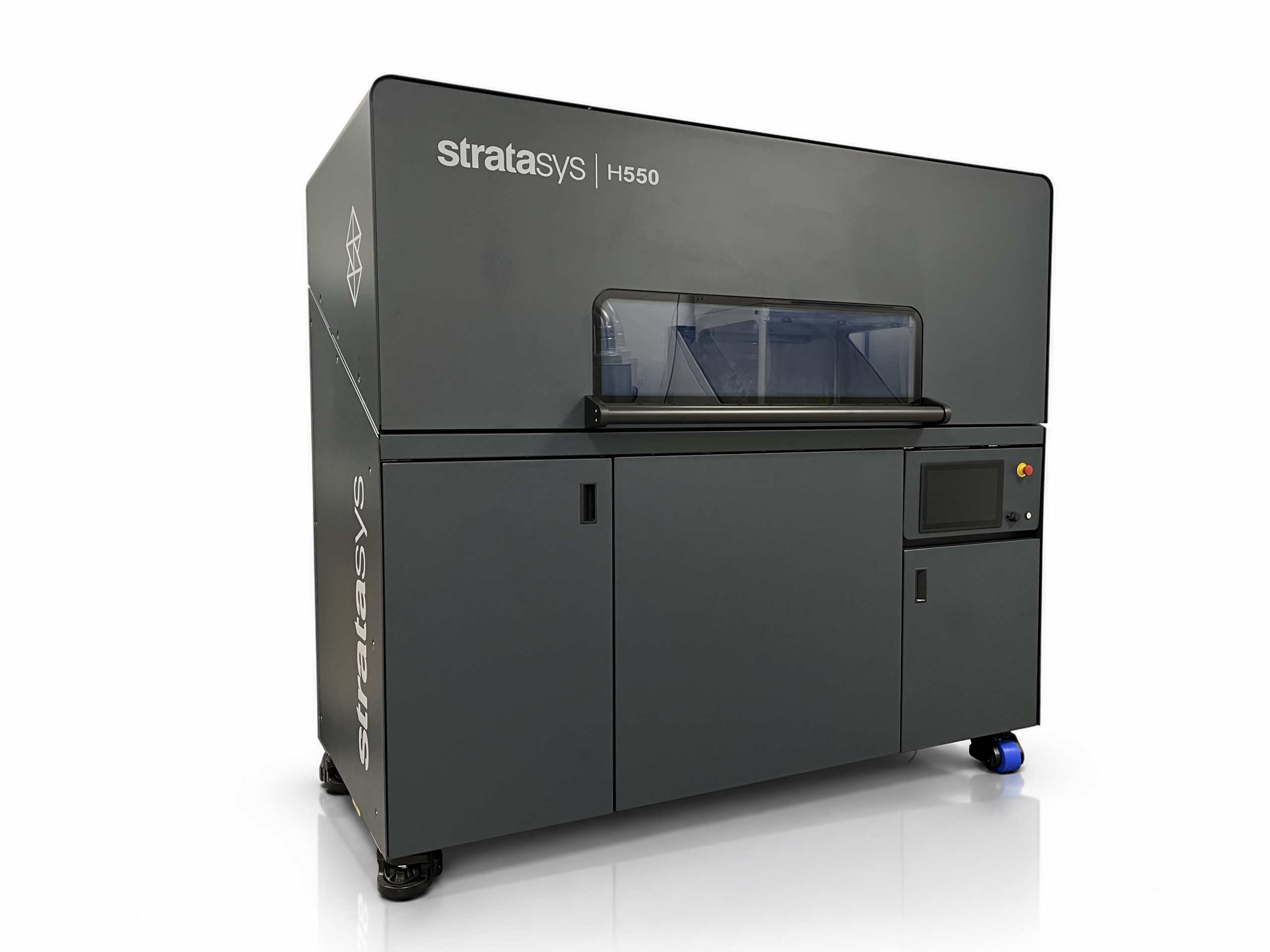
In addition to the European debut of its F870 3D printer, Stratasys also unveiled its new industrial H550 SAF 3D printer and PowderEase T2 post-processing system at Formnext. The addition to the SAF technology portfolio—with twice the build capacity of the H350—is specifically for manufacturers that want to scale for production and make larger parts, increase batch productivity, and improve economics of final parts production. The H550 will certainly help, with its 34.2-liter build volume, 450mm long axis, and fewer infrastructure requirements. Plus, Stratasys says the printer was designed to deliver up to 30% lower total cost of ownership (TCO) to comparable print-and-fuse systems, and faster time to part than comparable SLS printers. With its increased build capacity, the H550 can print larger parts, like automotive components, manifolds and ducts, and end-of-arm tooling (EOAT). Additionally, Stratasys unveiled the PowderEase T2, an automated powder handling workflow specifically for the H550. It supposedly only requires 30 minutes of operator time per build, and one station can support up to six H550 printers when they’re all using the same material, which will also help manufacturers scale their production.
“Longer parts than other print-and-fuse systems, faster than SLS, and at a lower total cost of ownership. With the H550, SAF is designed to give manufacturers a production system that provides the best available combination of part size, throughput and economics,” said Neil Hopkinson, Vice President SAF, Stratasys, and inventor of the technology behind SAF.
3D Systems Announces MJP 300, Powder Management, & Software Upgrades
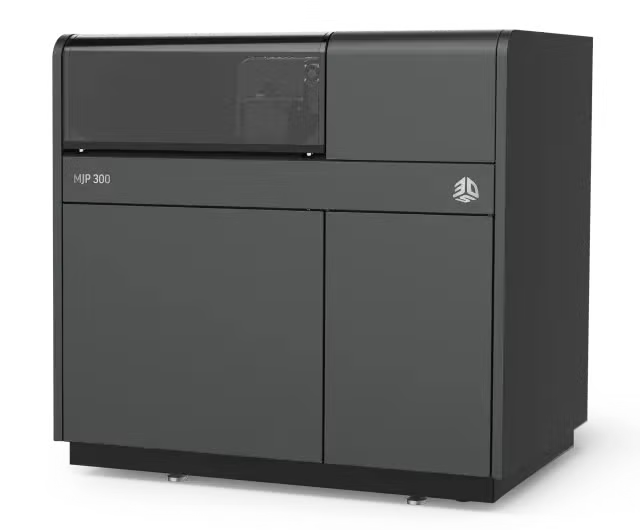
3D Systems had several new products to announce at Formnext, and the biggest was its MJP 300 multijet 3D printer, meant to achieve easier operation for rapid production of plastic parts. It features HD, UHD (Ultra HD), and XHD (extreme High resolution) build modes, enhanced cybersecurity to support ESA/IEC standards compliance, new software and fleet management tools, upgraded electronics for faster data processing, and more. Plus, the MJP 300 has the ability to grow large parts across its 294 x 211 x 144 mm build volume, meaning it can divide the volume into three lanes. 3D Systems also announced the TSR (Transport-Sieve-Reload) module, which is a closed-loop, mobile, powder management solution that can connect to DMP Flex 350 metal printers. The company’s professional 3D Sprint software was updated for new cybersecurity, and includes the .finite™ toolset for digital rights management, and a new Industrial Wax kit enables use of VisiJet Wax Jewel Red material for the MJP 300W Plus wax printer.
“We have spent the last eighteen months on targeted, focused investments in people, facilities, materials and technologies that reflect where the true growth and demand is for 3D printing – namely healthcare, dental, and aerospace & defense. As a result we have achieved numerous strategic milestones including the release of and clearance for the NextDent Jetted Denture solution, the release of the MJP 300W Plus wax casting pattern system, numerous FDA and EU clearances for 3D printed healthcare solutions, new Stereolithography platforms, and an expansion of our production facilities for aerospace & defense customers,” said Dr. Jeff Graves, President and CEO of 3D Systems. “These latest announcements at Formnext are a result of that targeted strategy and effort to deliver ground-breaking solutions to our customers.”
Prodways Launches New CERAM PRO 365 Max 3D Printer
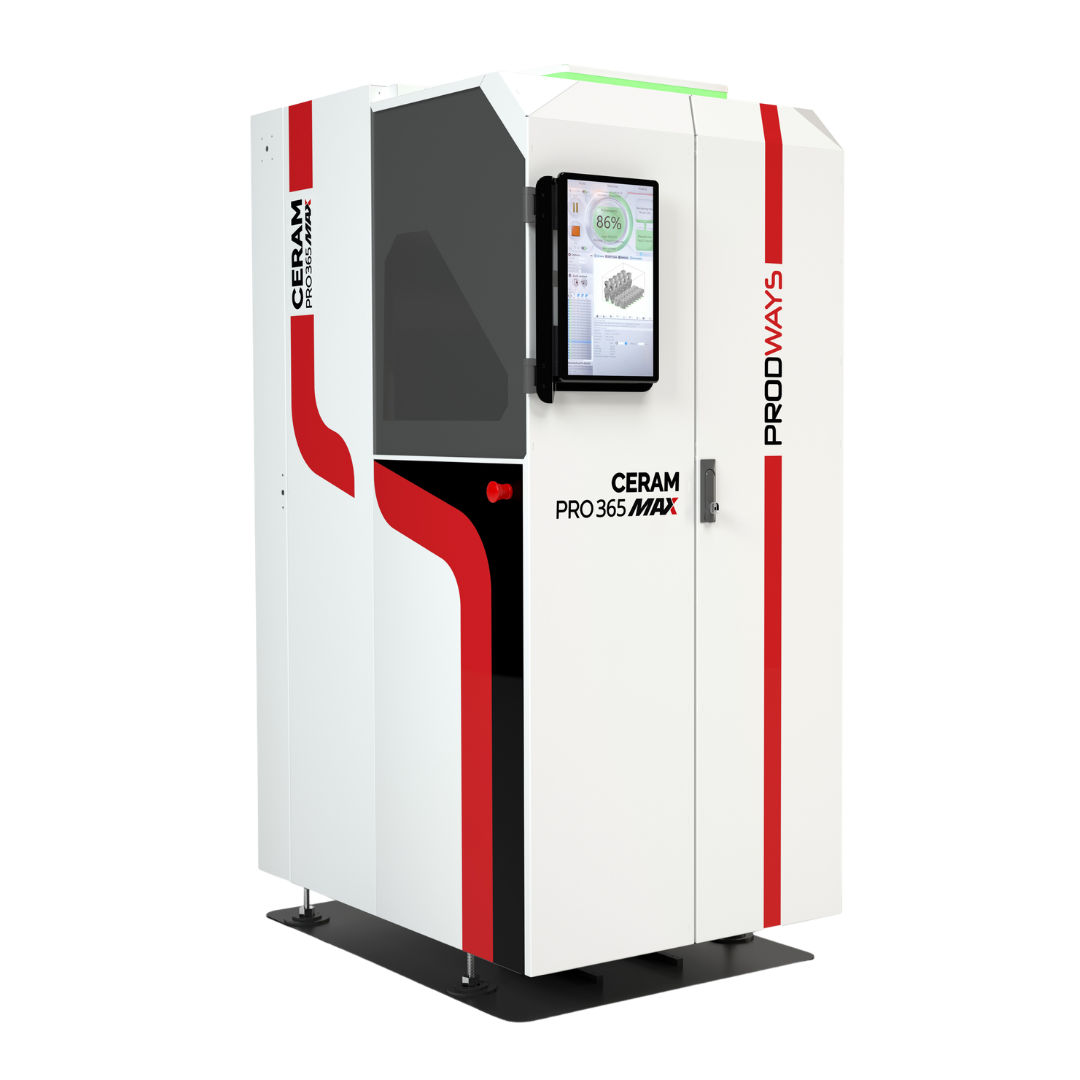
Ahead of Formnext, Prodways launched its new CERAM PRO 365 Max ceramic printer, with high resolution and a modular top-down build platform. It’s a high-performance configuration meant to increase the processing capabilities of the company’s CERAM PRO platform, and is meant for advanced material R&D, technical ceramic, and process qualification applications. It’s based on the company’s patented MOVINGLight DLP technology, and pairs a 264 x 328 x 350 mm build volume with 31 µm native pixel resolution. Because its projector delivers up to 200 mW/cm² of light intensity at 365 nm, the new CERAM PRO 365 Max offers an expanded processing window for demanding, highly absorbing ceramic formulations; there are also 385 and 405 nm versions available. The printer has a single DLP head, layer thickness of 10–100 µm, and a vat build height up to 350 mm. Finally, it’s compatible with Prodways’ SILICA SICAST 1200 and ALUMINA PHOTX A100.
“We designed the CERAM PRO 365 MAX with a clear goal: to give manufacturers and researchers more flexibility when working with challenging ceramic formulations. With up to 200 mW/cm² at 365 nm, this new configuration expands the possibilities for material and process development,” Prodways wrote in a LinkedIn post.
DWS Introduces Hybrid SLA Technology
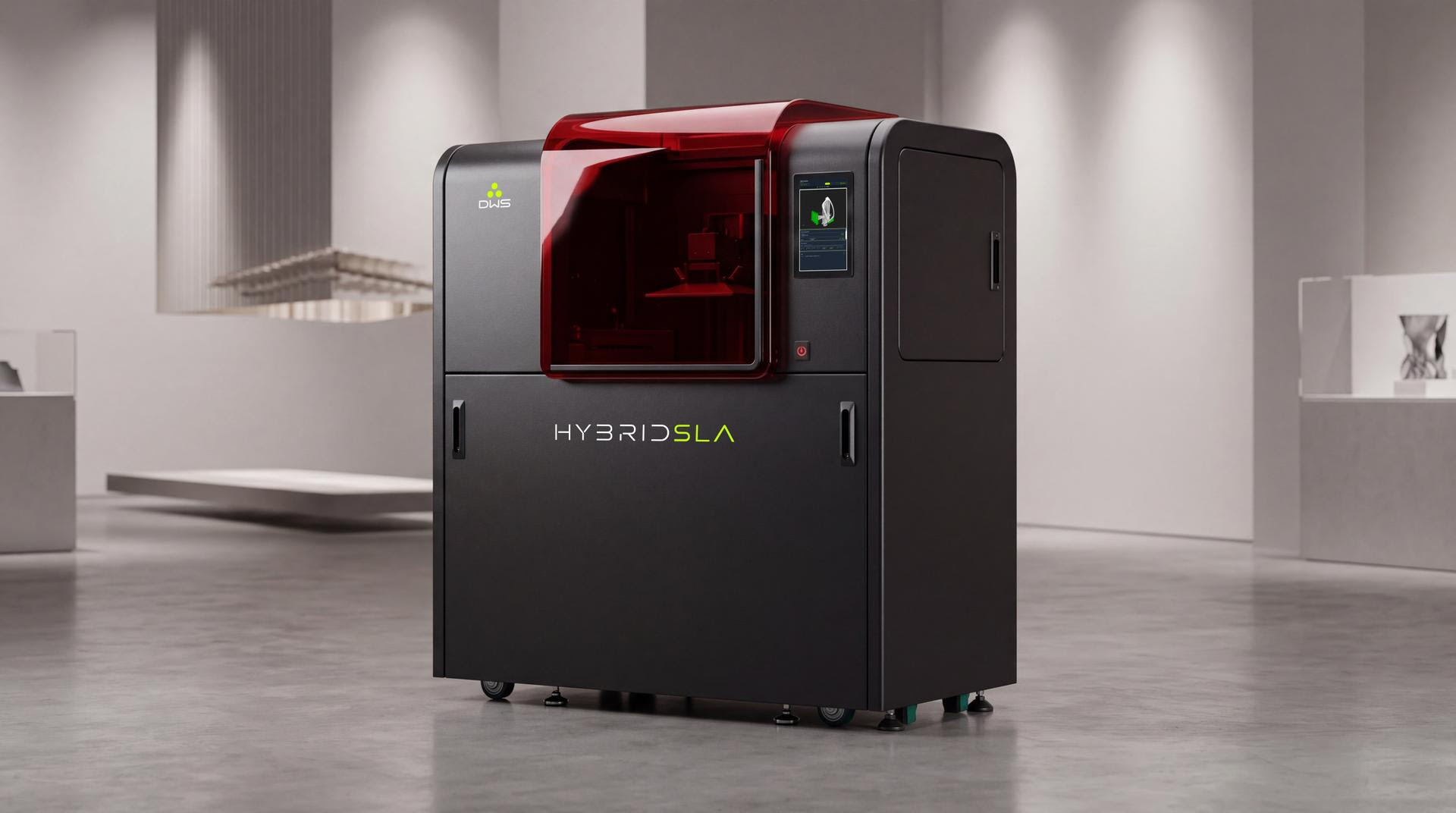
This last isn’t a new 3D printer, but a new technology. DWS announced the official launch of its proprietary HYBRID SLA, which offers a new approach to multimaterial 3D printing. The manufacturing world is changing, with AI algorithms majorly expanding design possibilities. But, a lot of the geometries, configurations, and structures created by AI are difficult to produce with conventional manufacturing. HYBRID SLA was developed to bring those challenging AI-created innovations into the physical world. The technology combines the high-quality surface finishes, precise geometries, and sharp details of SLA with an approach that was made to work with materials that have different properties. Users can print with materials in a wide range of viscosities within the process compatibility limits, even high-viscosity formulations; this results in much more design freedom for multimaterial components. In a world where we’re relying more and more on AI tools, I’d say this is coming at the right time.
“Innovation is not about promising what will be possible tomorrow, but about making possible today what was once impossible. With HYBRID SLA, we have turned this belief into a tangible technology, capable of expanding the possibilities of multi-material 3D printing,” said Maurizio Costabeber, Co-founder & CTO of DWS. “Our vision is to help bridge the gap between what Artificial Intelligence algorithms can design and what manufacturing can physically produce. This is how we approach innovation: challenging existing limitations and transforming new ideas into technological achievements.”
Subscribe to Our Email Newsletter
Stay up-to-date on all the latest news from the 3D printing industry and receive information and offers from third party vendors.
Upload your 3D Models and get them printed quickly and efficiently.