
An impressive $500 million raise by VulcanForms brings its total funding to $1 billion. What’s more, the funding comes from Apollo and JPMorgan, not venture capitalists (VCs). Desktop Metal vaporized this amount before failing, so VulcanForm’s victory isn’t assured. Indeed, the company has outsized ambitions to dominate 3D printed part production by building factories and scaling. Additionally, it got $21 million in subsidies from Massachusetts. And this, to me, is key to why I like their way of doing business. Let’s look at what is happening in services now and define the different types of service bureaus emerging. In a follow-up post, we’ll look at what the options are for the different types of service bureaus.
Key Developments
A few key things have happened in the service market over the years. One thing is that American Industrial Partners and CORE Industrial have brought in private equity (PE) money to consolidate machine shops and 3D printing services. This could be seen as rent-seeking, but it’s also a smart way to build defense-oriented firms that can handle the feast-or-famine economics of government contracting. These firms are betting on big trends such as America’s reindustrialization and the lack of a natural predator for small precision machine shops and defense supply chains. Xometry has continued its asset-light platform strategy and is growing well. Companies like Seurat have pioneered developing new technology and then rolling it out as a local service. This is a faster way to raise capital and lets you capture more long-term value while avoiding things like training service engineers everywhere. It’s much easier to make a machine in-house than one that has to run continuously at the customer site. Services that cater well to defense have also emerged, such as Sintavia. 3D printing also became the technology of choice for suppressors, rocket engine components, and scaling missile production. This has seen an influx of funding and scaling. We’ve also got companies such as Divergent that act like a systems integrator around a manufacturing base. I’d say the company most like Divergent was Carbon, and Beehive is like them but for one product.
Now, others may see these as very different businesses, even in different sectors, but if we characterize them, I maintain they are much closer to each other than their respective direct competitors are to them. In Beehive, Swissto12, and Conflux, we see a successful model: production services around a specific application. One of the biggest influences in our industry has been Anduril‘s precarious rise. This firm has fueled a lot of hype by bringing startup lingo to manufacturing and defense. I worry about Anduril because it sometimes seems more focused on ambitious promises than demonstrated results, or ‘all hat and no cattle,’ as they say in Texas. But Anduril is undoubtedly good at marketing. Hadrian pitched the software-driven factory so well that it now has a $7.87 billion valuation, and that has brought in many new investors and new money.
Hadrian is More Like a Wall in Your Mind
But it’s still unclear how much of Hadrian’s promised efficiency gains can be attributed to its software stack, or whether that software will provide a lasting competitive advantage. It’s all a bit SoftBank-y, you know: a big, plausible bet on a large total addressable market (TAM) and serviceable available market (SAM) size platform leader to catapult them into being unassailable while the technology turns out to be marketing. At the same time, new defense tech-focused investors have emerged. We’ve also seen the rise of Multi Jet Fusion (MJF) in polymer services, which has led to increased profitability at many sites. We are also starting to see more Material Extrusion and desktop 3D printers in print farms. Indeed, new print farm services will be one of the biggest influences in the market in the years to come. Low-cost laser powder bed fusion (LPBF) seems dead, while desktop metal LPBF is emerging. New ultraviolet (UV) resin full-color desktop machines, as well as desktop laser cutters and computer numerical control (CNC), will have an impact. But, as we’ve seen, while some adopted Formlabs‘ Pro Vat Polymerization systems and small sintering units quickly, it has taken time for them to percolate. LPBF machines have become better at making large parts while also becoming more productive. Machines are starting to be made for actual manufacturing with a focus on turnaround, precision, and quality, while having smart features.
New aluminum and aluminum alloys have opened new possibilities, as has the rise of Inconel and copper. New alloys will shape this market’s future, as will beam shaping and better light engines. Metal prices have fallen, and new entrants from China are emerging. Software for quality assurance (QA), such as Phase3D and Euler, is now much more important, as are post-processing machines from Solukon, Grenzebach, and others. Finite element analysis (FEA) and and computational fluid dynamics (CFD) have become more widespread, thanks in part to PanX and others trying to democratize it. People are now looking at OE, yield, scrap rates, and more. We’re really seeing scrap rates go down, and people are getting very good at efficiency. Before GE bought Morris, Additive was a global learning tribe; now we do a lot of our learning behind closed doors.
Magical Thinking is Not a Business Strategy

3D printed interceptor drone.
We’ve seen geopolitical events intrude on our industry. Everyone is more nation-state-focused now, and almost everyone is betting on defense without even half a plan to make it happen. Pro Tip: putting “Defense” on your website and hanging up a very big flag is not enough. If large flags made manufacturing possible, then all your wristwatches and jet engines would be made in North Korea. This is more like a cargo cult or that Oprah Law of Attraction stuff. Or, as the Diagnostic and Statistical Manual of Mental Disorders (DSM-5) and your psychologist would term it, “Magical thinking (MT) involves beliefs that thoughts or actions can influence events in unrealistic ways.” As per Wikipedia, Magical Thinking is when “words and sounds are thought to have the ability to affect the world directly.” This type of wish fulfillment thinking can result in the avoidance of talking about certain subjects (“Speak of the devil, and he’ll appear”), the use of euphemisms instead of certain words, or the belief that to know the “true name” of something gives one power over it; or that certain chants, prayers, or mystical phrases will bring about physical changes in the world. Magical Thinking is not a business strategy. And yet this is what most of our market is doing right now. We use the words warfighter, surge, and kinetic a lot, as if they were magical incantations that would bring about endless avalanches of money. But we are not diving into the feast-or-famine model that is modern military contracting. We’re not connecting enough with officials, and we don’t often enough really understand what the government wants or how to satisfy it. We’re not understanding procedures, requirements, or goals enough either.
Paper Surge
In reality, in a lot of places, 3D printing contracts are actually going to primes or established known vendors outside of Additive. It’s great that you’re talking to the government, but who do you know at the major defense contractors? The billions in supposed German defense money are tied up because they have no mechanism to fund research. And there is no way for defense innovation to get funded. So if they spend it, they’ll spend it on Rheinmetall equipment that will be outdated by the time it reaches the battlefield. Think I’m exaggerating? I thought that I was hallucinating when, in May of this year, Germany bought 2,000 unprotected transport trucks from Rheinmetall for $1 billion.
Meanwhile, Ukraine is resupplying frontlines with drones and Unmanned Ground Vehicles. Why not get horses? Bring back some proper cavalry and give the kids something to look at at your defeat parade.
John Frum
And in what seems like a bid to rid Germany of its industrial base, the government has greatly reduced funding to Fraunhofer, which is just about the most shortsighted thing any German government has done in many years. How are you supposed to outcompete the Chinese when you defund your main innovation pathway for manufacturing? Oh, wait a minute – could we have maybe got the Fraunhofer to do some of the defense innovation? Nah, let’s just blow this opportunity while our economy stalls and we don’t have any room to invest because we’ve promised this money for defense. The EU has decided that after Horizon, comes sunset, and it has not really invested significantly in advanced manufacturing anymore. The EU’s inability to reenergize Europe’s industrial base could be its undoing and cause a European Great Depression, but it’s spending time missing the moment and making it harder to ship products in the EU instead.
In the US, the surge is still mostly on paper. Factories are being built, but BLT, with 1,000 machines at its site, can still manufacture more than the US can. And US-made drones are not as capable as those in Ukraine. The globe-spanning GA US ones are great, but everything else being rolled out is too expensive and will be ineffective. Why on earth would you have a price floor for a product that you’re buying? What’s more, US-based drone innovation consistently fails to learn from what is happening in Ukraine. Oh, yeah, they stopped an invasion over there and killed over 500,000 Russians and their allies with drones. Over 80% of all vehicle kills, 75% of casualties, and 1,000 Russian casualties a day through drones. But no, we’re not going to do that; we’re not going to use desktop machines; we’re not going to make it cheap; we’re not going to make it effective. This is America; above all, it needs to be pretty. Bimbo defense, with a side of macho posturing. Manspreading missiles. And all the time it’s, “I’m going to start my own cool concept because I know better.” No, you don’t. You’re just building your little VC-funded Maginot line. They’re innovating faster in Ukraine and moving into heavy lift, mine laying, medium-distance, and combined drone warfare. We’ll just ignore this and come up with some static design for a cool defense-trend item that will be 120 times more expensive than it needs to be. It’s not a TikTok trend, people; the future of the world is at stake here.
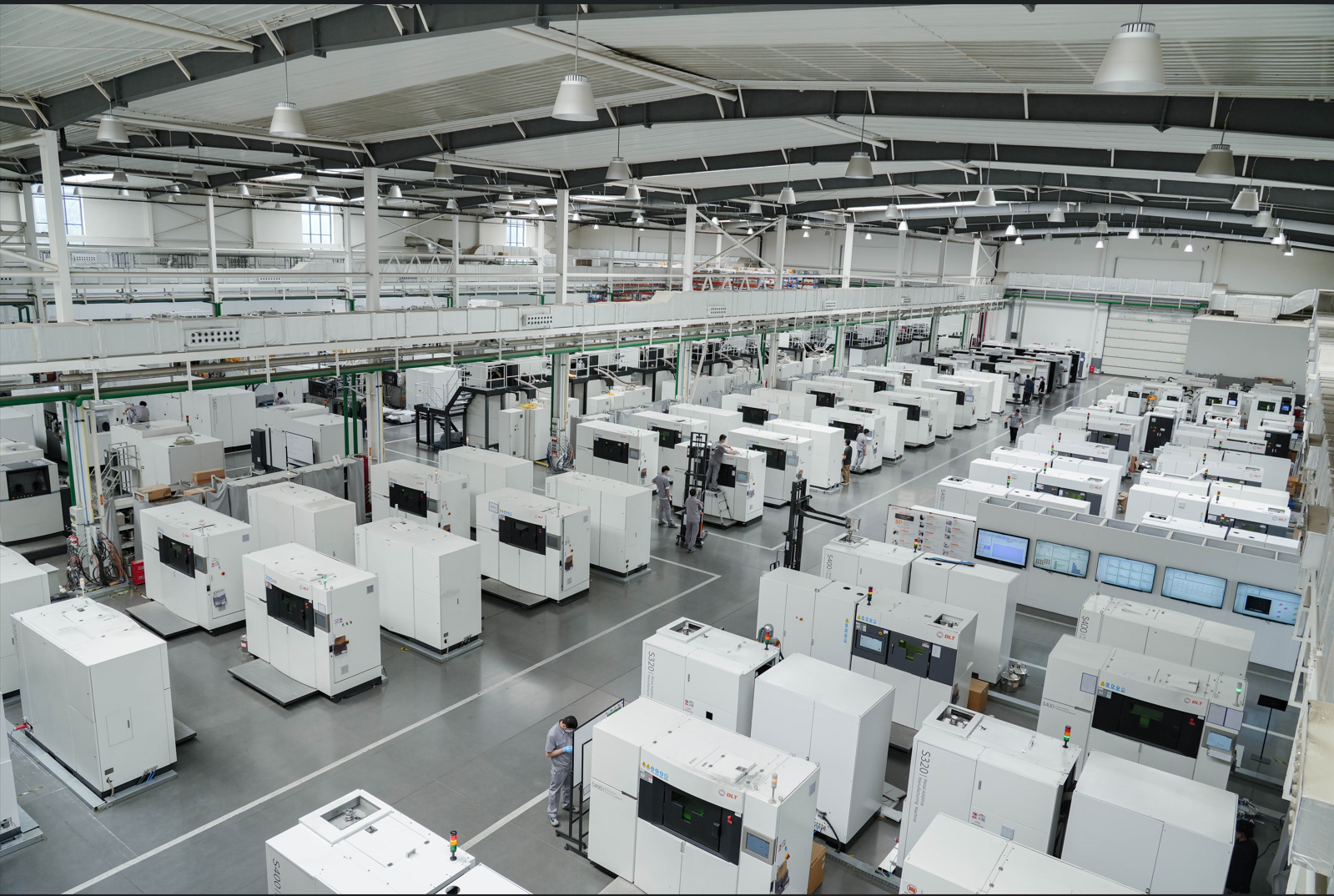
BLT factory. Image courtesy of BLT.
In the background, it’s clear that China is winning the 3D printing race. Through machines in many verticals, new material developments, and the fastest-growing businesses, one thing is clear: China is winning. China’s rise is real. And by spreading out into the desktop everything revolution, the country will dominate in desktop CNC, laser cutting, UV printing, and more. Meanwhile, the rest of the world resorts to magical Thinking.
Around the 1930s, a religion emerged on the island of Tanna in Vanuatu. The John Frum movement may have been entirely practical at first, turning their backs on European religion, money, and practices, and hoping the Europeans would leave, but leave all their stuff behind. Then, during the Second World War, American troops arrived, bringing an unimaginable volume of cargo and supplies. 10,000 locals also got jobs building for the military, which brought them into contact with many things and gave them a steady income. Later, after the Americans left, effigies of soldiers and ceremonies at landing strips with US uniforms were held in a bid to get the Americans to come back.
“In 1959, when David Attenborough asked one of the followers why he was still waiting for the cargo after it had been 19 years since it was promised and had not arrived, the man said “If you can wait two thousand years for Jesus Christ to come ‘an ‘e no come, then I can wait more than nineteen years for John.”
Vanuatu’s remoteness in the Pacific would make it an interesting place from which to launch and service drones or missiles. And part of US strategy is to be able to operate from remote places in the Pacific with drones and other craft to combat China. So maybe, just maybe, the cargo will finally arrive for the AM industry. But waiting around for it isn’t much of a strategy. Just keep chanting surge, forge, battlespace, lethality; maybe it will work out. After all, John Frum has only been gone 89 years.
Subscribe to Our Email Newsletter
Stay up-to-date on all the latest news from the 3D printing industry and receive information and offers from third party vendors.
Upload your 3D Models and get them printed quickly and efficiently.