Solukon has released the SFM-AT850 depowdering system. The German depowdering specialist has updated its product line, and this machine replaces the SFM-AT800-S and SFM-AT1000-S.
Rather than many small parts, this machine is designed for large metal parts such as hydraulics or rocket engines. You can also get an ultrasonic excitation upgrade, which would be handy for getting powders out of tight confines in things like heat exchangers.
The maximum part weight is 1,000 kilos, and parts can be up to 650 × 650 × 800 mm. The company said that “dense build plate packing and larger part requirements drove the adoption of the machine.”
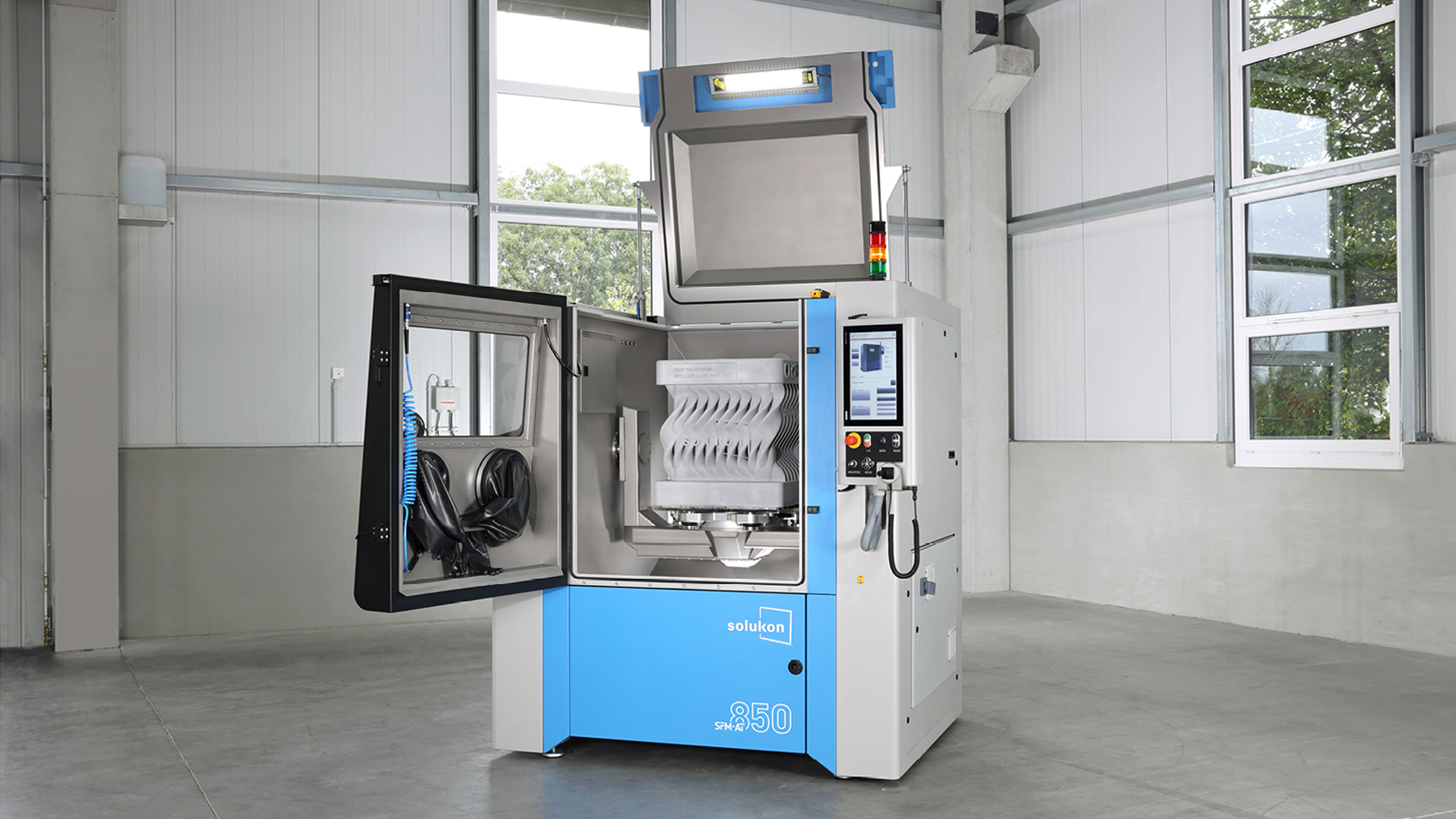
AT850 front top loading.
This is good news because it indicates that Solukon’s customers are moving more towards production at scale of large parts. Rather than one super-expensive nose cone, people are now looking at efficient full builds, with efficient strategies and supports. That tips the build plate weight to new heights. The company points to the Nikon NXG and EOS Onyx as driving growth in this segment. The Onyx is reportedly selling extremely well, and the NXG continues to sell, so this will build out this segment. But whereas before large machines were for unicorn parts or to show intent, this development means that people are manufacturing things efficiently.
And the rationale continues with a “front-top loading concept,” which makes it easier to load parts and remove them. The company thinks that lattices will drive the growth in Ultrasonic excitation. I think heat exchange and hydraulic channels will be big drivers too.
Solukon CEO Andreas Hartmann stated,
“Automated depowdering using ultrasonics has proven itself in recent years and established itself as a genuine alternative to pneumatic excitation. With the new SFM-AT850-E, this gentle and noiseless depowdering method is now also available to our customers for larger parts.”
I’m all for gentle machine tools. The machine comes with Solukon’s SPR Pathfinder software, which optimizes the unit’s depowdering dance based on the part’s CAD. A super handy thing is that, “As early as the design phase, users can use the software to check whether their geometry can be depowdered and obtain an accurate estimate of the depowdering time. Design for Depowdering is thus becoming a firmly established step in the additive manufacturing process chain.”
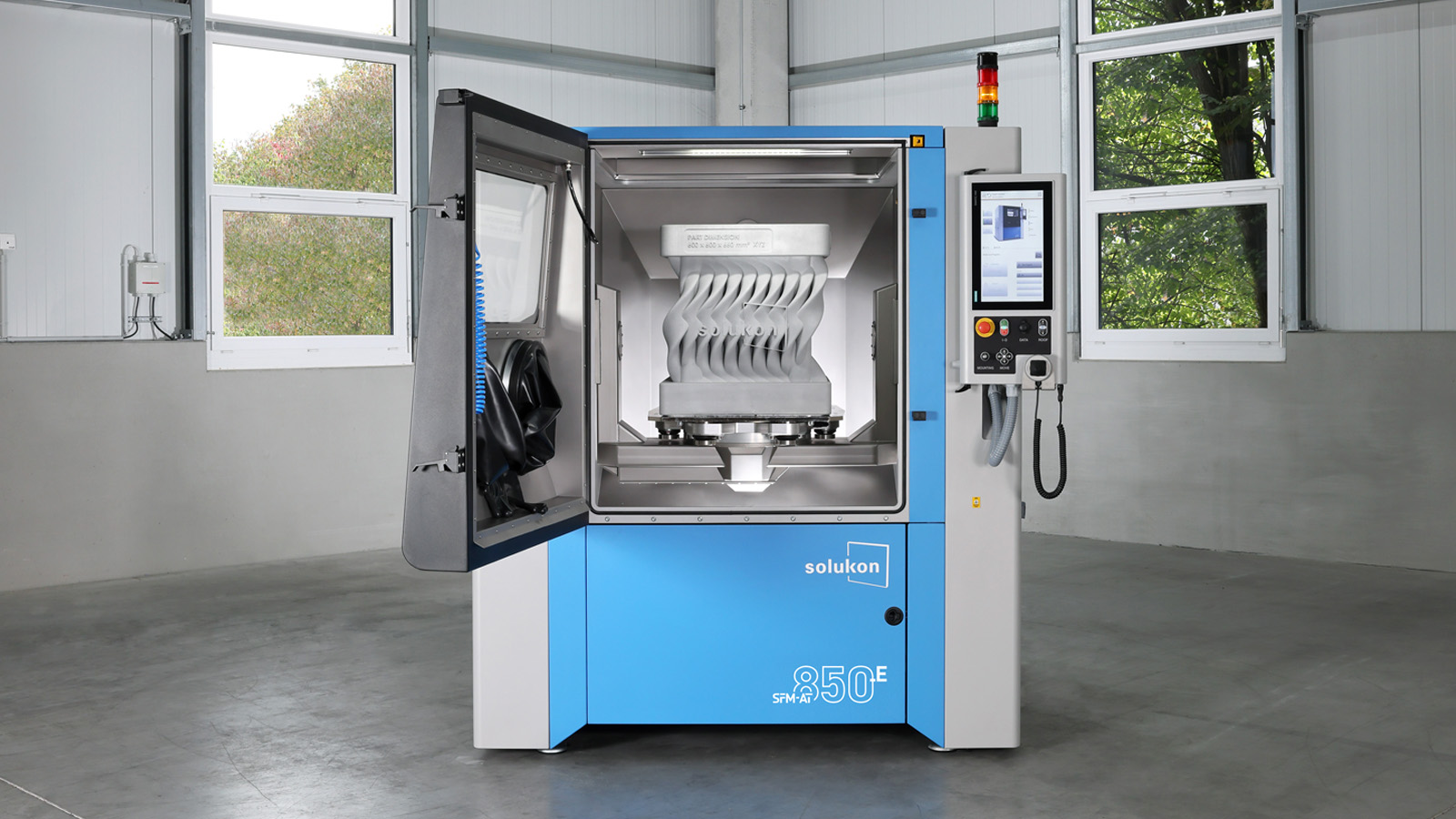
SFM-AT850-E version with ultrasonic excitation for gentle depowdering.
Love it, DfD for the win. For most parts, this won’t matter, but for serial production, excessive depowdering can slow time-to-part and become a bottleneck. And if you print the same part repeatedly, these time costs will keep adding up. And in very complex parts, it can be a huge problem if powder can’t be removed from some areas. Depending on the part’s needs, it could be catastrophic, and you might need to redesign it. That could seriously imperil a project, and some people would look very bad if that happened. So DfD to save your job, folks. There is also a 1,050 swing arm option for
Pathfinder has been made easier to use; access controls can prohibit some people from entering new programs. The glove ports are bigger, and there’s a new display as well.
The builds can rotate on two axes, and the machine can be inverted. The plate also has two additional compressed-air and two shielding-gas connections. The system will be available in Q3 2027, and Solukon will be at D58 in Hall 12.0 for Formnext. This seems like a sensible update to the Solukon lineup. And I’m buoyed that this update seems to point to sustained growth in production volume on the larger side of the LPBF market.
Images courtesy of Solukon
Subscribe to Our Email Newsletter
Stay up-to-date on all the latest news from the 3D printing industry and receive information and offers from third party vendors.
Upload your 3D Models and get them printed quickly and efficiently.