
We’ve long had a passion at 3DPrint.com for Kirigami shapes, be it in the form of bandages, nano fabrication, or sensors. We also wrote a lot about metamaterials and, more recently, about 3D printing on cylinders to add to existing shapes or to create new geometries. So something that combines all of these things is bound to be of interest to us.
A new open-access paper published in Progress in Additive Manufacturing, “Conformal morphing meta-cylinders 3D printing for mechanical intelligence programming,” opens up a new class of useful shapes. The paper, by Ali Zolfagharian, Moslem Mohammadi, Eui-Hyun Kim and Keun Park of Deakin University and Seoul National University of Science and Technology, details how desktop 3D printed cylinders can be programmed with different shapes, moduli, and energy absorption. The forms can also change into different states. The resulting compliant mechanisms (like the stretch and shape that makes your Pringles top close and open) can tackle a wide range of tasks. Tubes that work this way are obvious candidates for use as things like stents but might also serve as actuators or shock absorbers.
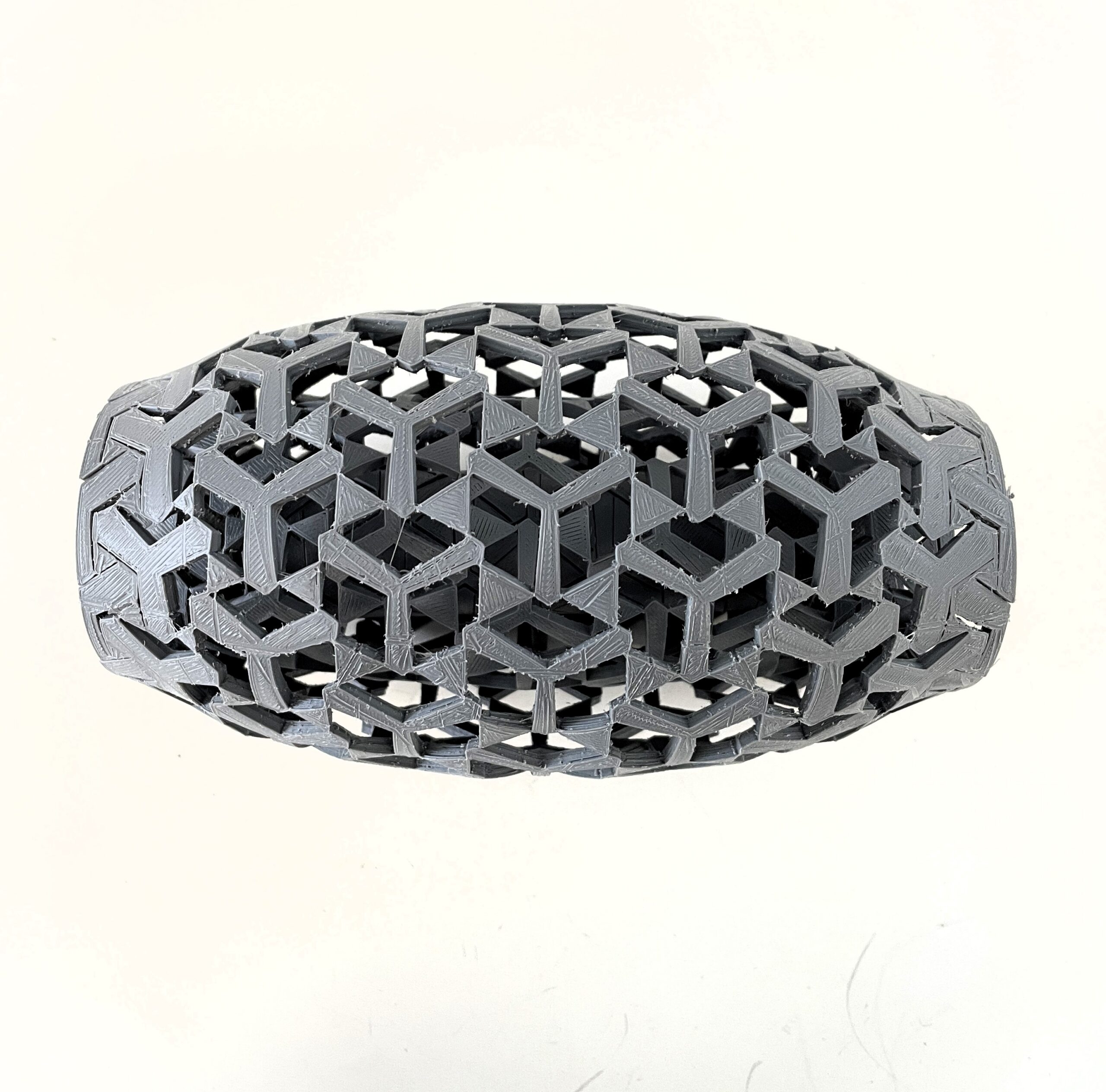
3D printed meta-cylinder with a programmable lattice structure. Image courtesy of Zolfagharian et al.
The resulting part is a multistable meta-cylinder, because it can quickly snap into several programmable set states. Variables such as the cell shape, wall thickness, and diameter can fit different needs. As with other examples, the printer here prints onto a rotating shaft. This reduces assembly but can also be used to optimize strength while making the inner surface very smooth.
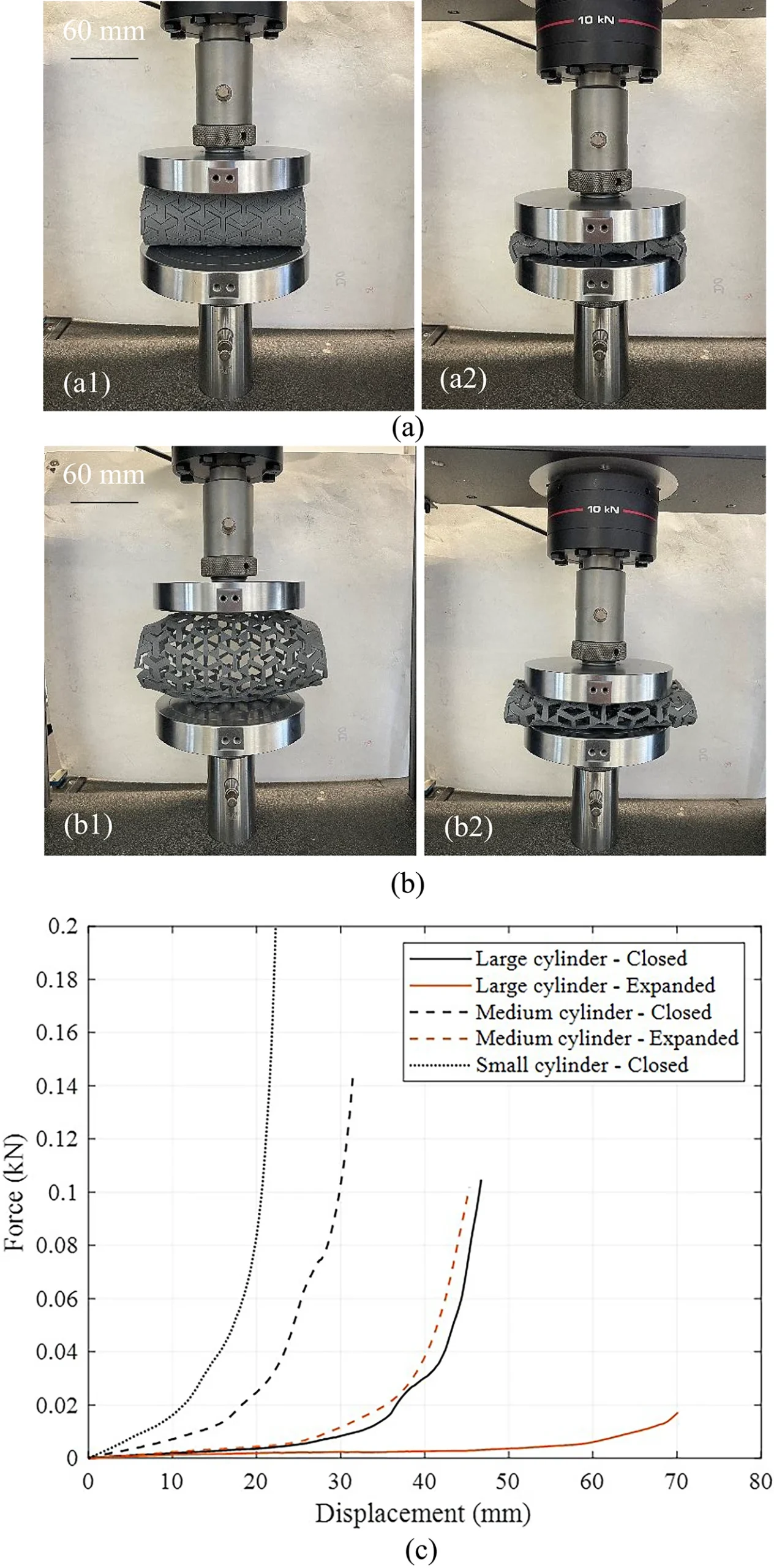
Comparisons of the FEAs of rotary-printed meta-cylinders with three different diameters. Image courtesy of Zolfagharian et al.
The team says that the “approach effectively uses morphology as a mechanical program. The as-printed state behaves as a comparatively stiff shell with pronounced snap-through events, while the expanded state becomes softer and more compliant,” and that, by combining closed and expanded cylinders, the assemblies produced sequential “soft-medium-hard” collapse responses, with different layers engaging at different stages of loading. This allows stiffness and energy absorption to be tailored without changing the underlying material. That is a very interesting approach, and you can see how you could turn a shock absorber like this into a hydraulic component or some kind of piston. You could also make a damping component or a kind of smart helmet liner that absorbs impacts and snaps with considerable specific impacts.
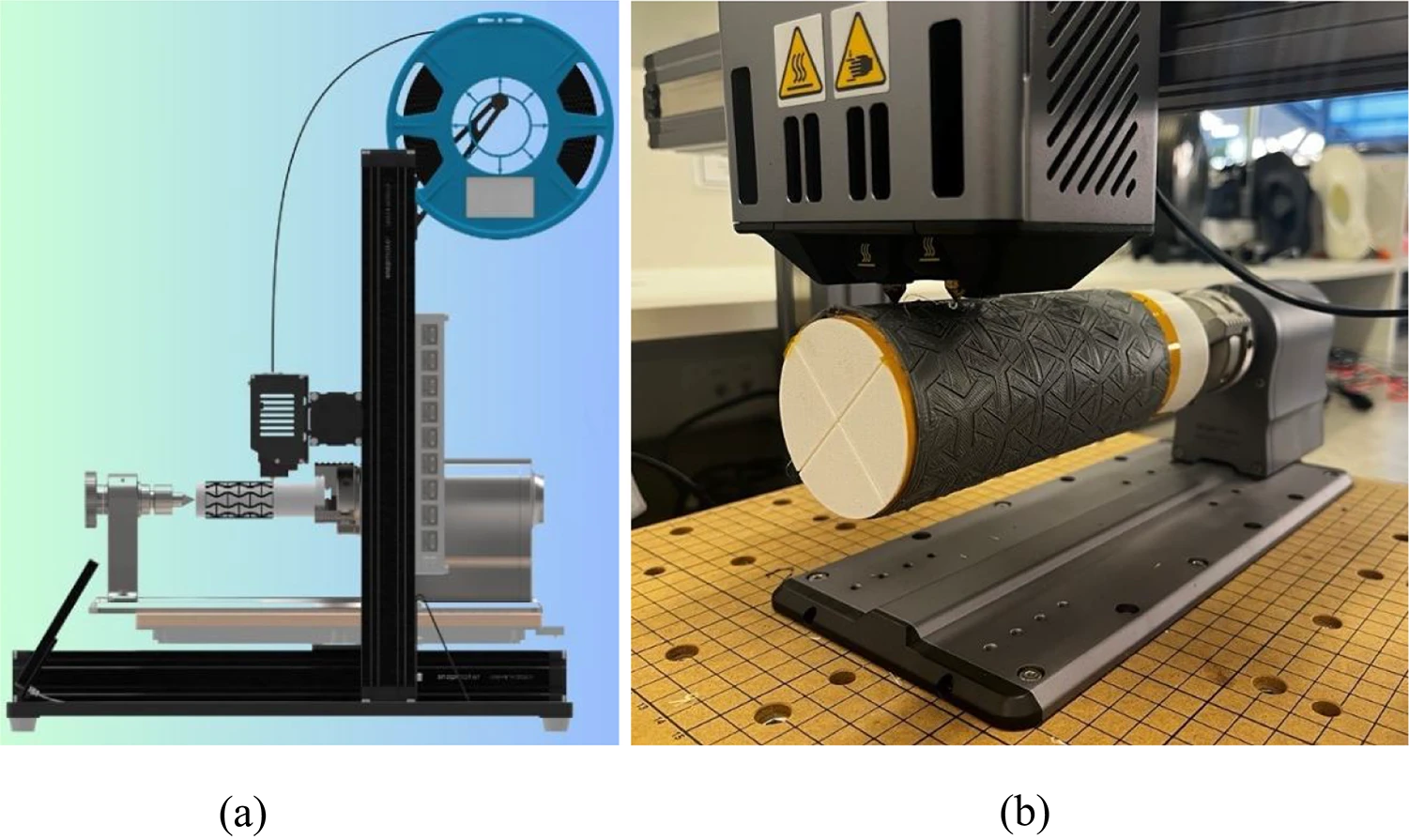
A commercial FDM 3D printer with a rotary module: the 3-in-1 Snapmaker 3D printer. b The rotary module setup utilized to perform non-planar 3D printing. Image courtesy of Zolfagharian et al.
What I love about this is that they essentially converted a 3-in-1 Snapmaker 3D printer into a rotary printer. This means that if you’d like to make a helmet or a shock absorber for a mountain bike, you may be able to do so on your home 3D printer. Or imagine trying to make a new kind of bike handlebar, and you want to snap it on the bike really easily, or you’d like it to have two states: super comfy and super grip. You could build a printer specifically for making your own handlebars using standard desktop machines. And then you can make a handlebar with two different states for comfortable riding or those moments when precision matters. I love the idea of desktop machines being adapted for specific products and industrial applications.
In this case, the team created the shapes in Rhino using Grasshopper, sliced them in Cura, and adjusted the G-code so it would run in a rotary mode. All prints are at 100% infill using ESUN eTPU-95 A. The design stuff is rather complicated, and I think that correctly designing the auxetic triangle shapes and defining how they will be built up would be the hard part. An interesting part of this is that the expansion bulges in the middle while the ends stay relatively small. This could be used to develop very specific actuator, pump, or piston designs, as well as to perform specific impact-absorption work. But I think it would be difficult to model this, and to determine how geometry, wall thickness, and the like will work out over time in your final part. Having said this, I love the potential of this. I really think that this could be a very cost-effective way to make lots of very interesting parts.
With TPU and other flexible materials being improved, printers getting better, and the expansion of print farms, these kinds of adaptations can be really meaningful. I can really see how someone could take this new vocabulary and make very useful things with this at scale.
Subscribe to Our Email Newsletter
Stay up-to-date on all the latest news from the 3D printing industry and receive information and offers from third party vendors.
Upload your 3D Models and get them printed quickly and efficiently.