In 3D printing, key industries include things such as poka-yoke and manufacturing tools like jigs and fixtures. These low-volume tools save money and reduce errors. Refits in things like military jets and trains are also a growing market for us, as are upgrades to trains. These are all relatively low-volume activities that benefit from parts made in specific materials at specific times. A lot of them have a decided ergonomic element as well. Again, ergonomically, 3D-printed add-ons- either a generally more ergonomic mouse or an individual one made to fit you are another area where we should grow.
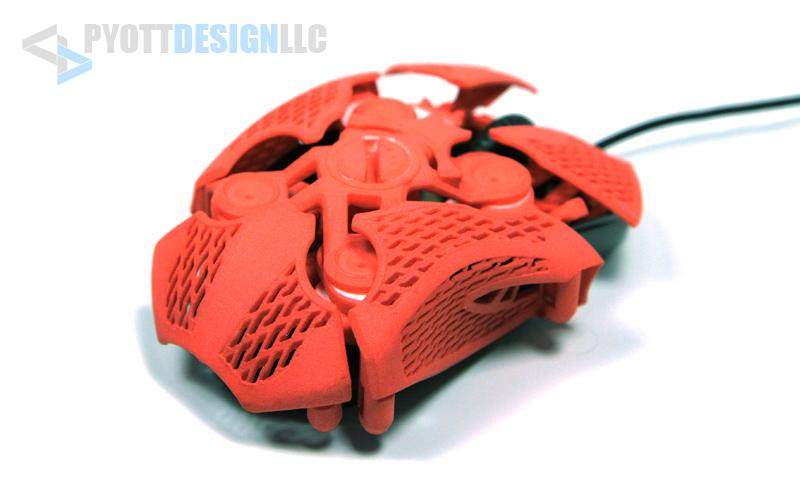
3D printed fully adjustable mouse. Image courtesy of Charlie Pyott Design LLC.
If we look at human factors, this is a study of how people interact with work, from how you sit at your desk to how you maneuver a pneumatic drill. It’s synonymous with ergonomics, but nowadays most people just use “ergonomics” to refer to a mouse that fits better. At the same time, human factors is the broader study of how people and work can fit together better. Human factors could include stress, bosses shouting at you to meet deadlines, a tendency toward sudden bursts of anger, and more. Human factors could be safety testing of products or better interaction design for websites. Human factors can be better training, better communication, better awareness, or empowerment, so that you feel you can go to your boss and report a problem with pump 3 before it blows up.
Throughout human factors, we can see many areas where 3D printing could impact the industry. But we have to realize that human factors will become more important in the near future. In many countries, labor is becoming scarce. And in some professions, such as construction work, the average age is over 50 and getting older every year. More devices, specialized devices, and greater financial need all intertwine there. Also, work is becoming more critical. If before I had lots of people who could operate my factory or take over a shift, now I have fewer people and may not be able to find a replacement quickly. Although emergency rooms have been optimized for many years, procedures are still more expensive. Improved hospital workflows are more critical when we have more patients and fewer staff to handle them. At the same time, patients are becoming older, meaning they may have more complications that interfere with their current diseases and hospital stays. This is made more difficult by the fact that fewer people may have to provide more care or deal with mobility issues. Things like obesity and dementia will make patient groups more difficult to manage. UX on devices and workflows will become more difficult with people suffering from things like Parkinsons, dementia, and poor sight, demanding increased attention.
Prototyping
With so many different issues and environments, prototyping plays an outsized role here. A lot of these devices have to be invented and engineered for a small group of people. Some cases are very specific. A small change can have big impacts. This also means that more prototypes, including form-and-fit prototypes, and more iterations will be needed for all of these specific solutions. This, in turn, points to devices being created on desktop machines, close to users, where inexpensive solutions can be developed with users. This direct dialogue is much faster and less expensive, with 3D printing giving the technology a real edge here. At the same time, we can make devices that fit a specific door, machine, or workplace. An individual device can therefore, through additive manufacturing, be adapted for many different workplaces. The setup of your milling station could be very different from another factory’s setup, but with additive, we can quickly change it. We can also easily modify designs for similar environments or uses. So maybe you add a texture to a stair or handrail, so everyone knows which part of the stairwell is meant for walking up rather than down. That same handrail add-on can be adapted to other rails. But if we wanted to do the same thing in a foundry where everyone is in gloves, we can adapt it for gloves. Do we want to do it for a fishing boat where everyone is likely to have wet hands? Then we can add texture to it. So individual inventions can be adapted more surely and specifically with additive through the easy availability of specific prototypes and changes.
Devices
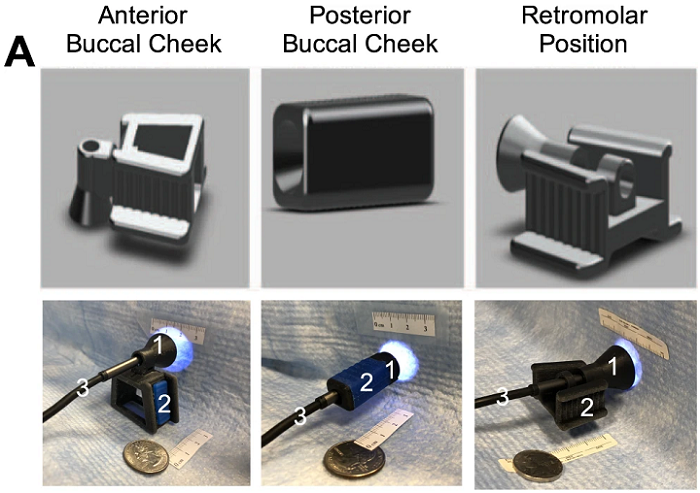
3D Schematics and photographs of the applicators for three different regions in the mouth. The photographs showcase the integrated unit with the applicator (1), bite wing (2), and endoscope (3) used in the ergonomics clinical study.
In the device sphere, 3D printing could play the most logical role. Here, indeed, the most is going on. Adapted devices can give groups of people more control over their environment. We can adapt a device specifically to your case, environment, hand, and situation. Similar to the advantages in prototypes, we can make end-use devices that combine new textures, sizing, adaptations, and specific changes for a specific situation. If we improve workflows, scanning can be used to make inexpensive things specifically and quickly. If we look at what is already being done in dental, we can see how a similar workflow can be replicated. CT or other scan-to-workflow and to-device capabilities can be replicated across many devices. Custom prosthetics, braces, and other specific devices are already being made.
Room Changes
At specific locales, we have another advantage. We can adapt a device to a workplace, machine, hospital, school, or more. What’s more, if a workflow changes, we can adapt the device quickly. We can make Braille signs for a hospital waiting room. But if they do not work, we can quickly adapt or make new versions of these designs. If there’s some construction going on, we can temporarily change the signs as well to reflect the new situation. Here I think that we can make a huge improvement over other technologies. Most human factors work seems to be focused on assessing the situation and improving the approach. But with additive, the whole process can be more fluid.
What’s more, we can work with the in-hospital 3D printing team to improve these areas at that specific hospital. We can also do this on an ongoing basis and keep tweaking our responses. So human factors becomes a much more local, quicker, and ongoing process. Overall, we expect it to be cheaper and more responsive as well. Additionally, we can implement different states. Do we tend to get more trauma cases on a Monday after the weekend, or more CTs in the evening while staff is busy with vaccinations every Wednesday? We can change the entire workflow or routing depending on the situations, pressures, or specific events.
Exigent Upfitting
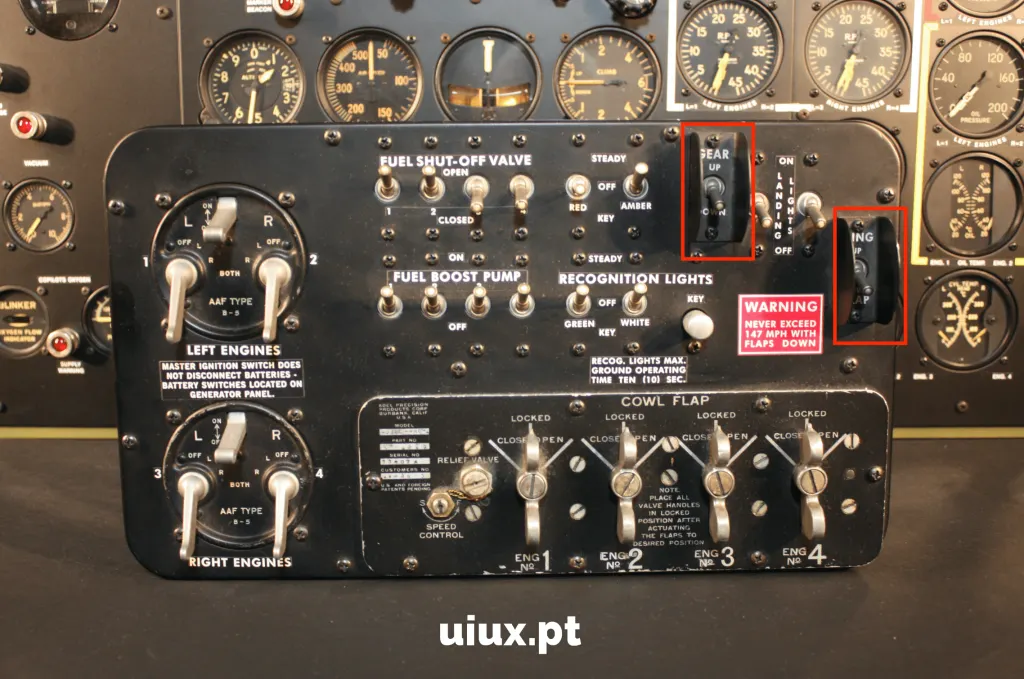
Aircraft cockpit control panel showing the landing gear and wing flap controls. Image courtesy of UIUX.pt.
The most interesting case is where we see exigent upfitting. This is where a specific situation becomes very dangerous, and a solution must be sought quickly. Often, this is not discussed, but it is ongoing. Similar to bridge manufacturing, we really help with speed and time-to-market here. The problem is that errors here are seen as embarrassing to organizations, so work here is not sufficiently publicized. A classic example illustrates how impactful this is, however. Many B17 bombers crashed during training during World War II. This was a huge problem, apart from the deaths, of course, since bombers and crews were scarce. In a seminal moment for human factors research, psychologist Alphonse Chapanis looked at what was going on. Rather than just “pilot error,” he saw that there were many identical levers in the cockpit. The landing gear controls and flap controls were identical; what’s more, they were near as well. He theorized that in exigent situations, pilots were grabbing the wrong lever, causing the planes to crash-land. The solution was to glue a tire to the landing gear lever and a flap-like thing to the flaps lever, letting the pilots more easily, and by touch alone, identify each lever. Alphonse’s use of the small shapes is an early example of shape coding, and that is something that we could do particularly well. But generally, by quickly devising unique solutions, we could play a huge role in these kinds of exigent cases.
Featured Image courtesy of Charles Tilford.
Subscribe to Our Email Newsletter
Stay up-to-date on all the latest news from the 3D printing industry and receive information and offers from third party vendors.
Upload your 3D Models and get them printed quickly and efficiently.