Additive manufacturing is at a crossroads. Simultaneously, we find ourselves between certain very different modalities, applications, and industries. Rather than being able to explore them all, companies will now have to specialize, focus, and concentrate their efforts to win outsized opportunities. Success will be more explosively rewarded but will be more difficult to achieve.
Three Phases
We can divide the history of additive manufacturing into several chapters. Initially, in the invention phase (1984 to 2009), several firms such as 3D Systems, DTM, EOS, and Stratasys commercialized their own technologies, focusing on that technology silo and those applications that would work with their machines. Later, from 2010 to 2025, the Hype phase saw an influx of VC, corporate, and SPAC money into the market. Pitchmen made inordinate promises about a Revolution afoot, which saw inflated expectations. Free-flowing money washed over everyone, strengthening those with the best promises and best PowerPoints, not necessarily those with the best ideas, abilities, or technologies. Now, in the Industrialization phase, some firms are progressing with large-scale implementation, while many companies use the technology casually.
The Desktop 3D Printing Revolution
Crucially, Bambu Lab is a billion-dollar revenue firm making good on some of the pitchmen’s promises to tens of millions of desktop users. The desktop 3D printing revolution may yet occur. Through better AI-assisted software, millions more people could make. And even without it, we can now see an influx of tens of millions of new users per year. These users don’t care about 3D printing, but they do care about cosplay, art, craft, inventing, and making money. But it would be naive to assume that these desktop printers are consumer devices. Hundreds of thousands of firms are also deploying them for prototypes, spare parts, and end-use parts.
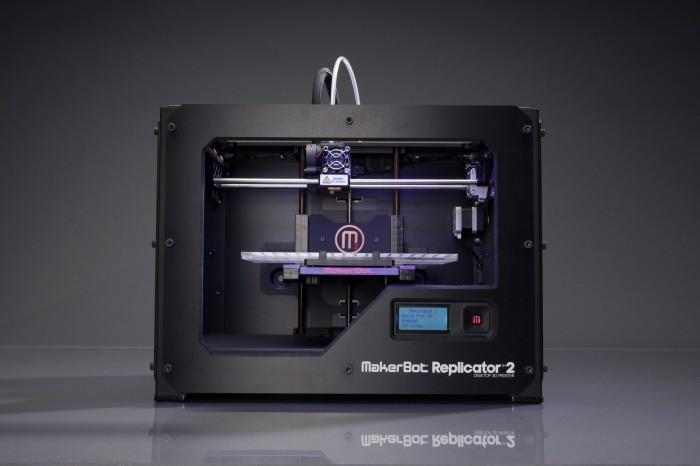
MakerBot Replicator 2. Image courtesy of UltiMaker.
There is far too much strategic replication in additive; far too many people are still trying to sell their inventions rather than create solutions. Companies need to look at cases where they can help all of the players in a value chain. Firms need to deliver on value and ease of use, and deliver true performance. Calling your mish-mash of ideas a solution will not solve anything. Just having a weight-saving part is unlikely to move the needle; instead, it may need to deliver on part-count reduction, functional integration, improved flow, easier adoption of design changes, lower up-front costs, and less capital deployed simultaneously. We will have to explore many advantages simultaneously if we really want deep, significant, and profitable implementations.
Over two million clear aligners are made each day, millions of bridges, crowns, and other additional dental parts are printed each year, tens of thousands of parts are flying on commercial aircraft, hundreds of thousands of shoes have been 3D printed, hundreds of thousands of prosthetics and orthotics have been 3D printed, and hundreds of thousands of surgical guides are being made. This year, over a million 3D printed orthopedic implants will be produced for spinal cages, acetabular cups, and knee surgeries. We already materialize information where it matters. But, this will accelerate as more efficient industrial machines and low-cost desktop units simultaneously lower part cost. In metal and polymer LPBF, as well as material extrusion and Vat Polymerization, we’re seeing breakthroughs in throughput and lower machine costs. Better, more, and lower material costs accompany this development.
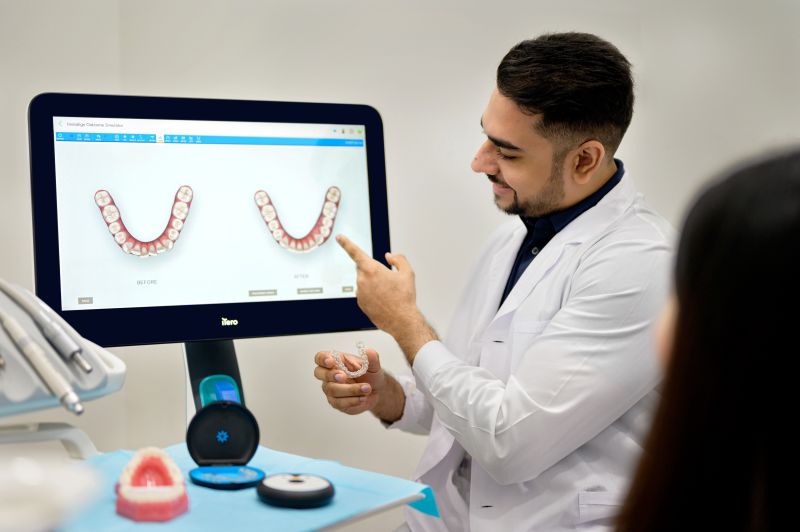
Invisalign treatment transforms dental problems. Image courtesy of Align Technology.
With CapEx constrained in many businesses, times are more chaotic, and true globalized competition is now biting; it is time to act. Businesses can become more resilient, more flexible, and more responsive by adopting additive. Through additive, you can help companies better meet fickle consumers in a more competitive environment. Additive Manufacturing is just a tool, but one that can drive organizational change, make companies more competitive, and help organizations adjust to new market realities. You can quickly adjust your products using 3D printed components, tooling, or parts of your assembly line, for example.
Single Click 3D printing
But if we are to make additive work, we have to make it more accessible. We have to make printing a one-click process to engage more users. We have to make implementation as easy as signing up. We have to create systems integrators so that companies can have the right toolchain made for them. And we have to as firms own additive applications.
With unparalleled understanding, adopt additive to precisely outperform any company worldwide with the specific geometry that only you can create (or only you can create at this price point) for that application is the winning play. This will also be a defensible win that can lead to long-term advantage in a particular application. There is a similar opportunity in specific industries that is not being sufficiently addressed. Be the best possible partner in the precise implementations needed for specific people at particular players in hospitals, semiconductor, petrochemical processing, chemicals, robotics, etc. You need to make a tool that is demonstrably best for a task and a tradesman. And then you need to develop the go-to-market best for that person, her industry, her business model, and her company.
Additive Manufacturing is a tool that can be utilized, but it needs to be used alongside strong value propositions, go-to-markets, applications, and companies. Any chisel won’t do. Just a hammer-shaped object won’t do. A universal pen for everyone will probably not work particularly well for anyone. But a well-made tool that exactly suits the right person’s purpose will win. Right now, with additive, we have to actually use our technology to make the right things for the right industries, applications, people, and purposes. This is something that additive manufacturing is ideally suited for, but given the limitless possibilities, we never thought to make what is best.
Subscribe to Our Email Newsletter
Stay up-to-date on all the latest news from the 3D printing industry and receive information and offers from third party vendors.
Upload your 3D Models and get them printed quickly and efficiently.