
Recent reporting on the UPS MD-11 engine separation on Flight 2976 has understandably focused on the immediate question: what happened?
The investigation will determine that, as it should. Serious engineering incidents deserve facts, not speculation. But stories like this tend to provoke a broader reflection inside engineering organisations. Because experienced engineers know something the headlines rarely capture: failures rarely begin where the failure becomes visible. The public sees a moment. Engineering sees a timeline.
What eventually becomes a visible problem is often the accumulated result of hundreds of smaller decisions, assumptions, compromises, operational realities, and signals – each individually understandable, sometimes reasonable, but collectively significant. A maintenance observation that felt manageable at the time. A trade-off accepted under pressure. A known limitation that quietly became normal.
Engineering people understand this instinctively. The story is rarely that one thing failed – the story is usually that many things happened.
This raises a question that Andre Wegner, CEO of Authentise, and Thomas Rees, Innovation Lead at ToffeeX, believe engineering organisations are not paying enough attention to: How much engineering reasoning actually survives inside engineering systems?
For all the investment made in digital engineering, modern organisations remain extraordinarily good at preserving outputs and surprisingly inconsistent at preserving intent. Requirements are documented, CAD models are version-controlled, Simulations are stored, compliance frameworks exist, and change requests, maintenance records, and validation reports all provide evidence that work happened.
But the reasoning behind decisions often lives elsewhere.
Why was one design path rejected? Why did an experienced engineer decide the technically elegant solution was not worth the manufacturing risk? Why did a programme choose the option that looked worse on paper but carried lower certification uncertainty?
Those decisions frequently live in design reviews, supplier conversations, Teams chats, whiteboards, meeting discussions, and institutional memory. Then institutional memory retires.
“We built systems to record engineering outputs,” says Wegner. “What we didn’t really build were systems that preserve engineering thinking – the rationale, assumptions, and trade-offs that explain why something happened in the first place.”
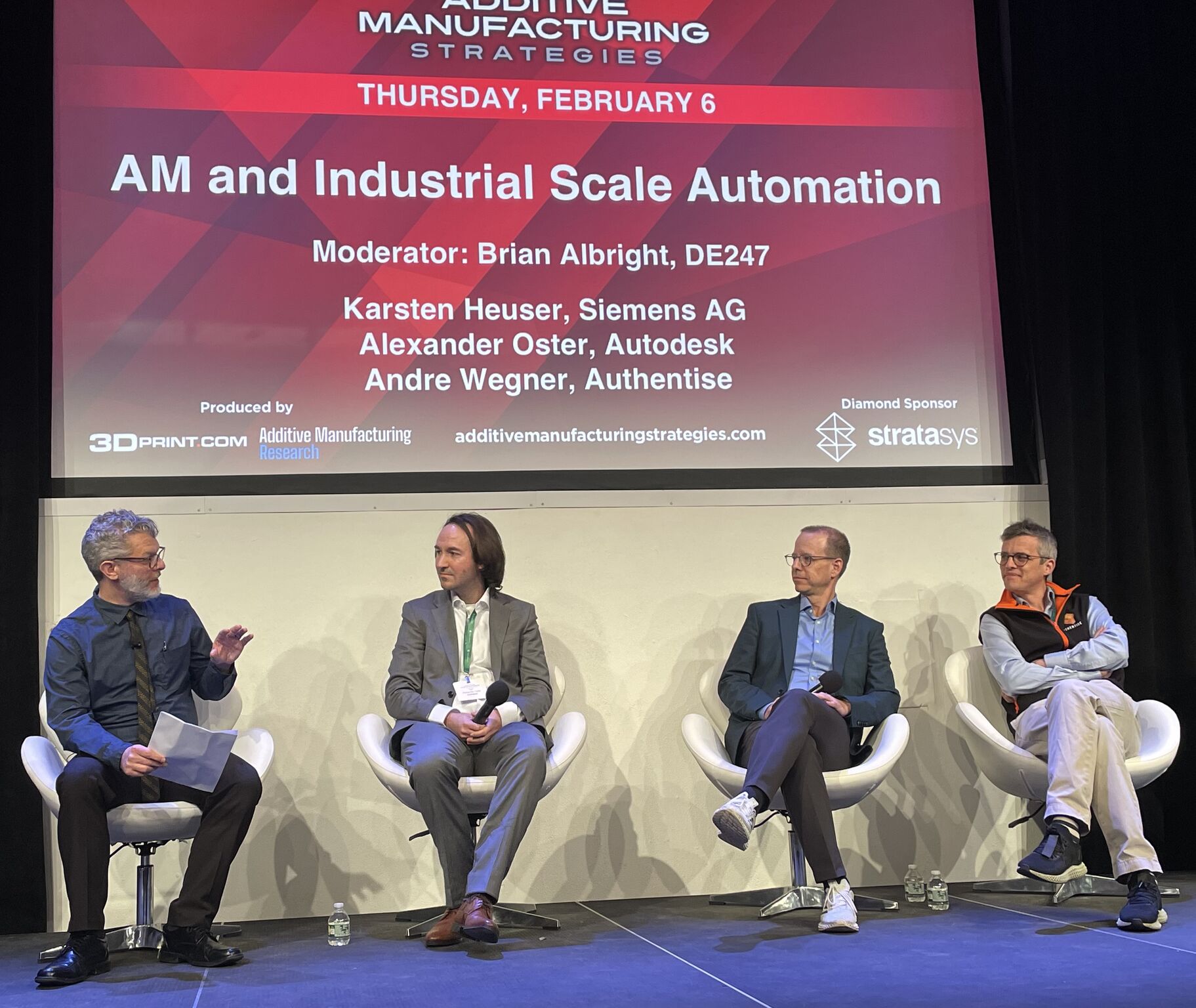
AMS 2025 Panel moderated by Brian Albright, with Karsten Heuser, Alexander Oster, and Andre Wegner. Image courtesy of 3DPrint.com
At RAPID this year, Wegner and Rees explored what they believe is becoming an increasingly overlooked bottleneck in digital engineering: lost engineering intent.
As discussed during the session, “several of the most important design decisions in an engineering project are never written down.” For a long time, engineering organizations more or less got away with this. Teams sat together, senior engineers carried institutional memory, and expertise was transferred informally. If a decision had been made five years earlier, there was usually somebody nearby who still remembered why. It was messy, occasionally chaotic, but surprisingly effective.
The problem is that engineering has changed: Products have become more complex, and supply chains often stretch across companies and continents. Certification requirements have multiplied, and teams have become distributed. Specialist expertise has deepened to the point where no individual could realistically hold the full picture anymore.
At the same time, many organisations began losing decades of tacit experience through retirement and workforce mobility. The old system of “smart people remembering things” stopped scaling, and now another shift is underway.
From recording to building
Historically, missing context mostly slowed organisations down. Teams repeated mistakes, revisited old decisions, and occasionally rediscovered lessons they had already learned. It was expensive and frustrating, especially as new manufacturing capabilities could not be adopted due to a lack of knowledge or historical context.
AI changes the stakes because optimisation systems, generative engineering tools and autonomous agents increasingly depend on the context they are given. But engineering intent rarely arrives in neat, structured form.
Rees sees this problem clearly in optimisation workflows: “The solver only sees what it is given,” he says. “It sees constraints, objectives, and parameters. But engineers are usually thinking about much messier realities – manufacturability, operational trade-offs, certification risk, supplier capability, lessons learned.”
At RAPID, Rees described the challenge succinctly: “The gap between what the solver receives and what the engineer intends is where design intent gets lost.”
This matters because engineering has never really been an optimisation problem alone: It is a judgment problem. A trade-off problem. The technically optimal answer is often not the organisationally optimal answer. Or the certifiable answer. Or the manufacturable answer. Or the answer that avoids repeating an expensive lesson from three programmes ago.
“People talk about AI optimising engineering,” says Wegner. “But optimise for what? If context disappears, you risk becoming very efficient at solving the wrong problem.”
That, both argue, is why engineering intent matters more now than it did ten years ago. The challenge is not simply documenting more; if anything, most engineering organisations are already drowning in documentation. The real shift may be in rethinking when engineering knowledge gets captured.

Historically, organisations documented periodically. Something happened, teams discussed it, and eventually someone updated the formal system – usually after information had already been compressed, simplified, or quietly forgotten.
Wegner and Rees argue that the future looks closer to continuous intent capture: preserving rationale while decisions happen, across reviews, conversations, simulations, and workflows rather than trying to reconstruct them later. As discussed during RAPID, the shift may be from something periodic, manual, and inherently lossy toward something continuous and structured.
Neither sees this as replacing engineers. Quite the opposite, in fact. The goal, says Wegner, is simple: “Engineering expertise isn’t disappearing. But the reasoning behind good engineering disappears faster than most organisations realise.”
Wegner and Rees explored these ideas together at RAPID and will continue the conversation next week in a webinar titled “The Hidden Cost of Lost Engineering Intent: How engineering decisions disappear — and what AI can do about it.”
Subscribe to Our Email Newsletter
Stay up-to-date on all the latest news from the 3D printing industry and receive information and offers from third party vendors.
Upload your 3D Models and get them printed quickly and efficiently.