
TPU and other elastomeric materials have traditionally been tricky and difficult to print. Elastomers are generally difficult in additive manufacturing (AM). In the case of material extrusion, the use of soft, flexible filaments has been grafted onto machines, software, and standards created for and by more rigid materials. This has also made it harder than it should be to 3D print elastomeric materials at home. Now in orthopedics, material extrusion TPU could become the default solution for orthoses and could lead to hundreds of thousands of orthoses being produced on desktop machines. Shoe 3D printing is growing as well, while more applications, such as sports gear and handles, remain tempting.
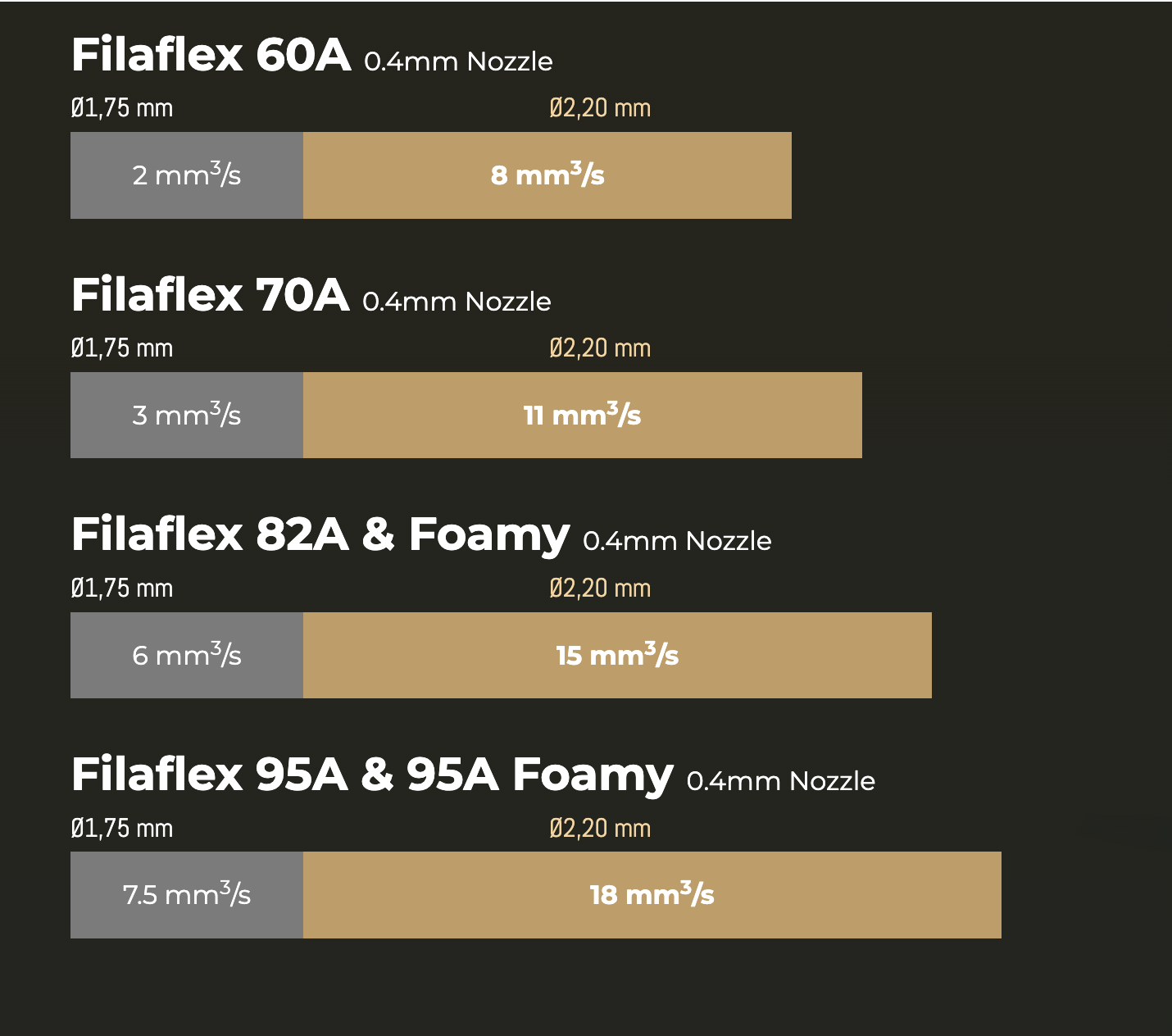
Early flexible filament producer Recreus, makers of the Filaflex line of filaments, believes it has a way to improve the printing of flexible materials. Their rather surprising solution is a new filament standard, the Filaflex 2.20 System. The system combines a new hotend with a 2.20mm-diameter filament and promises to significantly speed up 3D printing TPU. The company says the hotend includes a 2.3-2.4mm channel that extrudes faster, is more reliable and repeatable, and reduces clogging. The greater cross-sectional area could also reduce print-stopping bends in the filament. The combination could let you 3D print three times faster. The company believes that “We’ve proven that flexibility and speed can now coexist.” The industry is ready for the “#FlexibleRevolution.” They believe that in the most prevalent diameter, 1.75mm deformations occur too often, while 2.85mm is not thermally efficient. To them, 2.20mm is a Goldilocks-like optimum.
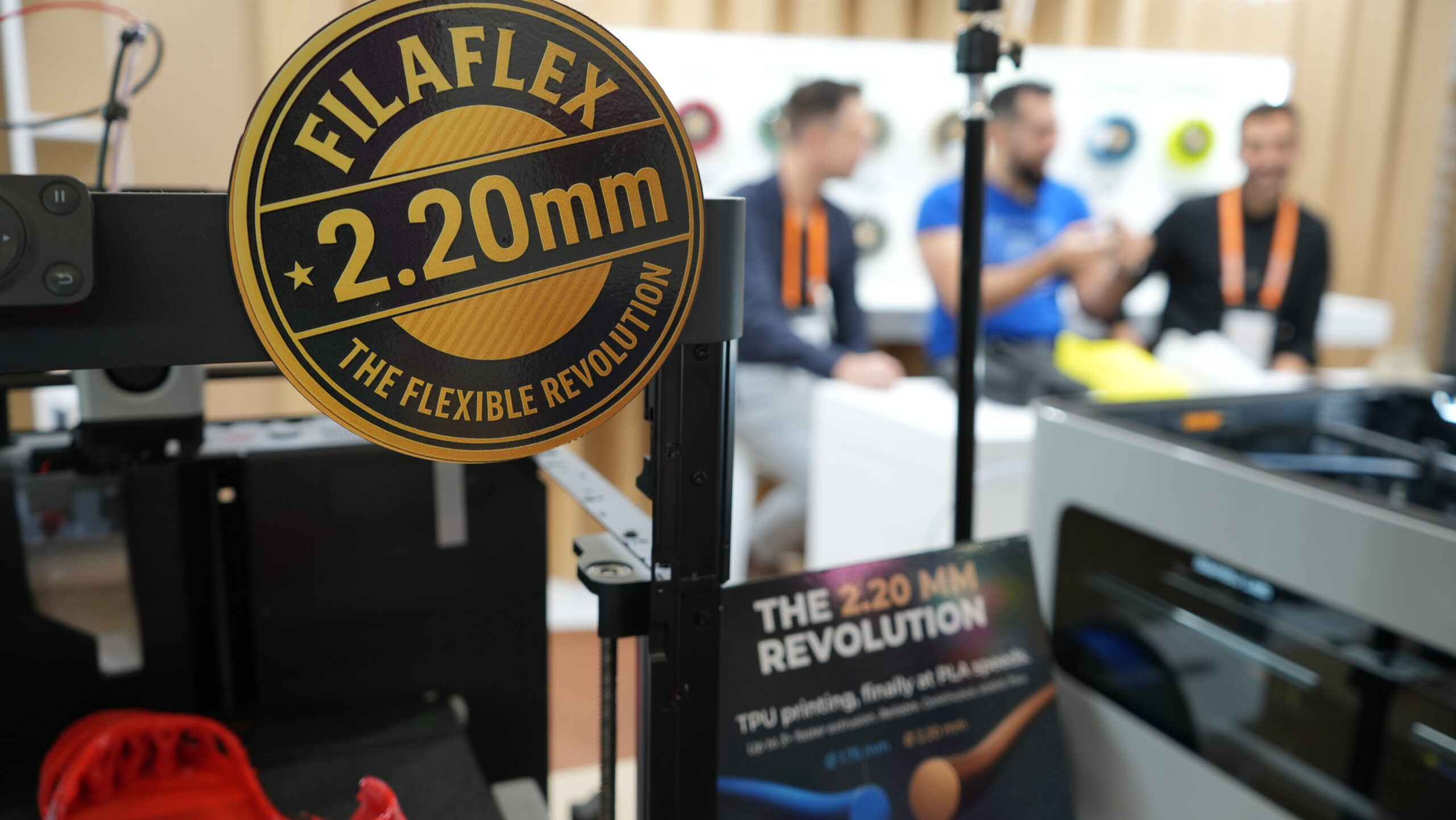
The company hopes to release the filament soon. If the firm could improve flow characteristics and reduce errors, I’m sure that a lot of people will try out this optimal solution. The kit needed may deter many, but for the really interesting applications, people will use systems where they exclusively print TPU. The team also says their hotend can still be used with rigid 1.75mm filament. Switching between them is also said to be easy. Recreus says they’ve made the hot end compatible with Bambu Lab P1P, P1S, and X1C Carbon. It’s working on doing so for the H2D, H2S, and P2S. It is also compatible with the Prusa Research MK4S, Core One, Core-One L, and Prusa XL.
Recreaus wants OEMs to partner with it, license its technology, and offer it on their machines. For the rest of us, you can preorder a kit to convert your 3D printer here. If it’s fairly straightforward to switch, many may do so. But in my mind, there aren’t many casual TPU users. This kit could convert more people to being that, but you’re unlikely to make the investment if you don’t see the value. So this could solve a problem that sufferers don’t realize they have. For someone looking to print shoes, prosthetics, medical gear, sports gear, or industrial components, this setup could be a very tidy solution. If it does indeed let you speed up prints while making the process more reliable, it could become a valuable asset for many manufacturers. Especially for those setting up print farms, the combination could be irresistible. If it works, it could lead to lower part costs and higher profits through the better utilization of capital, a winning combination. But will people switch? If more filament firms supported the standard, many would consider it; however, regardless of the merits, if the only option is Recreus, people may not choose it. Driving adoption, therefore, will be difficult but may be very advantageous not only for Recreus but for the industry as a whole.
Subscribe to Our Email Newsletter
Stay up-to-date on all the latest news from the 3D printing industry and receive information and offers from third party vendors.
Upload your 3D Models and get them printed quickly and efficiently.