
We’re starting with standards in this weekend’s 3D Printing News Briefs, as ASTM has re-launched its Advanced Manufacturing Division as the Critical and Emerging Technologies (CET) Division. Then we’ll move on to research, first with 3D printed electronic skin for prosthetics, and then an animal study in regenerative medicine. We’ll finish with cookies 3D printed from plastic waste…yes, I’m serious!
ASTM International Launch Critical and Emerging Technologies (CET) Division
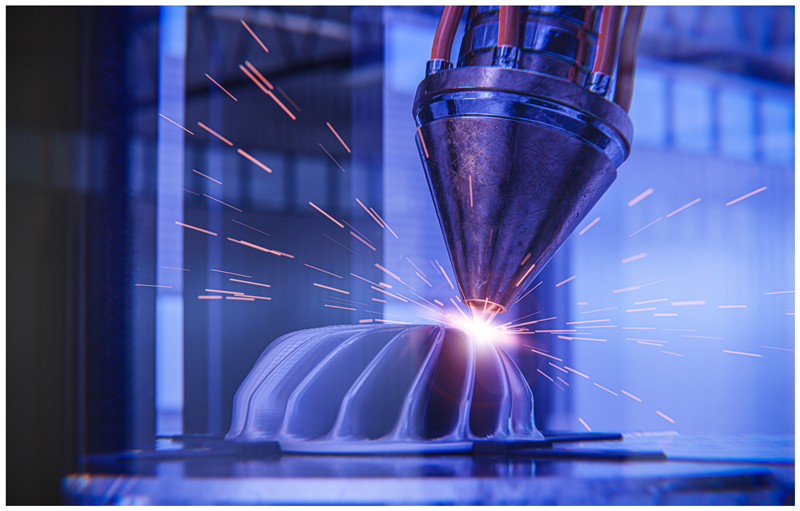
A modern 3D printer is printing a metal turbine. The future of machine part manufacturing. Image: ASTM International
To speed up standards for rapidly converging technologies, ASTM International has re-launched its Advanced Manufacturing Division, only now it’s the Critical and Emerging Technologies (CET) Division. The division is active in about 10 ASTM committees and cooperates across 25 countries, working mainly in pre- and post-standardization. Convergent technologies, like artificial intelligence (AI), are at the forefront of innovation, but instead of growing in isolation, they advance interdependently. Over 40 national governments publish lists of CET, and these lists tend to shift. Instead of attempting to track them, ASTM engages with these technologies where they actually meet, in order to create opportunities to develop standards with technologies as they grow. The new division works to assess CET in terms of where standards are needed most, and scales development for the areas by defining roadmaps, building certification and training opportunities, and applying market intelligence. While the new CET Division maintains advanced manufacturing standardization (including additive manufacturing) as its flagship, it adds other cutting-edge topics from ASTM sectors at different maturity levels, including robotics, drones, AI, semiconductors, and more.
“The launch of this division reflects where ASTM is heading as an organization, from developing standards to delivering standards solutions across the technologies reshaping the global economy. We have proven this model in advanced manufacturing, where our community built a globally adopted framework jointly with international partners, and through Centers of Excellence that embed standards early in the research process,” said ASTM International President, Andy Kireta. “The CET Division scales that approach in partnership with industry, government, academia, and standards bodies around the world.”
Research Develop 3D Printed Electronic Skin to Give Prosthetics Sense of Touch
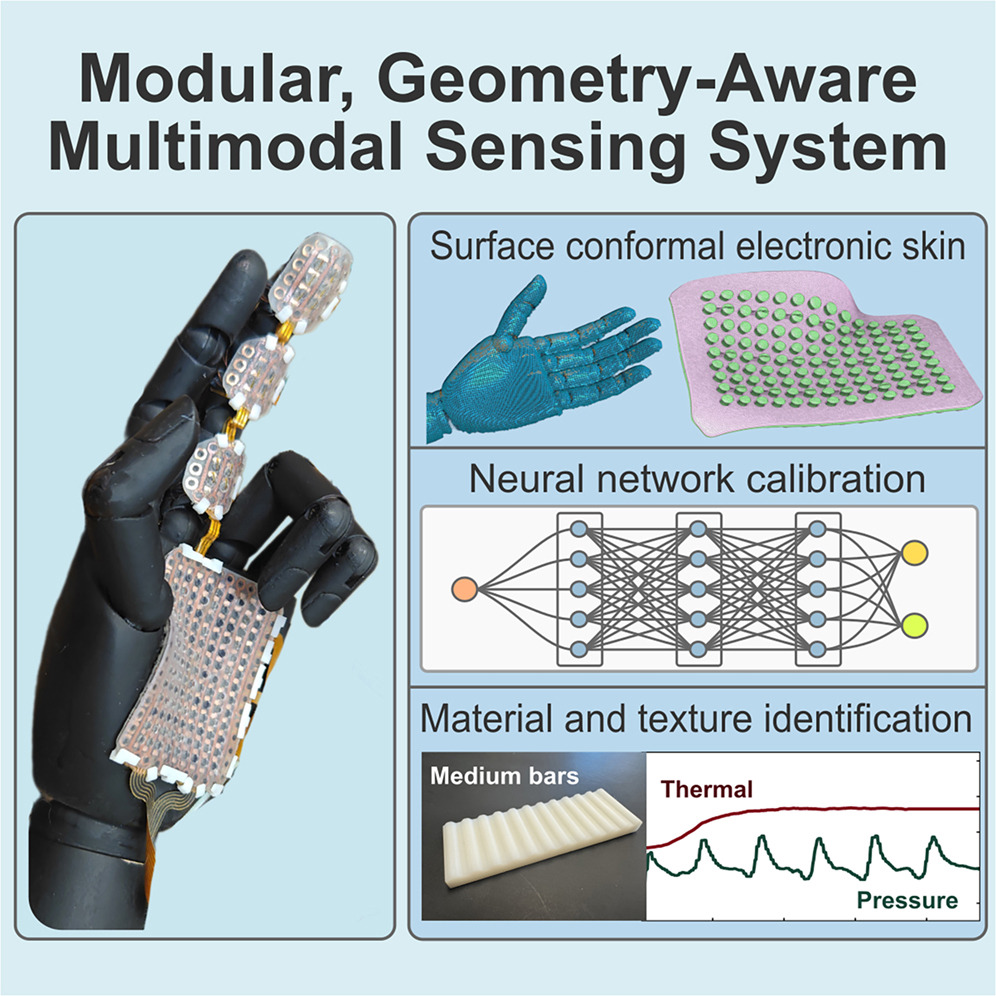
Graphical abstract
Something a lot of prosthetic hands are missing is a sense of touch, but electronic skins are helping with this issue. Unfortunately, most of the existing ones offer a custom fit or good sensing performance, but not both. Researchers from Washington State University have developed a customizable 3D printed electronic skin that gives prosthetic hands temperature sensing and human-like touch. They start by using a structured-light 3D scanner to scan the prosthetic, and then software maps sensor layouts right onto the scan data. SLA 3D printing is used to manufacture custom structural layers, and then the researchers assemble laser-cut flexible electrical layers into sensor modules that snap together. Inside these multilayer modules are pressure-sensing matrices made out of piezoresistive film and temperature sensors. Because they’re stacked, both sensing systems are able to occupy just about the same physical area, which offers dense multimodal feedback over the prosthetic’s surfaces. Finally, a neural network was trained to calibrate individual sensing elements, and remove manufacturing noise, to quickly interpret the sensor data. This modular sensing system can be custom-built to match individual prosthetics, and is said to detect pressure and temperature with about 10 times the amount of spatial resolution that commercial glove-based sensors offer.
“Diverging from previous e-skin platforms that concentrate on planar multimodal sensing,32 material-level innovations,33 or algorithmic signal interpretation34 independently, here, we introduce a prosthetic sensing system with a “scan-model-print” manufacturing framework that bridges the gap between high-fidelity sensing and personalized fabrication,” the team wrote in their paper. “Specifically, the novelty and strength of this platform combine (1) a prosthetic-based, surface-conformal sensing system design, introducing 3D scanning and stereolithography (SLA) printing into the fabrication process to enable seamless coverage over free-form and articulated regions; (2) modular, LEGO-like snap-fit sensing modules, supporting on-demand and robust installation, module replacement, and reconfiguration without adhesives or full-system redesign; (3) spatially interlaced pressure and temperature matrices, increasing sensing density while maintaining electrical and mechanical decoupling; and (4) neural-network (NN)-based calibration and denoising, compensating for pixel-level variability and measurement noise in high-density sensing modules.”
BIO INX Material Used to 3D Print Implantable Microscaffolds in Rabbits
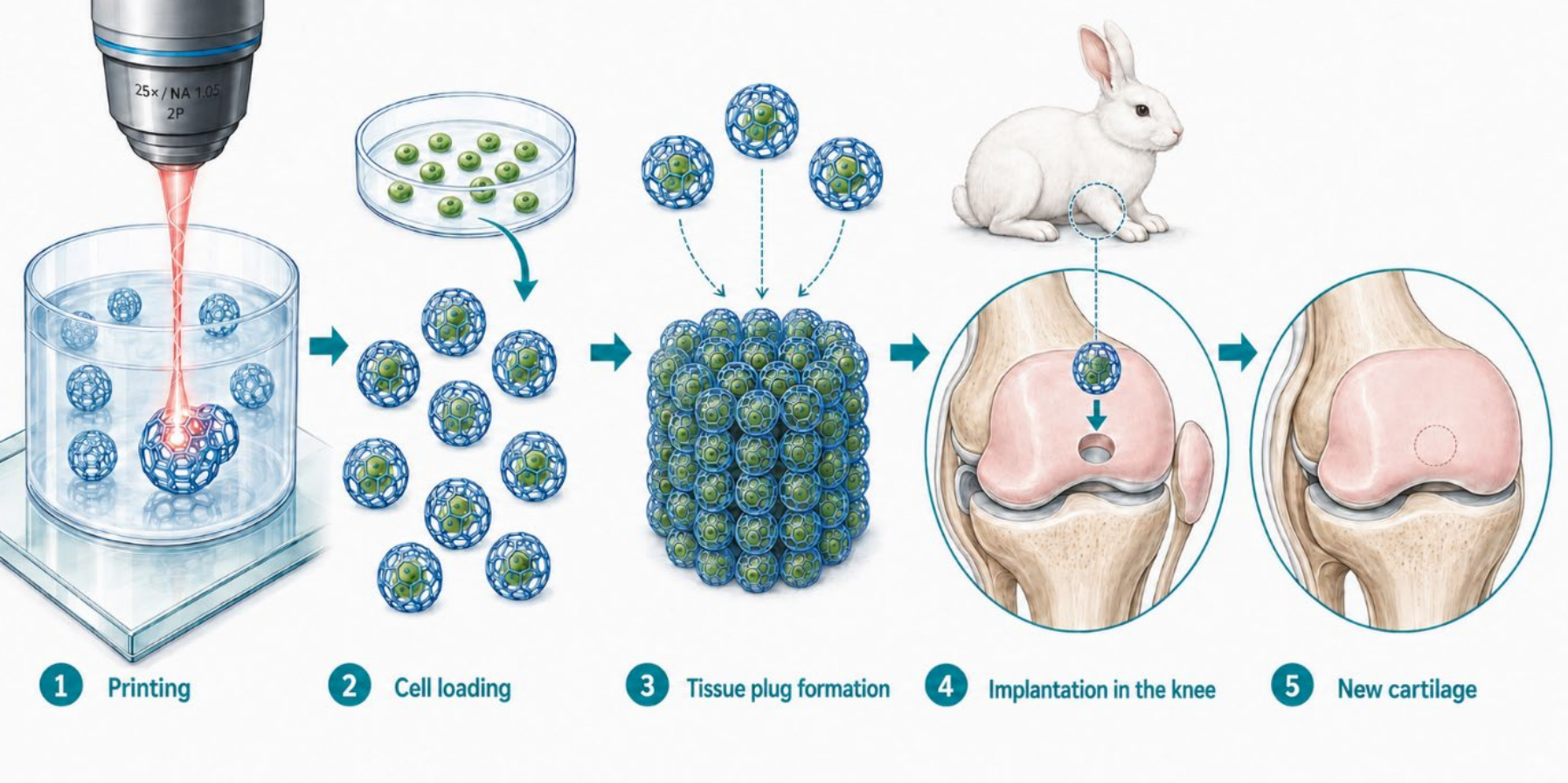
From 3D printing to new Cartilage: the building block is printed using multiphoton lithography, filled with cells, combined into a plug, allowed to mature and placed inside the knee of the rabbit and grows there into new tissue.
Scientists at TU Wien, along with collaborators from the Ludwig Boltzmann Institute for Traumatology – AUVA and the Medical University of Vienna, published a preclinical study demonstrating the regeneration of functional cartilage in living rabbits. They used DEGRAD INX, a biodegradable resin from BIO INX, to print implantable microscaffolds with very high-resolution multiphoton lithography. The microstructures, with a 0.3mm diameter, were loaded with stem cell-derived cartilage cell spheres, which were then cultured and assembled into tissue constructs. The team says that these constructs are able to regenerate critical-sized osteochondral (bone cartilage) defects in a rabbit model. They reported “highly encouraging results” after 12 weeks, with rabbits that received these 3D printed implants showing majorly improved cartilage regeneration, in comparison to untreated control animals. Because cartilage tissue has such poor regenerative ability, this in vivo study is a really big deal. BIO INX says it’s the first publication that shows the technology working successfully in living animals, and demonstrates that advanced biofabrication and high-resolution biodegradable materials can successfully achieve “minimally invasive regenerative therapies for cartilage repair.”
“This publication represents another important validation of our DEGRAD INX platform. By combining the unmatched resolution of multiphoton lithography with a fully biodegradable material, researchers can fabricate sophisticated cell carriers that simply were not possible before,” said Aysu Arslan, CSO and Co-founder of BIO INX. “Seeing these materials contribute to the regeneration of cartilage in vivo is an exciting step towards future regenerative therapies for patients.”
Researchers Upcycle Plastic Waste into Yeast to Make Cookies
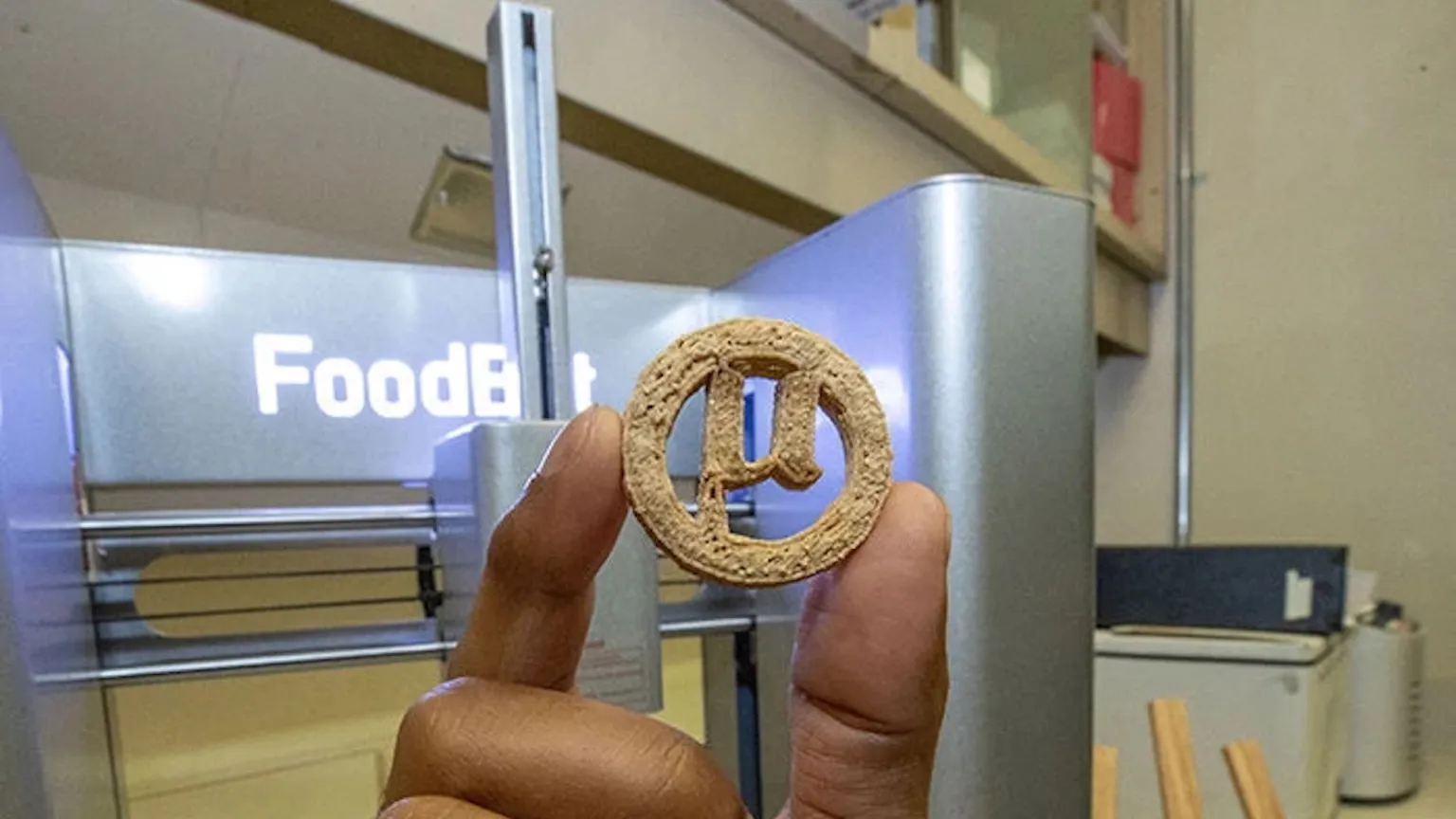
This cookie is made using waste plant materials and plastic and could feed humans everywhere from submarines to spaceships. Image courtesy of SIU Carbondale Communications.
At the fall meeting of the American Chemical Society (ACS), researchers from Southern Illinois University (SIU) Carbondale presented a very interesting project: using microbes to transform plastic waste into cookies with 3D printing. The research was conducted as part of a NASA-led project focused on creating food for deep space, but it could be applied on Earth as well, what with increasing concerns about food security and ever more plastic pollution. Polyethylene terephthalate (PET) is one of the most common forms of plastic, used to make water bottles, and it contains carbon-rich molecules. To rebuild carbon into something like protein, typically you’d use solvents and chemical reactions, but the team instead used microbes—specifically yeast—in a more eco-friendly solution. Using a proprietary process called oxidative hydrothermal dissolution, the researchers programmed several yeasts to convert molecules found in PET plastic and biomass into vitamins, proteins, and flavorings. Then they added fiber, starch, and sweetener to the mix, and extruded it through a 3D printer to produce protein-rich cookies called µBites, pronounced “microbites.” Grad student Sandhya Jayasekara also created yeasts that are able to produce more food additives, like creating vanilla flavoring from plant biomass, to make the cookies more consumer-friendly.
“Global food demand is expected to rise 35–56% by the year 2050, and about 30% of the world population will be at risk of hunger in the future. The way to address that, I believe, is by using microbes,” said Associate Professor Lahiru Jayakody.
Subscribe to Our Email Newsletter
Stay up-to-date on all the latest news from the 3D printing industry and receive information and offers from third party vendors.
Upload your 3D Models and get them printed quickly and efficiently.