
In this holiday weekend’s 3D Printing News Briefs, the focus is entirely on additive construction! We’ll start with news out of North America, specifically Canada and the United States, and then move on to two stories from India. Read on for all the details!
University of Windsor Officials Starts 3D Printing Multi-Story Student Residence
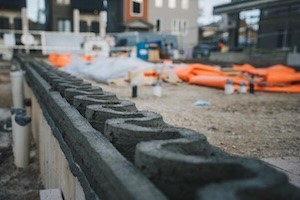
The University of Windsor is getting what’s said to be the first net-zero, 3D printed, multi-story student residence in Canada, and work has officially begun on the building. Project collaborators include several strong community and industry partners. The federal government provided $2 million in funding through the Federal Economic Development Agency for Southern Ontario, while Desjardins Ontario Credit Union added an additional “strategic investment” of $250,000 through its Community Development Fund. Next-generation Canadian additive construction (AC) company Printerra Inc. is completing the 3D printing work for the entire project, and worked closely with the permitting and municipality office to secure the building permit—the first in the country for a 3D printed multi-story residential building. The building at 1025 California Avenue is meant to serve as a living laboratory and training ground for students and researchers in the Faculty of Engineering, and will include seven residential units to house students.
“We’re thrilled to be the innovation partner on this visionary project, showing the world what’s possible when technology, research, and collaboration come together. This milestone reflects Printerra’s leadership in advancing additive construction and providing a platform that enables its wider adoption,” said Leigh Newman, CEO of Printerra Inc.
U.S. Army ERDC Completed Additive Construction Experiment
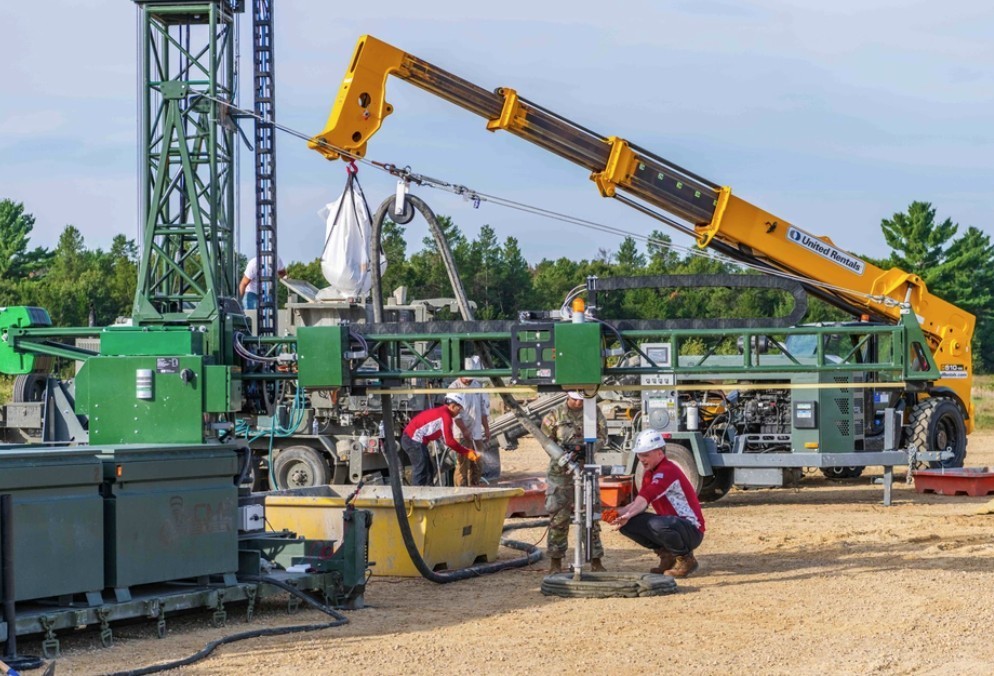
The U.S. Army Engineer Research and Development Center (ERDC) conducted an experiment, shown here Sept. 12, 2025, at Fort McCoy, Wis., on additive construction technology to develop materials and equipment solutions for the Army. The ERDC is partnered with Applied Research and Associates to develop innovative technology that essentially prints 3D complex objects using concrete. The U.S. Army 3D-print complex infrastructure enables units to directly print on site maneuver enabling infrastructure using primarily local materials. With just a small amount of transported cement, Soldiers can mix, print and build the structures needed to support their mission. Soldiers with Wisconsin and Maryland Army National Guard spent a week getting some hands training and experimentation to provide feedback on the equipment. (U.S. Army Photo by Amanda Clark) (Amanda Clark, Fort McCoy Multimedia-Visual Information Office)
Not long ago, personnel with the U.S. Army Engineer Research and Development Center (ERDC) conducted an AC experiment on South Post at Fort McCoy in Wisconsin; partners included Applied Research and Associates, the University of Arkansas, Iowa State University, and Robotic Construction Technologies. Jeb Tingle, senior scientific technical manager with the ERDC, explained that the industry, academic, and government partnership worked on developing materials and equipment solutions to help the Army “print maneuver enabling infrastructure,” such as retaining walls and culverts. The goal is for the military to be able to deploy to a remote area and use local materials and a little cement to mix up concrete that could be used to print these types of infrastructure elements, so they can complete “missions anywhere in the world.” According to Jim Mantis with Applied Research Associates, this technology could be a very helpful tool to help “empower the Army to be more effective in its maneuver and counter-mobility missions.”
Tingle said they completed some of the experimentation and training with troops from the National Guard, and that they are “hoping to get feedback on the equipment from the Soldiers who were here from both Wisconsin Army National Guard and the Maryland National Guard that were able to get some hands on the equipment, get some hands on some of the training modules that we’re working on developing as this technology advances, and we’re really looking for their feedback.
“What we did is we developed several training modules around this material so that we could test that out here and get that feedback from them on it and then go out and execute the work and see if they can follow the materials that we put together and make it happen. So we’ll take those lessons learned and the feedback from the Soldiers, we’ll take that back, we’ll work with the research team, we’ll modify some of the techniques that we use to characterize the materials, we’ll modify some of the equipment solutions to make them a little simpler and easier for the Soldiers to understand and the Soldiers to be able to use and make them more effective in the combat zone. We’ll take those, we’ll modify the system, and then we’ll refine that and we’ll come back and we’ll do a final demonstration next year. Then we’ll use that to inform an acquisition decision by the Army acquisition offices.”
Tvasta Partners with CEPT University for Advanced 3D Concrete Printing Workshop
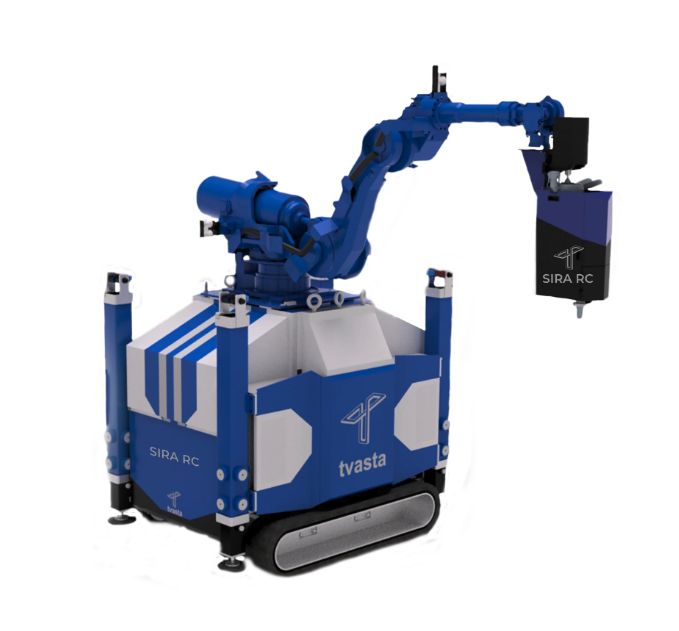
Image courtesy of Tvasta
Finally, CEPT University in Ahmedabad, India has signed a Memorandum of Understanding (MoU) with deep-tech startup Tvasta Manufacturing Solutions, based in Chennai. Tvasta will provide the university with a robotic arm that can 3D print complex forms with concrete, so an advanced 3D concrete printing workshop can be held on its campus. This move is a clear signal to where the next wave of AC in India will come from, and could set CEPT up as one of the country’s most influential academic hubs for additive concrete construction. The workshop should take place in the next few months, and researchers from both CEPT and Tvasta will experiment with things like 3D printed façade elements, methods where electrical conduits are embedded into 3D printed walls, and integrated structural systems in which roofs, walls, and slabs are printed as a single unit. They also plan to investigate how 3D printed concrete responds to heat, airflow, and climate, and look into printed components that can be manufactured off-site and then assembled elsewhere.
“Tvasta has been a pioneer in 3D Concrete Printing, grounded in deep research and collaborative innovation, consistently pushing the boundaries of what is possible in construction automation. We are excited to collaborate with CEPT University, a world-renowned institution leading advancements in architecture and design,” said Kalyan Vaidyanathan, CTO (Construction), Tvasta Manufacturing Solutions. “Through this partnership, Tvasta architects and CEPT faculty will jointly offer studio courses in DFAM (Design for Additive Manufacturing), with projects being practically built using Tvasta’s 3D concrete printers at their workshop. We also look forward to collaborative R&D in energy-efficient construction and structural performance of various 3D-printed architectural elements, along with other breakthrough initiatives in the near future.”
Indian Army & IIT Hyderabad Deploy On-Site 3D Concrete Printing
3D Concrete Printing Technology Operationalised by Trishakti Corps#TrishaktiCorps, in collaboration with IIT Hyderabad under Project #PRABAL, has operationalised On Site #3D Concrete Printing #Technology in #Sikkim and other forward areas. This capability also used earlier in… pic.twitter.com/Qx7bOiP9Ac
— Trishakticorps_IA (@trishakticorps) December 6, 2025
Moving on from U.S. military construction printing, the Indian Army is using 3D concrete printing to enhance defense infrastructure modernization. The Trishakti Corps in Sikkim and adjoining forward areas recently deployed on-site 3D concrete printing technology to advance mission-ready, sustainable construction along the country’s northern borders. The indigenous robotic printer they used was developed specifically for forward area operations in collaboration with IIT Hyderabad under Project PRABAL, which stands for Portable Robotic Printer for Printing Bunkers and Accessories.
The vehicle-mounted system has a circular mixer, piston pump, robotic arm, and on-board generator, all of which enables deployment in rugged mountain terrain for fast construction of sentry posts, bunkers, and protective structures. This offers significant operational advantages, such as reduced troop effort and project timelines, customized designs, higher precision and compressive strength, improved quality control, optimized use of local materials, and enhanced blast and ballistic resistance. The mobile printer also supports advanced camouflage needs, and all 3D printed structures built with the system have successfully undergone live ballistic trials, which confirmed their durability, strength, and protective performance in real combat scenarios.
Subscribe to Our Email Newsletter
Stay up-to-date on all the latest news from the 3D printing industry and receive information and offers from third party vendors.
Upload your 3D Models and get them printed quickly and efficiently.