
Xometry (Nasdaq: XMTR) just delivered a milestone quarter and also announced a major leadership change. The company posted record results and made it clear it feels confident about the future. It also announced a CEO transition that keeps founder Randy Altschuler closely involved. For 3D printing users and suppliers, the bigger story is that Xometry is leaning hard into its AI-driven marketplace model and expanding its additive manufacturing offerings, especially for higher-value production work.
Looking at the numbers, in 2025, Xometry reported record fourth-quarter revenue of about $192 million, up 30% from a year ago, driven mainly by marketplace revenue of about $178 million (up 33%). The company ended the quarter with a record 81,821 active buyers. It also pointed to improving economics in the marketplace, with the marketplace gross margin at 35.3% in Q4.
Record quarter plus a CEO transition
Xometry described its Q4 and full-year 2025 earnings as “record” results, and something that is really important for the marketplace model is the buyer base. The company finished Q4 with 81,821 active buyers, a new high, pointing to what it described as a “widening network effect between buyers and its global supplier base.” So basically, when more buyers use the platform, more orders come in. When more suppliers join, Xometry has more options to choose from, which helps it match jobs faster and more accurately. Over time, all of that activity gives Xometry more data, which helps its software improve pricing and job routing.
This matters for 3D printing because it’s not a separate business inside Xometry. It runs on the same marketplace system as the other service offerings, including CNC machining, injection molding, sheet metal, and casting. So when Xometry adds more enterprise buyers and more certified suppliers, it increases the odds that AM orders (especially higher-performance polymer work) get placed faster and repeated.
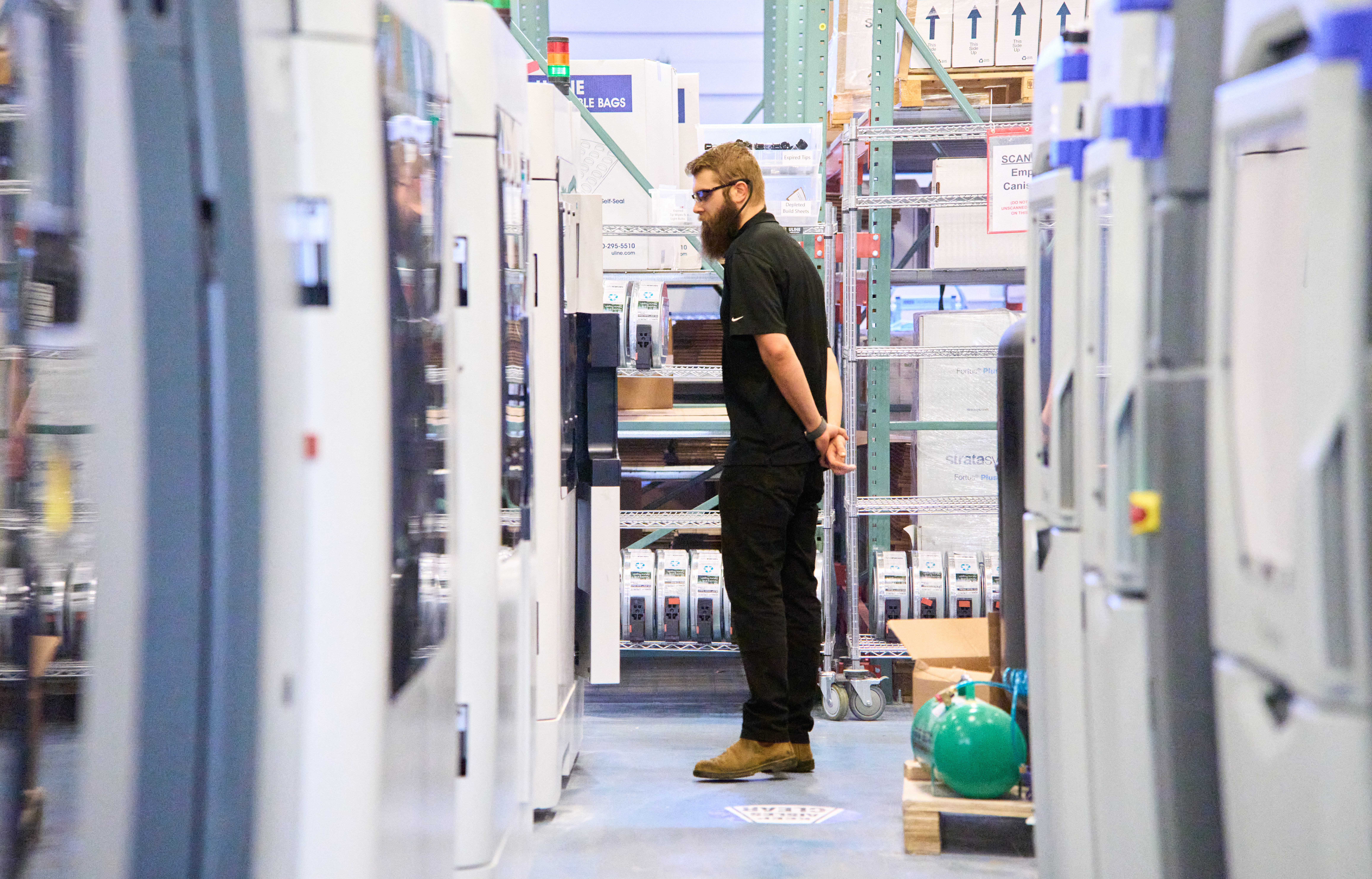
Xometry’s Gaithersburg, Maryland site. Image courtesy of Xometry.
Along with the record quarter announcement, Xometry revealed a planned leadership transition. Company founder Randy Altschuler will become Executive Chair effective July 1, 2026, and President Sanjeev Singh Sahni will become CEO.
Altschuler told investors during an earnings call that “This transition is a result of a deliberate, long-term succession process with our board, and we are aligned in our conviction that Sanjiv is the right leader for our next chapter. Together with Laurence Zuriff, I co-founded Xometry in 2013 with a mission to make the world’s manufacturing capacity accessible to all by digitizing the vast, highly fragmented custom manufacturing market. We stayed true to that vision from the start, and that consistency is now delivering scale and accelerating growth and profitability.”
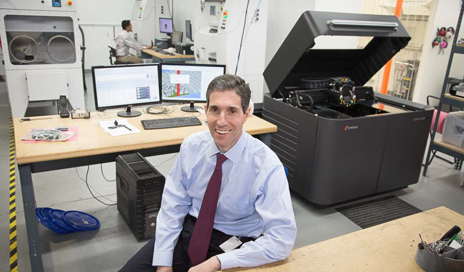
Xometry CEO and co-founder Randy Altschuler.
What this means for 3D printing on Xometry’s platform
Xometry is a broad on-demand manufacturing marketplace, but the earnings call offered a few specific signals for additive manufacturing. Firstly, Xometry says it expanded its additive materials portfolio.
Management said that in Q4, it added a portfolio of high-performance materials for additive manufacturing technologies in the U.S. marketplace, positioning them as important for advanced applications in aerospace, defense, and medical devices. In fact, adding more materials makes the platform more useful for real production jobs, where customers need strict specifications, documentation, and repeat manufacturing, not just quick prototypes.
The real focus is production-style adoption
Xometry executives pointed to growth in larger enterprise accounts and multi-year programs. In the earnings call, Altschuler said the company is becoming “more embedded in customer workflows.” In some cases, that means Xometry is included in a customer’s bill of materials (BOM), the official list of parts used in production. In other words, customers are not just using Xometry for prototypes, but for repeat production parts.
“Xometry is becoming more embedded within the enterprise customer workflows, which in turn drives larger and more predictable spend. In 2025, we ended with four accounts with at least $10 million spent, driven by strong execution from sales and the efficacy of our technology solutions. We expect more accounts to join the $10 million plus threshold in 2026, driven in part by many multi-year production programs across key end markets. In 2026, we are focusing on driving further structural enterprise adoption through deeply embedded sales and marketing motions, and increasing use of technology solutions, including Teamspace and ERP procurement integration,” explained Altschuler.
AI tools help strengthen the platform
As for Sahni, he said the company is continuing to invest in AI tools, including Design for Manufacturing (DFM) features and software that can interpret technical drawings. These tools help spot problems early and reduce delays.
The easier it is to go from a CAD file to a confirmed order, the more likely customers are to come back. And repeat, additive manufacturing business is necessary to build stable, long-term production revenue.

Nexa3D LSPc® Resin 3D Printing Service by Xometry. Image courtesy of Xometry.
Xometry’s Q4 results showed growth and improved profitability at the same time. Revenue was roughly $192 million for the fourth quarter, up 30% year over year. Meanwhile, marketplace revenue was about $178 million, up 33%, and marketplace gross margin was 35.3%.
Mewwhile, for the full year 2025, Xometry reported revenue growth of 26% and delivered positive adjusted EBITDA of $18.5 million, compared to a loss the previous year. The company said revenue growth accelerated throughout the year, alongside improving margins, marking what executives described as a “transformative” year for the business.
Xometry expects growth to continue in 2026 and said the first quarter has started strong, even as broader economic conditions remain uncertain. Xometry combined record growth, especially in its buyer base, with a planned CEO transition meant to keep the company on track while continuing to expand its product offerings.
For 3D printing, what’s important is that the company is adding stronger materials and embedding itself more deeply into enterprise purchasing systems. That’s what can turn additive from a one-off solution into repeat production business.
Subscribe to Our Email Newsletter
Stay up-to-date on all the latest news from the 3D printing industry and receive information and offers from third party vendors.
Upload your 3D Models and get them printed quickly and efficiently.